Thursday, April 30, 2009

Electric cars: the shocking truth

For years, people have been waiting for clean, efficient eco-friendly electric cars to arrive. Hybrids like the Toyota Prius don't really cut it. While Hollywood celebrities queue up to display their eco-credentials by buying a Prius rather than a Ferrari, they're kinda missing the point.

The BBC's Top Gear motoring show did a head to head comparison of the Prius with a BMW M3 sports sedan last year. The deal was that the Toyota would blast round the show's test track as fast as its little green wheels could carry it and the BMW gas guzzler would follow along behind.

At the end of the test, the BMW returned a shocking gas mileage of just 19.4 miles per Imperial gallon. The eco-friendly Prius returned an impressive 17.2 mpg. Err, right. So if I want to save the planet, I need a fast BMW rather than a rather sad hybrid econo-box.

Ignoring the pathetic gas mileage, the Prius also uses highly-toxic rare metals that have to be shipped halfway round the world to be refined, then halfway round again to be screwed together into a car.

The carbon footprint of this 'green' vehicle is astonishingly-large. Taking the energy costs and emissions of building the thing and then safely disposing of the noxious components in its batteries into account, you'd have to drive it to Venus and back before you saw any real planet-saving gains.

And there's not much point driving to Venus anyway - the place is hotter than hell due to global warming caused by all those pesky Venusians driving SUVs.

It has also been calculated that the Prius would actually be kinder to the environment - and deliver better performance - if the batteries and electric motor were removed completely. The feeble petrol engine would then have far less weight to drag around and would use a lot less precious fossil fuel.

So let's consign hybrids to the dumpster of history and examine the alternatives.

All-electric cars sound ideal. They can be charged from a normal power point and offer silent, environmentally-sound motoring.

AbsurdWell, up to a point. There are a few minor issues. Again, we have the absurdity of carrying half the vehicle weight around in the form of batteries to push the thing along, together with the massive eco-impact of disposing of the lead, lithium and associated nasty chemicals usually associated with the creature from Alien's spit that ate through the floor of the Nostromo.

That ain't gonna save many baby polar bears.

Ignoring the environmental footprint of electric cars, let's look at their practicality. In Europe, Citroen has just launched an electric vehicle called the C1. This has a range of around 70 miles before it needs recharging. The charging cycle takes seven hours and requires the car to be plugged into the domestic supply.

Sounds OK on paper, doesn't it?

Not to me it doesn't. I live in a remote corner of North Wales. Hey. It's my choice, OK? I can do most of my grocery shopping at the little stores a few miles away, but at least once a month, I need to make the trip to the large out of town megastore up on the coast where they actually stock the stuff I want to buy.

The round trip is around 75 miles. Do you see where this is headed? Were I to use the electric Citroen, which costs about a quarter as much as its gas equivalent to do the trip, I'd have to stay overnight at the megastore while I waited for the car to recharge. That kinda puts a dent in my savings, not including the fact that the electric C1 costs twice as much to buy as the gas equivalent and the fact that all the frozen stuff I buy will defrost before I get it home.

Cash handoutsEver keen to be seen to be green, the UK Government is promising cash handouts to people buying electric cars. Only problem is, the Citroen is available right now and the Government handouts won't come into force until 2011 at the earliest. That's not incentivizing me a hell of a lot, to be brutally frank.

In the US, purchasers of hybrid vehicles may not have to pay their first year�s state registration fee under a new plan drawn up by the Office of Energy Conservation, which wants to use $1 million of federal cash to offer incentives for buyers of fuel-saving cars. The buyer of a hybrid car would get a certificate to send to the Department of Motor Vehicles, who would then accept it as payment and bill the Energy Office for the registration fee.

But the program would operate on a first come, first served basis and only cover the first 20,000 vehicles. It will be June before a decision is made on whether the scheme will go ahead.

So with administrations around the world hardly falling over themselves to encourage people to go green, are there actually any upsides to moving away from gas-powered vehicles?

Sadly, the answer appears to be a resounding no.

While the above-mentioned C1 with its 70 mile range is obviously about as much use as a chocolate fireguard for people who live in the country, it could find a home in cities as a runabout or commuting vehicle.

Or could it?

Trip hazardCertainly in all the inner cities I've ever lived in, very few houses have off-road parking and many apartments are up on the 20th floor. How exactly are users of electric cars supposed to recharge their vehicles overnight? Run power cables over the sidewalk into the street? Throw a 100 yard long power cord out of the apartment window down to the road?

And where does all this lovely, clean electricity come from? Err, oil, coal and nuclear powered power stations, that's where.

It just ain't gonna work, is it?

There is light on the horizon, however. Cars powered by hydrogen fuel cells will eventually offer comparable performance and range to gas-powered cars and when they need refuelling, it will mean taking a couple of minutes at a gas station rather than all night before you can continue on your way.

But hydrogen cars are still some years away. In the meantime, the only alternative for this reporter is, regrettably, to continue to drive my 4.2 liter, 400hp, supercharged Jaguar V8 that returns a tidy 19 miles per gallon.

Hell, that's a lot better than a Prius can manage.


Click

Zooming into the record books: The 1965 race car expected to go ...

Under the bonnet: The unique vehicle shows off what's under the hood as it stands at the 'racing line'

Under the bonnet: The unique vehicle shows off what's under the hood as it stands at the 'racing line'

Legendary driver Bob Bondurant drove the car to victory .

He said: 'I won a lot of races with this Daytona Cobra Coupe, but when I crossed the finish line at the Reims race track I yelled "Yes!".

'It was a fantastic feeling. I always wanted to race in Europe against the world's best drivers. Winning that World Championship was the crowning achievement of my career. I think it's wonderful that the car is being showcased 40 years later.'

The car was also used for many years by a North Dakota businessman, who drove the car to and from his six gas stations, clocking up 300 miles a day.

It was also leased to Paramount Pictures for use in the Howard Hawks film 'Redline 7000'.

Onlookers stare at the classic 1965 car - one of only six ever made

Onlookers stare at the classic 1965 car - one of only six ever made

The auctioneer Dana Mecum said despite the recession the classic car business is thriving.

Of the half dozen made this is the only one never to crash.

Peter Brock was only 22 years old when he designed the car taking some of his inspiration from 1939 German bus designs that had astonishing aerodynamics.

The car was built by hand and has a unique tail designed for optimum speed.

The Shelby Cobra Coupe was instantly famous and its popularity and value have increased with time.

'It's a really spectacular car,' said Casey Milano, account executive at Mecum.


Click

Master plan puts teams who accept revolution firmly in the driving ...

As the FIA’s World Motor Sport Council (WMSC) announced the radical new rules for next season’s World Championship yesterday, Mosley came under fire from Luca Di Montezemolo, the Ferrari president, but there are no indications that he is going to change his mind and he can watch and wait with some confidence as the deadline for entries for the 2010 season arrives on May 29.

At Ferrari, as at some of the other big teams, there is considerable nervousness about enforcing a cap and about a “two-tier” championship developing, with cars running under separate rules. This may well happen.

But Mosley is prepared to gamble that most of the existing teams, and any new teams that enter the field in 2010, will accept his capping regime and that, after perhaps one season when Ferrari and possibly one other outfit will try to continue spending a fortune, everyone will come into line.

Mosley summarised his case yesterday in a letter to the Ferrari president, which was leaked to The Times. “We are confident (as are our accountants and lawyers) that a budget cap will be enforceable,” it read.

“The cleverest team will win and we would eliminate the need for depressing restrictions on technology which the existing teams are discussing with a view to reducing costs. I hope Ferrari will take the lead in agreeing the cost-cap mechanism, thus freeing its engineers to work and preserving its shareholders’ money.”

In its announcement, the WMSC clarified much of the detail of what amounts to a revolution for Formula One. To start with, the £40 million headline figure is up on the £30 million originally announced by Mosley in mid-March, a recognition by the FIA president of the difficulty that teams used to spending huge sums will face. For some of the biggest spenders, the new regime will lead to considerable redundancies, something that the FIA regards as a necessary evil if the sport is not to go to the wall.

The cap is quite loose in other ways. Driver salaries are not included, so men such as Lewis Hamilton, the defending drivers’ champion, can carry on earning £15 million a year. Nor are marketing and hospitality budgets, which can run to tens of millions of pounds, nor the cost of fines and penalties, nor engine costs for 2010 or “any expenditure which a team can demonstrate has no influence on its performance in the championship”.

Apart from saving money and trying to keep the sport alive, Mosley is also intent on encouraging new teams to come into the sport. With that in mind, the FIA has extended the grid for next year from 24 to 26 cars and Bernie Ecclestone, the sport’s commercial rights-holder, has agreed to offer participation fees and expenses to new teams. These include an annual payment of $10 million (about £6.75 million) each, plus free transportation of two chassis and associated kit for each race outside Europe.

The budget cap will be enforced by a new “Costs Commission”, made up of a chairman and two commissioners appointed by the WMSC for three years. The FIA says that the commission will “appoint auditors and other financial experts as required”, but also that it expects a “healthy amount of self-policing”.

If the cap fits...

What is the cap set at? £40 million for 2010

Is it voluntary? Yes

What is not included in the cap? Driver and test driver salaries, marketing and hospitality budgets, payment of fines and penalties, engine costs for 2010 only, other expenditure not related to on-track performance and dividends on profits from competing.

What other rule changes come into force in 2010? Refuelling during races will be forbidden and tyre blankets will be banned.

What will be the penalty for a team that exceeds the cost cap? This depends on the case and there are no “fixed penalities”. The new “Costs Commission” will judge the degree of misdemeanour and advise the FIA, which will determine the penalty.


Click

Obama: "Ich bin ein Chrysler!"

And so it begins: Making bankruptcy sound like a fun thing to do on a slow spring afternoon, Barack Obama today "congratulated" Chrysler on the "opportunity" of Chapter 11 and if I were GM, I wouldn't be getting too friendly with this guy and his staff at the next White House cocktail party. I mean, look at what happens to companies he likes.

Chrysler filed for bankruptcy protection Thursday in New York under Section 363(b) of Chapter 11 of the bankruptcy code -- and officials hope Chrysler will stay in bankruptcy for just 30- to-60 days.

The company's merger with Italian giant Fiat has also been approved by the White House, and former Chrysler owner Daimler is giving-up their 20% stake in the Highland Park, MI, car-maker. Fiat will shut-down their Euro car-making operations for as long as two months over the summer to prepare for the Chrysler deal; the first Fiat-Chrysler made-in-USA cars might not appear for at least two years.

In a 15-minute speech announcing these moves this morning at the White House, President Barack Obama praised those who have made shared sacrifice to try and save the iconic American company, including Chrysler management, the UAW, creditors which agreed to accept as little as 33% on the dollar for their securitized Chrysler debt holdings, new Chrysler partner Fiat and old partner Daimler.
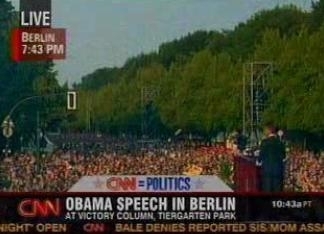
2009-04-30-obamaberlin.jpgObama speaks before the 2008 US elections in Berlin in front of an estimated 300,000; the speech was reminiscent of JFK's famous June, 1963 "Ich bin ein Berliner" ("I am a Berliner") speech. Today, Obama told us, like it or not, that we are all Chrysler, with important stakes in the company, from our shared national and institutional memories of it to the US middle-class which the company helped in great part to create

He also blasted in plain and no uncertain terms "hedge funds," "speculators" and other investors and creditors who refused to support the government's efforts to have them cut the amount of Chrysler debt they hold.

"I stand with the Chrysler employees and their families, dealers and communities. I do not stand with those who won't help out when everyone else is supporting," Obama said.

Chrysler will also idle most of its plants during its time in bankruptcy.

The shutdown begins Monday and will stretch through the 30 to 60 days it is expected to take to restructure in Chapter 11 bankruptcy, the company said in a statement today, according to industry journal Automotive News.

Chrysler has 12 assembly plants, including eight in the United States. It also owns and operates five North American engine plants, six stamping plants and seven transmission and parts plants.
Chrysler has 26,000 UAW workers and 10,000 represented by the Canadian Auto Workers.

Obama said Fiat is planning to bring "billions" in technology and car-making ability to the US quickly, and that the Canadian government and the Canadian Auto Workers have also approved the deal (Chrysler has extensive facilities in Canada).

Apparently, Chrysler CEO Robert Nardelli was among those who didn't wholly support the White House's plan.

"We would have preferred not to use this 'surgical bankruptcy,' Nardelli was quoted as saying by CNBC, "An inordinate amount of time went into creating this plan. This is a bittersweet moment for me."
2009-04-30-nardellichryslerevsportscar.jpgIncumbent Chrysler CEO Robert Nardelli introduces some Chrysler EV concepts at a 2008 press conference; the dream cars weren't enough to catch public -- or investor -- interest, and Nardelli will leave his Chrysler post, at the latest, when the company emerges from bankruptcy

As if he had some better idea. "Bittersweet?" He'll work his way through it while spending some of his pension with his buddies on country club golf courses like those at La Quinta or Doral, the natural and recommended habitat for failed US auto executives.

But the corporate fate of his second-in-command, Jim Press, who ran Toyota in this country for many years and was the first and still-only American on Toyota's board of directors in Japan, hasn't been announced as yet, and is frankly much more interesting than anything having to do with Nardelli.

Press brings the goods; he knows how to run a successful car company.

Chrysler should keep Press on as president, running day-to-day-operations and reporting only to Fiat CEO Sergio Marchionne.

Obama said that the US government will be backing all Chrysler warranties; that the "full force" of Washington is behind this entire plan.

The government also announced that it is loaning GMAC additional money so it can take over financing of Chrysler vehicles from Chrysler Financial. The government already has infused nearly $6 billion into GMAC.

The Treasury will provide Chrysler with $4.5 billion in exit financing. The company will not now cancel any of its retiree contracts (covering some 173,000 UAW members), reduce current benefits or lay-off any workers (Obama says today's plan "saves 30,000 Chrysler jobs").
2009-04-30-chryslerlogo.jpg

But a question remains, as we've noted in this space before, concerning what Chrysler plans on doing with their 3,300-strong US dealer network. No doubt they want to cut it to some extent, though Fiat would like as many as possible to remain open so they can sell their Euro-made cars there, but whether the company will use their bankruptcy filing to avoid compensating lost dealers isn't yet known. Only a bankruptcy judge can break the powerful and protective state franchise laws which dealers use to establish their relationships with car-makers.

Chrysler will have a new board of directors and the government will take a role in helping to select the board.

A UAW health care trust will own 55 percent of Chrysler's stock, but won't have voting rights control. The trust will, however, appoint a member to the company's board of directors.

Fiat will start with a 20 percent stake in Chrysler and as it meets three different milestones -- including building a 40 mpg vehicle in the United States -- it will get a total of a 35 percent stake in the company.

Fiat will be allowed to increase that stake only after US taxpayers are fully paid back by Chrysler for the various loans and loan guarantees Chrysler has received since late last year.
2009-04-30-mussolinialfaromeo6c2300pescara.jpgItalian fascist dictator Benito Mussolini in his custom-made Alfa-Romeo 6C 2300 Pescara; Fiat makes Alfa, Lancia, Ferrari and Maserati in addition to their own epynomous brand, and now Chrysler, too. Heady company, no?

The automaker -- which between 1936 and 1949 was the second-largest U.S. auto company -- narrowly avoided bankruptcy in 1980, when it won a $1.5 billion government loan guarantee, which it paid off in 1983, ahead of schedule, in part on the strength of the K-Car and the sale of its defense unit.

Even during its near-failure in 1979/1980, this company founded by an engineer who built locomotives and then cars and trucks, Walter P. Chrysler, was still the tenth largest corporation in America.

In 1998, it was sold for $some $40 billion to Daimler-Benz -- a troubled tie-up that ended in 2007, when the German automaker sold Chrysler to wall Street's Cerberus Capital Management in a $7 billion deal.

Cerberus will relinquish all equity and Daimler has agreed to give up their remaining 20% of Chrysler ownership and pay into the Chrysler health care fund.

The company hopes to auction its good assets -- likely purchased by the U.S. Treasury -- while the bad assets would be left behind in bankruptcy court to be liquidated.

Last night I finished re-reading Lee Iacocca's 1984 autobiography which details his march on congress in 1979 for $1.5 billion in loan guarantees to keep Chrysler alive.
America's greatest-ever car salesman, Lido A. Iacocca. He saved Chrysler from the B-word the last time all this happened, in 1979

Iacocca was determined to do anything and everything to keep Chrysler from filing bankruptcy, believing the public would lose all confidence in the company and never again buy a Chrysler vehicle if they entered Chapter 11.

President Obama talked his usual great game of absolute confidence at the end of his announcement this morning, yet one has to wonder why (and if) the American public would be anymore or less worried today about a car-maker bankruptcy than they were 25 years ago.

But I have to admit it was exciting to hear the president tell the country, "If you're going to buy a new car, buy an American car."

Shades of Lee Iacocca's most-famous TV advertising spot for Chrysler; "If you can find a better car, buy one."


Click

Jet Casino Dream Car Weekend Giveaway


Everyone has dreams, some which can be fulfilled, and some which are a little harder to achieve, but if your dream is to drive around in style in a luxury dream car, then Jet Casino should be your first stop.  The fast accelerating relatively new online casino, Jet Casino, are going to be steering at least one lucky player in the right direction with their Dream Car Giveaway promotion. 

Jet Casino issued a press release in which they posed the question "Have you ever wondered what it would be like to own a Supercar?  Well Jet Casino is giving its player the chance to find out during the month of May."  The winner will have the chance to drive one of a wide range of sports cars for an entire weekend! 

The promotion runs for the whole month of May, from the 1st to the 31st, giving players plenty of time to ensure that they are eligible for the lucky draw that will take place at the end of the month, making one lucky player very happy.  Entrance to the promotion is very easy, and could not be more simple, as players simply have to deposit and wager the equivalent of £25 or €25 ($50 for those depositing in US dollars) and continue play as they usually do.   

The wagers can be used to play any games that Jet Casino offers, from slots or blackjack to poker or any other of the players favourite games - there are no restrictions!  At the end of May, all players who deposited and wagered the required amount will be entered into the lucky draw, whether they are aware that they entered the competition or not, and one player will soon be living their billionaire's dream for a weekend. 

The Casino Manager at Jet Casino, Paul Fitchford, said "Whether you want a Lamborghini for the weekend or a Ferrari, we'll give you the opportunity to park one in your driveway."  The winner can choose from a list of cars that is available on the Jet Casino website.  The cars range from the Formula 1 inspired Ferrari F430 Spider and the Porsche 911 through to a choice of high end BMWs, Mercedes and Range Rovers. 

Jet Casino is owned by Asia Pacific Gaming Limited and was launched in November 2008.  The online casino is powered by Playtech and licensed by the Alderney Gambling Control Commission.  Jet Casino offers bonuses on special deposit methods and benefits that players accrue through The Club Lounge, as well as a 100% match bonus for new player deposits.

< Back to news index Disclaimer: Betastic.co.uk is an independant UK Gambling and Online Gambling review site and is not affiliated with any one UK gambling site. Online gambling always contains a certain element of risk and therefore it is advisable that you do not play if you are at all prone to gambling addiction. Please consult our online gambling help page to seek advice. Online Gambling | Online Poker | Online Casinos | Online Bingo | Online Betting | Skill Gaming | Financial Betting | UK Gambling reviews | Best UK Gambling sites | UK Gambling guides Copyright © 2009 betastic.co.uk - An online gambling and betting company

Click

The idea of a budget cap for teams seems to be out of touch with ...

posted 5 Hours Ago

I don't recall saying that it is only a drivers world championship, my words are, first and foremost" it is a driver world championship and was from its inception. I note somebody suggest that in which case why don't drivers build their own cars? Well of course they did, how do you think McLaren came about, Brabham. Are we really trying to suggest it is primarily a constructors world championship? Surely we are not that interested if its a Renault or a McLaren that wins, its the driver we support first thet make of car is incidental. If Asda or Tesco chose to enter a car, would you buy a jacket with team Asda or team Tesco on it? I doubt it. It is only because the sport as got hijacked by the car manufacturers that people hav elost sight what it is. Surely when you settle down in front of the telly on a Sunday, you want to watch close action, somebody challenge another driver for the lead of a race and not just at the first bend? Its little wonder its not that popular in America, there is simply not enough action throughout the duration of the race to keep the Americans interested. I am advocating, that it is the job of the guys in the pits to prepare a car for racing, when they have set everything to what that drivers specifys is his chosen best setup, it is then over to the driver to decide how best to use his chosen setup to get over the chequred flag first. What would you think if your football team went out onto the pitch with earpieces in their ears, and somebody like Alex Fergusson, radio each player and told him were to stand on the pitch? Would you argue that the target audience had moved on? You'd think it had gone stark raving stupid, but what you are currently watching is the equivalent of that. All I am saying is the decissions should be taken by the driver once the car is on the race track. In its current format that is not the case, and as such we do not see wheel to wheel racing for 200 miles and yet we once did.

add comment | complain about this comment

comment by Ernie Beccllestone

Click

Ferrari unveils 599XX

    Ferrari unveils 599XX

Reuters                                        30 Apr 2009


Ferrari 599XX

Ferrari has released more details on its hardcore 599XX track special, which was unveiled for the first time at the Geneva motor show in March.

 Related Link
 Tata First On Ferrari F1!

 Ferrari California: Asian Market Debut!

Powered by a modified 700bhp version of the 599's 6.0-litre V12, it's one of the world's most effective track day weapons. Ferrari has obsessively replaced standard 599 bodywork with lightweight carbon fibre alternatives, so it weighs in at just 1330kg and looks like a GT racing car.

Slick racing tyres, carbon ceramic brakes and a mean looking spoiler complete the package. But the cleverest thing about the 599XX is its aerodynamics. Ferrari has employed all of its F1 wind tunnel know how to make this car super slippery and able to generate massive downforce at speed. An F1 style gearbox is able to shift cogs in just 60 milliseconds via a paddle shift system.

As with the Enzo FXX, which this car effectively replaces, a select few customers will be invited to pay £1.1 million for use of a track-only 599XX. They will become part of the Ferrari development team and its engineers will use data gathered from the cars during special sessions held at the world's finest race tracks and Ferrari's factory circuit, Fiorano.

In the right hands, Ferrari says the 599XX is capable of lapping its legendary test track in 1 minute 17 seconds - that's just a second slower than the Enzo FXX.

Check out : Fashion on Wheelz


Click

Wednesday, April 29, 2009

Fiat makes dubious saviour for Chrysler, auto analysts suggest

Fiat makes dubious saviour for Chrysler, auto analysts suggest

VANCOUVER, B.C. — Barring some last-minute derailment, a plan to rescue Chrysler using taxpayer dollars and an alliance with Italian automaker Fiat SpA appears to be falling into place.

Most of the concern so far has been related to whether Chrysler's Canadian and U.S. workers and its bondholders would make the concessions needed to open government purses and trigger Fiat's commitment.

There's been less attention paid to how exactly Fiat's non-cash investment in the ailing Detroit manufacturer will put a shrunken Chrysler back on the road to viability.

Some analysts are skeptical Canadian and especially American buyers will once again embrace Fiat or Alfa Romeo, its formerly independent upscale brand. Poor sales and a reputation for dodgy quality forced them to abandon North America in the 1980s.

Chrysler says it will get access to all of Fiat group's vehicle platforms except Ferrari. A spokesperson says it's premature to get into specifics until the deal has passed the due-diligence phase.

The long-term viability plan submitted to the U.S. government in February says Chrysler would gain immediate access to substantially all of Fiat's vehicle platforms.

The Italian carmaker's lineup is dominated by small, fuel-efficient models such as the Grande Punto, the Fiat 500 subcompact - an icon in Italy equivalent to the VW Beetle - as well as small people movers such as the Qubo and Multipla.

Just which models would make the trip overseas has not been decided.

Chrysler likely would continue producing minivans, pickup trucks and some Jeep models. But it will probably kill its dated Caliber hatchback, Sebring sedan and maybe the fullsize Chrysler 300, the only real success story from its previous alliance with Germany's Daimler-Benz.

Fiat had been plotting a return to North America. Now it would gain access to Chrysler's dealer network, while Chrysler would expand its toehold in Europe and other international markets where Fiat plays.

But in the end the auto business is about the cars. Supporters of the Fiat-Chrysler alliance are hoping a generation of consumers has grown up not knowing that Fiat once stood for "fix it again, Tony."

"They will run up against that predisposition particularly of Americans to the Fiat brand and the memories of the Fiat brand," says Richard Cooper, a Toronto-based analyst for J.D. Power and Associates. "As we know, brands that have that do tend to take a while to get over it."

Hyundai almost foundered here in the 1980s when its first offering, the budget-priced Pony, turned out to be lemon. It's taken the Korean company years and billions poured into design and quality improvements to re-establish its products as alternatives to Japanese makes.

Dennis DesRosiers, Canada's best-known auto analyst, says the Fiat-Chrysler marriage faces considerable obstacles.

"The Fiat strategy requires three near miracles to occur," he says. "One, Americans have to start buying small entry-level vehicles. They never have. Secondly, they have to buy Italian small vehicles. They never have."

"And third, the small vehicle that they buy will have to be profitable. And they typically are not."

The U.S. market is the key to Chrysler's survival. Unlike Canada, where small and medium-sized cars make up half the sales, Americans are not fond of little cars.

The three compact car segments made up 19 per cent of U.S. sales last year and J.D. Power forecasts it could go to 22 per cent by 2012, especially if fuel prices climb back to US$4 a gallon.

That presents an opportunity for Fiat-Chrysler but also a challenge. There are plenty of high-quality small cars already available from Japan, Germany and, increasingly, Korea.

"We've been spoiled on Corollas and Civics and that's who Fiat would be head-to-head with, the best of the Japanese," says DesRosiers.

"There's no guarantee you can get the consumers out of their Toyotas and Hondas and into an Italian car."

Italian cars historically have a reputation for brilliant design and styling but maddening quality lapses.

Fiat is said to have made large strides in quality under Fiat chief executive Sergio Marchionne, the Italian-Canadian who took over the helm in 2004.

But a look at J.D. Power data from Britain suggests Fiat has some way still to go.

The firm's customer-satisfaction survey, which samples opinion after two years of ownership, has ranked Fiat at or near the bottom for the last four years.

The vehicles at the top of the British survey come with familiar names: Honda, Toyota, Lexus.

Fiat has some good products, says DesRosiers, "but it has to be completely re-engineered for a North American marketplace."

Given the speed of the rescue effort, that won't happen at first. Rebadged Fiats, unchanged except for safety-related modifications, likely will be sold in Chrysler showrooms.

"These things don't happen overnight," Cooper agrees. "You don't just flip a switch ... It does take time to reinvent the lineup and that's going to be a good few years."

It remains to be seen whether the taxpayer-funded plan gives Chrysler enough time.

DesRosiers is somewhat cynical, believing the plan's main goal is to get the automaker off the government's political agenda.

"What they're trying to get to is a situation where Chrysler can limp along," he says.

"You're not looking at economics; this is what's confusing about the whole thing. It's not an economic equation. It's a political solution they're looking for."


Click

CEO defends killing off Pontiac

AUTO BUZZ

CEO defends killing off Pontiac GMC and Buick survive the cuts, while Saturn, Saab and Hummer will be gone by the end of the year

From Thursday's Globe and Mail

As he faced the media this week and announced the death of the Pontiac brand, GM CEO Fritz Henderson testily defended the decision by attacking "frankly disconcerting" coverage of whether it should have been the GMC truck brand or Buick to receive the axe.

GM executives have been very protective of Buick, not because it's been burning up the sales charts in North America — in fact far from it — but because of the brand's popularity in China.

GM is trying to spare the growing Chinese market as much as possible from the unrelenting cuts needed in its shrivelling home market; even though vehicle sales have dropped in China, it's still a huge market.

GMC, on the other hand, has virtually no presence outside North America, as well as no products that are not nearly identical to trucks offered by Chevrolet, in both looks and price.

Photogallery

In essence, it is a badge-engineered brand, needing little investment to differentiate its products, but racking up sizable sales by its huge distribution network selling what for many years were GM's most profitable models — pickup trucks and large SUVs.

"Our view is that both of these brands [Buick and GMC] should be core brands, because they're both highly profitable brands," said Henderson. "I've read lots of coverage that is frankly disconcerting about Buick and GMC, because they made no business sense to me."

These disconcerting views may have pointed out that GMC is profitable because it costs relative peanuts to change a Chevy Silverado into a GMC Sierra, for example, especially if the bean counters put all or most of the development costs for the popular pickups on the Chevy side of the ledger. GM has publicly vowed for a generation to end the brand engineering practice, acknowledging that it hurts the appeal of each brand, and has made a concerted effort to at least visually differentiate vehicles sharing similar or identical oily bits under the skin.

That's why there was so much surprise over the decision to kill Pontiac, because it did have a clearer brand mandate as well as unique products, namely the Solstice convertible (unique at least after the planned chopping of Saturn and its Sky drop-top) and the Vibe hatchback, just introduced as a 2009 model last year.

Henderson said that neither model will be rebadged for another GM brand, although he did say there were still negotiations to take place about the Vibe with Toyota, GM's joint-venture partner in the NUMMI plant in California where the Vibe — the 2009 AJAC Best New Economy Car over $18,000 — is built.

It's likely the Vibe will outlast the rest of the Pontiac line into 2010, as the Australian-built G8 and most of its other products will be phased out by the end of this year, said Henderson.

Saturn, Saab and Hummer will also be sold or killed by the end of 2009, if not before, he said.

The loss of Pontiac will be a major blow to many Canadian dealers, where the brand often represented the least-expensive and best-selling models, which drives traffic to dealers' more lucrative service department. Unlike in the United States, none of these GM brands had stand-alone dealers in Canada.

"All of our Pontiac dealers also sell Buick and GMC, and half also sell Chevy or Cadillac models," said GM Canada spokesman Tony LaRocca. "Our go-forward strategy is to grow the product offerings of Buick and GMC — both successful and profitable brands."

Volt in Canada by late-summer 2011

Despite all the hype around the Chevrolet Volt and the race to its planned November, 2010, debut, Canadians will have to wait until late-summer 2011 for the Volt to arrive in dealers here, according to vehicle line director Tony Posawatz.

The Volt will arrive in Canada nine months after its U.S. debut, he told Volt enthusiast site gm-volt.com.

Small Fiat sedan shown to Chrysler dealers

In a sneak preview at Chrysler's Auburn Hills, Mich., HQ intended to boost morale and optimism, the company showed its dealers a small Fiat sedan that will reportedly become the basis of a new entry-level model for the brand.

Besides the redesigned Jeep Grand Cherokee shown at the New York auto show earlier this month, and a revised Chrysler 300, Montreal-raised lead designer Ralph Gilles also rolled out a small Fiat sedan that he said would underpin an upcoming Chrysler, The Wall Street Journal's website reported.

The report noted that Gilles said the "small sport sedan" would receive new styling by Chrysler, and while the report didn't note the model shown, the car is believed to be the Fiat Bravo, a small hatchback that is the only car that comes up on Fiat's Italian website when searching for a compact sedan.

This of course assumes that the merger goes ahead and that Chrysler staves off bankruptcy, both of which were still uncertain as we went to press.

New Ferrari site allows virtual track time

Italian car maker and dream spinner Ferrari launched an impressive redesign of its website a few weeks back, which allows you to virtually test drive the car you configure yourself on Ferrari's famed Mugello race track, as well as take a spin in each of Ferrari's current lineup with Michael Schumacher.

It's a pretty serious effort, as many of the videos are in HD, and shot with vibration-damped cameras, important when you're bombing along in a Scuderia at more than 200 km/h.

The ferrari.com site also allows visitors to view video tours of the Maranello plant complex, starting with the distinctive red front archway, to the Galleria museum and the wind tunnel where Formula One cars are tested throughout the year.

In all, it now boasts more than 600 video clips, and thousands of car, race and historical photos.

Formula One fans will also be impressed with the live telemetry readings available on race weekends, and can follow along on blogs by both Kimi Raikkonnen and Felipe Massa, even if the Ferrari F1 drivers are not quite the most active bloggers around.


Click

Another special Ferrari up for auction

RATE:

We’ve featured a couple of very special cars that are coming up for auction over the last few days, but this Ferrari really is The One.

It is 1990’s Ferrari 641/2 fitted with a 685bhp, 3.5-litre V12, a seven-speed sequential gearbox and was driven by Nigel Mansell and Alain Prost. This specific car was Alain Prost’s and is the chassis he was using when Ayrton Senna took him out of the Suzuka Grand Prix to clinch the championship in typically controversial style. It was recently returned to Ferrari’s F1 Clienti team for a ‘no expense spared’ restoration, which included a new injection system, a new set of gears, a braking overhaul and dyno testing totalling 360 hours work and costing €110,000. It was given a check-over around Fiorano by Ferrari’s test drivers and ‘performed impeccably’. As RM Auctions has rightly pointed out, this car is a ‘unique piece of Grand Prix history’, driven in one of the hardest-fought championships ever as well as being involved in one of the most controversial racing incidents in the history of the sport. It’s expected to sell for €300,000 - €400,000 and it offered without a reserve. Check out the Suzuka incident here:


Click

THAT'S the Winner?

250-gt

First of all, we should state that the official postion of Autopia is that any Ferrari is better than any car that any of us currently owns.

That said, we were completely flabbergasted to see a ‘56 250 GT Coupe Pinin Farina win the restoration category at this year’s Concorso d’Eleganza Villa d’Este. Usually cars such as Ferrari’s Berlinetta Lusso or an all-conquering racer such as the GTO take home the big trophies, but this year it went to an older, more, ahem, restrained vehicle. But this is no ordinary 250 GT.

This Coupé Pinin Farina actually started its life as a show car. It debuted more than half a century ago at the 1956 Brussels Motor Show. After the show, the car was handed over to Ecurie Francorchamps, the famous Belgian racing team that gave such famous racing drivers as Paul Frere and Jackie Ickx their starts. It went on to compete in numerous races.

A couple other notable things about chassis no. 0419: The first is the name. Note that it is Pinin Farina, not the now contracted Pininfarina. The coupe was made back in the day before Giovanni Battista “Pinin” Farina (the youngest of ELEVEN kids) smushed the two names together into the now world famous Pininfarina tag. Also of note is that the restoration of both running gear and bodywork was completed just a few days before the event by Ferrari Classiche, a new division within the Ferrari organization that specializes in complete restorations of classic Ferraris at the factory in Maranello.

So yeah, OK, this is a pretty important car, and we would like to add to its already impressive accolades by awarding it top honors in Autopia’s Concours de Today.

Photo courtesy Ferrari


Click

Tuesday, April 28, 2009

Suzuki's Alto is a cheery little city car but is it really value ...

WHEN YOU consider how the Mini became such an icon, you have to wonder why the Suzuki Alto isn’t a feature of as many history reviews and documentaries. After all, the Mini didn’t invent frugal motoring – nor was it always a joy to drive, as I can well attest, writes MICHAEL McALEER , Motoring Editor

What it did have was access to western society via the pop culture of its time. The Alto, on the other hand, will never make it into the movies.

Nevertheless, its contribution – though nowhere near as significant as Mini’s – should not be dismissed. This is not just another boxy city car: it’s a cheery little runaround that has done its bit for getting less affluent motorists onto the road.

The Alto is back to basics motoring and that’s de rigeur these days. With the focus on frugality, those lectures on the value of money are coming home to roost. A global downturn calls for a global car.

For the fortunate few, the Ferrari 599 featured in this week’s Motors is a possibility. For the rest of us it’s good to dream, a form of anti-recession escapism. The darker reality finds us faced with a Suzuki Alto.

As Tata prepares to pursue the masses with its Nano, Suzuki has been similarly eager to capture some of this market.

Then again, the Alto is not simply a Suzuki. It is actually built in Haryana in India in a joint venture with local car firm Maruti, as with every Alto sold in Europe since 1994. This car and its predecessors have been sold under many guises. The same car has featured in India as the Maruti, in Colombia as a Chevrolet and in Japan as both a Nissan and a Mazda. That’s what’s known in business terms as leveraging your assets.

It may be a small city car but it has certainly seen the world. That’s something often missed in coverage – this car should share centre stage with other global icons of motoring, yet it demurs from the limelight. The same could be said of its parent. With dominant Japanese brands like Toyota and niche players like Mazda, it’s hard for Suzuki to get a word in. Nevertheless, owners it has won over all seem content.

In recent years it has stepped up its profile. The Swift and SX4 are marking a new era for the brand. They are stylish, western-focused vehicles that look as smart on the promenades of European capitals as they do on the flyovers of Tokyo.

So, what of the Alto? Well, it’s functional motoring, of the type loved by those A to B motorists for whom it’s just a better way to travel than horseback.

Its interior is pretty sparse. There’s a radio/CD with two speakers, a few dials for the air-con, steering wheel, gearstick and handbrake and that’s about it. Sorry, I almost forgot: there’s grey and black plastic – a lot of it. Even in the rear, where you can fit two adults without a struggle, the rear windows come with opening clips rather than window winders.

After that it’s about the mechanics. The good news there is that, given the basic nature of most small cars, Suzuki has this end of things sorted.

Up front there’s an enthusiastic little three-cylinder, 1-litre engine that does a mean imitation of a scooter at higher revs. However, kick it into fifth and the whine becomes a mere drone. For its size, it’s very eager.

With just 67bhp it has a lot to do to keep the show on the road, yet it manages with more haste than several of its rivals. Certainly it feels a lot quicker than its direct rivals, even if there is a high whine from the engine bay.

It’s a rather rudimentary ride, with the suspension bottoming out on more heavily rutted roads, while it has a tendency to pitch a little in crosswinds on the open road. Despite this, handling feels steady and never too woolly. One of the most impressive features is the light clutch and accurate transmission that should suit city drivers. On the motorway in fifth you can keep up with the rest of the pack, although 120km/h on an open road is not its natural habitat.

For anyone who started driving in the early 1980s, this car will offer few surprises.

The Alto’s big boon is in terms of fuel consumption and emissions. Whereas many of its rivals, like the Renault Twingo and Fiat Panda, have equally diminutive engines, their emissions levels cast them into tax category B. The Alto, on the other hand, records just 103g/km, putting it lower than even the much-acclaimed Toyota Aygo.

So what you have is a fun little city car that suits a couple who rarely leave the urban or suburban streets. It’s got a tidy turning circle, nice smart steering feel that makes it easy to manoeuvre, room for two adults in the back and enough bootspace to cope with a weekly shop.

However, it’s the penny-pinching in the interior and other omissions that make you feel a bit hesitant about spending €11,500. For this money you could get a pretty well-equipped used car. Here you get one that doesn’t even have a vanity mirror in the passenger sun visor, lacks rear window openers and requires the ignition key to open the boot. Should motoring really be this basic for €11,500?

Small and versatile with a strong brand pedigree, the Alto nonetheless suffers under the weight of competition. Whereas its slightly larger sibling, the Swift, is a shining star in its own segment, the Alto is something of an also-ran when pitted against other equally competent rivals like the new Hyundai i10 and the Fiat Panda. The Twingo has a certain charm and small-town runaround European chic about it, the Panda matches that with smart features and layout and the Toyota Aygo carries with it the Japanese pedigree similar to Suzukis and a wider dealer outlet that invariably increases its sales.

These are all low-emission city cars that offer equal ease and value. Yet, for the time we spent in the Alto, we couldn’t help thinking of friends of ours who recently went shopping with €10,000 in their pockets. For the first 10 minutes we directed them towards smart little city cars like this. Yet their only interest was in used cars. For them, a four-year old family car offered more car for the cash than a small city car, even with its new car smell and shining 09 plates. That’s something dealers of such cars will always find hard to overcome.

If you’re looking for something small and practical around town this is a decent – if not quite dominant – entry from Suzuki.

Yet for all the drive towards smaller, greener, transport, for many motorists it’s the metal for the money that matters, and you can’t help feeling they will cast their eye over the used car lot as quickly as showroom at any Suzuki dealership.

Factfile

Suzuki Alto

CC: 996

BHP: 67 0-100km/h: 13.5 secs

Top speed: 154km/h

Bootspace: 129-774L

Consumption: 4.4

CO2 emissions: 103g/km (€104 tax)

Price: €11,500 Engine: a three-cylinder 67bhp 996cc petrol engine putting out 67bhp @ 6,000rpm and 90 nm @ 3,400rpm Specification: ABS with EBD, dual front and side airbags, side protection bars, electric front windows, folding rear bench, radio/cd with two speakers, 14” steel wheels with covers, air-conditioning system, rear opening flaps on windows, manually adjusted wing mirrors L/100km (mpg): urban – 5.5 (51.4); extra-urban – 3.8 (74.3); combined – 4.4 (64.2) CO2 emissions: 103 g/km Tax: VRT – 14 per cent; motor tax – €104 Price: €11,500

This article appears in the print edition of the Irish Times

Click

Ferrari 599XX extreme track car developing new technologies for ...

Image Gallery ( 17 images )

First seen at this year’s Geneva International Motor Show, the Ferrari 599XX is an extreme track car being used to develop new technologies for future roadgoing supercars .. and you can buy one if you're the right sort of client. A limited number of 599XXs will be available for sale to Ferrari’s most valued customers, but Ferrari will prepare and run the cars on behalf of their owners, enabling them to drive them at special events at Ferrari’s own Fiorano test track and at leading race tracks in Europe and the USA. Data gathered from these track days will be used to further enhance and develop technology for future frontline Ferrari models.

This includes reducing internal friction in the engine, faster gearbox operation, aerodynamics that automatically adjust depending on whether the car is cornering or going in a straight line, as well being speed dependent, and a new high speed adjustable chassis. New weight saving ideas are used throughout the car, including carbon fibre brake calipers.

While based on the 599 GTB Fiorano with the same transaxle layout and engine type, this prototype is an extreme track car. Ferrari's engineers have carried out extensive work on the engine's combustion chambers and inlet and exhaust tracts. These modifications, combined with the fact that internal friction has been reduced and the maximum revs have been boosted to 9,000 rpm, helped achieve the target power output of 700 bhp/515 kW at 9,000 rpm. Particular attention was also paid to cutting the weight of the engine unit components. This was achieved both by optimizing forms - as in the new crankshaft - and adopting exclusive materials, as in the carbon-fibre used for the intake plenums. A new gearbox shift strategy cuts overall gearchange times to 60 ms.

The chassis of the 599XX uses an innovative electronic model called the "High Performance Dynamic Concept" which has been designed to get the maximum performance from the car by managing the combination of the car's mechanical limits with the potential of its electronic controls. The mechanical and electronic systems work together to get the maximum performance from the car under extreme high performance driving, for consistent lap times. The aggressive handling has been improved thanks to the adoption of second generation SCM suspension system. Track usage is also made easier thanks to the new "virtual car engineer", a screen in the car that provides a real-time indication of the vehicle's track performance.

The 599XX's aerodynamics were honed in numerous wind tunnel test sessions with the result that the car now boasts 280 kg of downforce at 200 kmh and 630 kg at 300 kmh. The front underside of the body is completely faired-in and the vents that channel hot air from the engine bay have been moved to the bonnet.

The "ActiflowT" system increases downforce and/or cuts drag depending on the car's trim cornering conditions, courtesy of the use of a porous material in the diffuser and two fans in the boot which channel the air flow from under the car out through two grilles next to the tail-lights. Winglets have been added to the rear buttresses to increase downforce. Synthetic jets have also been incorporated into the rear of the car to control and smooth the air flow and to reduce drag.

Ferrari's engineers have also used F1-derived metal "doughnuts" which partly cover the brake discs and wheel rim. These have the dual function of improving both aerodynamics and brake cooling.

In terms of the bodywork, composites and carbon-fibre have been widely used and the engineers drew on their experience in working with aluminium to reach the weight target. The development of increasingly high-performance materials has also benefited the carbon-ceramic material braking system. The brake pads are now made from carbon-fibre which means that the calipers are smaller whilst guaranteeing the same efficiency. The new racing carbon ceramic braking system also delivers shorter braking distances and is generally more efficient due to the weight saving.

The 599XX comes with slick tyres (29/67 R19 Front and 31/71 R19 Rear) specifically developed to maximize stability in cornering and increase lateral acceleration. They are fitted to 19 x 11J wheel rims at the front and 19 x 12J at the rear.


Click

Can this latest Ferrari outrun the recession?

Inside the new 599 HGTE there are carbon-backed seats finished in leather and Alcantara, a white rev counter and the full carbon package across the dash In this section »

LUXURYMOTORS: Supercar Survival I. Though it may seem anathema to the current market, the Ferrari 599 HGTE supercar will have guaranteed buyers in die-hard Ferrari fans, writes BEN OLIVER

NOW, YOU’D think, is not the time to launch a new version of an exotic V12 supercar, particularly when the eye-watering additional €18,000 it costs brings only a few cosmetic changes and an improvement of less than 1 per cent in lap times. But this is exactly what Ferrari is offering with its 599 HGTE. And, in the bizarre world of supercar economics, it actually makes sense. We’ll explain.

Until last year, the market for super-luxury cars costing over €150,000 was booming. Driven largely by the property market and bonuses, it had increased five-fold since the late 1990s and was worth around €6 billion and over 25,000 cars annually. Aston Martin saw the most dramatic transformation; it went from building 46 cars in 1992 to 7,400 in 2007. Bentley leapt from fewer than 1,000 sales to over 10,000 each year.

BMW completely reinvented the Rolls-Royce brand, selling 850 €400,000 Phantoms each year, spinning off coupé and convertible versions and planning the more affordable Ghost.

Lamborghini doubled in volume and Ferrari quietly dropped its promise not to compromise exclusivity by building more than 5,000 cars; in 2007 it grew to 6,500.

Then, as you might be aware, the economy took a dive. In 2008, Bentley sales slumped by nearly a quarter; Aston Martin will drop by nearly a third this year. Ferrari held steady at around 6,500 in 2008, but predicts that global sales will be about the same again in 2009, despite an additional 2,500 units of its new California, meaning its existing model range will drop by a similar figure.

Which is where the 599 HGTE comes in. Those devoted Ferrari customers less affected by the downturn would gladly pay double what they do now, but Ferrari can’t rack up the prices without looking greedy, so instead it finds new and imaginative ways for spendthrift customers to spend money. Clients have been offered the chance to buy and run an old F1 car with the Corse Clienti programme, become a factory test driver with the FXX programme, do a season’s racing in a F430 challenge, learn to drive better or go on holiday with Ferrari, choose from a range of lavishly-tooled accessories and have their vintage Ferraris restored and authenticated by the factory.

Ferrari’s personalisation scheme means the average new-car client spends an additional €18,000 per car on purely cosmetic customisation. And, although they’re intensely loyal to the brand, many customers dump their old cars as soon as something newer, faster and redder comes along. That’s why the HGTE makes sense; it will prop up sales of Ferrari’s big V12 and help the company survive the downturn. And to customers, another €18,000 for a car that drives even slightly better looks like a bargain.

So what do you get with the slightly awkwardly-named Handling Grand Turismo Evolu-zione? It’s mainly a suspension package with a few driveline and styling tweaks; Ferrari wants the 599 to feel a little sharper without compromising its GT credentials. There are new, five-spoke wheels which save a total of 5kg and are shod in slightly softer, stickier Pirellis. Ride height is down 10mm and the springs are stiffer: 17 per cent at the front, 15 per cent at the rear. The SCM magentic damping system has been reprogrammed to cut roll and pitch. There are also changes to the gloriously-named F1 Superfast paddleshift manual transmission; the shift time has been cut a little further, from 100 milliseconds to just 85. And the exhaust note has been retuned for a little more volume and aggression.

Aesthetically, there’s a choice of five colours for the brake callipers, the rear venturi is finished in black and the cavallino rampante in brushed aluminium. Inside there are carbon-backed seats finished in leather and Alcantara with the Handling GTE logo stitched across the backrest, a white rev counter and full carbon package across the dash.

But is it any better to drive? Ferrari claims an 8 per cent increase in grip and a reducation of 0.6 seconds in the 599’s lap time at Fiorano in the hands of its test drivers. Others may struggle to tell the difference. On the road, turn-in and front-end grip both seem slightly improved, but there isn’t much wrong with the way the standard 599 slices into bends.

That wide, flat hood in front and the knowledge that there’s a big V12 beneath it both tell you to expect understeer, but the 599 corners like a Lotus Elise and the HGTE package raises the threshold a little higher; you would need to be driving like a complete moron to find the limits of the HGTE’s front-end adhesion on a public road.

In Sport mode – the default setting – the 599’s ride remains unruffled despite the stiffer springs, and there’s still noticeable but progressive roll. In Race mode, roll is more tightly contained but too stiff over poor surfaces, jolting the occupants and disrupting the flow of torque to tarmac; save it for the circuit. The gearchanges are now borderline-savage and the 599s hard, metallic howl is perhaps 10 per cent angrier, without being entirely anti-social.

The standard 599s abilities are so great that its hard to approach its limits on the public road – but the difference is more noticeable on the track. You spend more time around the redline, can enjoy that new exhaust note more and make more changes with all five change-up lights lit; the novelty of – and shock at – changing gear in less than a tenth of a second never wears off.

But with stability control disengaged you can exploit the HGTE’s greater natural composure. On the track it now feels far less like a slightly out-of-place GT car, turning in impassively, cornering flatter and pushing into controlled oversteer without an awkward lurch.

But how many 599 drivers will drive their cars this way? Not many, we suspect, but that won’t stop at least 40 per cent of them (Ferrari’s figures) ticking the box and paying the money for the ultimate version of Ferrari’s best-ever GT car.

The extra orders will be significant in Ferrari’s efforts to survive the current unpleasantness. And the rest of us (the fans: clients buy cars, fans buy mugs, and Ferrari’s marketing effort makes a clear distinction between them) have our part to play, too.

Ferrari plans a merchandising offensive bordering on tacky; car sales might be down, but last year its revenue from mugs, brollies and F1-style babygros was up 28 per cent, and it continues with the official opening of the flagship Ferrari store in London’s Regent Street by F1’s Kimi Raikkonen on May 6th. Times might be tough, but with this kind of slightly cynical commercial nous, we suspect Ferrari will be safe.

Factfile Ferrari 599 HGTE

Engine: 5999cc 48V V12, 620PS/612bhp@7600rpm, 608Nm/448lb ft@5600rpm

Transmission: six-speed sequential manual

0-100km/h: 3.7 sec

Max speed: 330km/h

Consumption: 15.7mpg/17.9l/100km

CO2 emissions: 415g/km

Weight: 1,692kg

On sale: now

UK price: inc HGTE package £207,194 (HGTE package €18,000 plus local taxes in all Euro markets)

This article appears in the print edition of the Irish Times

Click

Ferrari's new F430

This autumn Ferrari will unveil the replacement for the 430 series. The new car is radically different too. New engine and transmission, new gearbox, all-new structure, new driver aids.

The basic structure of the current 430 is a modified version of the 360’s aluminium frame. But for the new car – name unknown – the structure and chassis will be completely new. It’s a blank-sheet car, for the stylists, aerodynamicists and engineers. We know this because it’s going to be built on a new production line, the one Ferrari installed for the California.

The new car will go faster than the current 430 while using less fuel. We’re talking about power well north of 500bhp, 0-62 in under 4seconds and breaking the 200mph barrier then. It keeps a V8 engine, but direct injection (as recently fitted to the 911 Carrera) gives it the efficiency. The new fuel system is well able to work even at the 8000rpm-plus of the screaming Ferrari V8.

As to the size of the engine, we frankly don’t know. Our Ferrari engineers are keeping schtum, but we’ve heard two sets of rumours. First, it’ll grow towards 5.0 litres. Second, it’ll shrink, but get turbos.

There’s no F1-style KERS yet. Ferrari says it’ll be about 2012 before we see it in a road car. Look, they can’t even get it working reliably in a racer yet.

But more efficiency gains in the engine can come from careful internal friction improvements. Which might sound dull, but last year they quietly cut the official consumption of the 599 by 15 percent without harming power.

The transmission is new. No more is it the single-clutch F1 type, even though with the 430 Scuderia Ferrari honed that to a pitch of speed and smoothness no other manufacturer has got close to.

No, for the new car it’s a twin-clutch seven-speed. It’s the one from the California, but its shift strategy is faster and more aggressive for the mid-engined car. Ferrari engineers are very proud of this gearbox. It’s as compact and as light as the six-speed F1, whereas Porsche’s PDK is 30kg more than a 911’s manual box.

Ferrari engineers tell us they’ve made major breakthroughs with stability control electronics. They say they can now make the cars as quick around a track with the electronics on as off, even with genius test drivers at the wheel never mind normal human beings. With the E-Diff and F1-Trac, the new base car is likely to get close to a current Scuderia on the track.

And yet the engineers insist it’ll be comfortable. For the California, they had to design new strategies for the adaptive damping to stretch the possible compromise. They made the California as sporty as a Ferrari should be but more smooth-riding. Now they can up the ante on the new mid-engined car, by shifting the compromise the other way: just as comfy as an existing 430, but even sharper to steer.

Though one scooper shot a near-finished car rolling onto a trailer, the test cars driving near Maranello are still heavily disguised. You can tell they have slightly longer wheelbase and marginally wider track compared with the hacked-about 430 bodies that they’re using for disguise. They also have big air scoops above the rear wheels. Aero innovations include ducts to remove air from high-pressure areas such as the wheel-arches and exhaust it without turbulence in spiralling jets at the rear.

We don’t want the car to grow. Its size is already a bit of a nuisance on tight twisty roads. Besides, size means weight. To help fight the pork, some exotic materials will be used in the structure, but it’ll mostly be aluminium.

So what difference does the new assembly line make? Well, the cars are put together in modules, rather than as a series of components bolted to the base shell. This means that they can also be taken to bits in modules when they need servicing. In the first three years, a 599 needs 50 hours’ scheduled maintenance. The comparable figure for the California, manufactured the new way, is just 11 hours.

Because Ferrari has gradually made its cars more and more useable over the past decade, people are driving them more. And that’s why service times matter now.

So it’s going to be a busy year for Ferrari. We don’t even have the California in the UK yet, and the 430 Scuderia Spider 16M isn’t even on the road anywhere. But come autumn, we’ll see official photos of this V8 coupe replacement. Prices? Unknown but high. Desirability? Higher still.


Click

I'm racing off to Italy


1936 Delahaye

The 1936 Delahaye 135 S Court Competition Teardrop looks fast even when it's standing still. Yours for $3.7 million

As usual, I will get a table at Da William in the via Flavio Gioia, where my old mate, Ferrari and Fiat boss Luca Cordero di Montezemolo, joins me for a tortellini con burro e salvia and a few glasses of Michele Chiarlo Cerequio.

Montezemolo brought Ferrari back from the grave. Under him, the company won its first drivers and constructors championships for 20 years, started making money again and was voted the best place to work in Europe. So successful has Montezemolo been at restoring Ferrari and Fiat (the only car company in the world with the country of origin in the brand) that he was nearly seduced to run for prime minister. However, when he thought about the number of times the Italian government changes leaders, the car industry looked positively stable.

The purpose for my visit is RM Auctions' Ferrari Leggenda E Passione auction and drink-fest, where a legendary 1957 Ferrari 250 Testa Rossa, the fourth of only 34 made, is expected to set an auction world record. The car was sold new to Piero Drogo, a competent driver who won a few races in South America but achieved more fame in his subsequent role as a coachbuilder.

The highlight of my trip, though, will be a visit to Mario Righini's car collection. Righini has the world's best collection of Italian cars, which is like saying Australia has the world's best Australian rules team. After all, there are Italian cars and there is everything else.

Righini's 15th-century castle houses, amon other beautiful machines, the Auto Avio Costruzioni 815, the first Ferrari fully designed and built by the man himself. It has a 1.5 litre eight-cylinder engine, made by joining two four-cylinder engines together.

If all this classic car talk has made you salivate, then hop over to the Lakewood Yacht Club in Seabrook, Texas, where on May 2 Worldwide Auctioneers will have more than 100 serious vehicles up for sale. My pick is the extraordinarily sexy 1936 Delahaye 135 S Court Competition Teardrop Coupe for a little more than $3.7 million. Designed by Giuseppe Figoni, it was one of 15 made for the road, 10 more were built for the racetrack.

The car on sale next weekend was made to order for Le Mans winner Jean Tremoulet, and has unique bodywork and a unique high-performance engine. Figoni was the Michelangelo of car design. He created the voluptuous teardrop coupe coachwork. His cars looked as if they were going fast even when they were standing still.

But this body was even more voluptuous than any other he designed. First, it was made entirely of aluminium and the slope is longer and more sweeping. Best of all, this Delahaye has had only five owners.

Talking of sexy things, Bonhams has just sold a two-seater Vickers Supermarine Spitfire to Steve Boultbee Brooks for $3.7 million. Steve and his brother Clive make their money from shopping centres, are the 270th richest people in Britain and run the company from a converted cocoa barge moored on the Thames at Cadogan Pier in Chelsea. Steve was the first man to drive a vehicle from the US to Russia; he also hiked barefoot for three days across the Himalayas and trod water for 10 hours in the Antarctic Ocean while he waited to be rescued after his helicopter crashed.

A few glasses of Michele Chiarlo Cerequio in Maranello sound a lot more exciting.


Click

Monday, April 27, 2009

Keselowski surprise Talladega winner after crash

Carl Edwards’ car goes airborne after colliding with the car of Brad Keselowski, right.
(Full-size photo) (All photos)

TALLADEGA, Ala. – Under normal circumstances, Sunday’s Aaron’s 499 would have been NASCAR’s feel-good story of the year.

Brad Keselowski, a 25-year-old driver with a bright future in just his fifth career Sprint Cup start, wins in a car owned by a low-budget team owned by a James Finch, a stock-car wildcatter who’s been racing his whole life for a moment just like this one.

But there’s rarely anything normal about racing at Talladega Superspeedway, a 2.66-mile track known for wild competition and even wilder wrecks, a place where cars race with restrictor plates to choke off power in at least a passing glance at safety for competitors and the people who can’t keep themselves from coming to watch.

So, it seems, your opinion of what happened on the final lap of Keselowski’s surprising victory depends on your appetite for danger.

Keselowski called it “a great show.” But Carl Edwards, whose car was sent flying into the catch-fence in a final lap wreck in which seven spectators were injured, said “it’s something we’ll do … until somebody gets killed, and then we’ll change it.”

After a 14-car pileup seven laps into the 188-lap race, another wreck involving at least 10 cars on Lap 180 bunched the field for a restart with just four laps left.

Ryan Newman, who had hung back trying to avoid a wreck to that point, had been ushered to the front with a drafting push from Denny Hamlin right before that second big wreck. But Hamlin had been shuffled out of the draft and fell back into the pack to the point he wound up in that Lap 180 melee.

Newman, meanwhile, sat in the lead with Dale Earnhardt Jr. riding his rear bumper as the final four-lap dash began. Determined to try to make their cars the only ones that could win, Earnhardt pushed Newman’s Chevrolet trying to create a gap between them and the pack that rumbled behind them.

That gap appeared and Earnhardt said he didn’t think anybody else would have a shot at passing the front two. But he was wrong.

Edwards, who had restarted ninth, pulled out of the single-file line and Keselowski, who restarted 11th, came with him.

Just as Hamlin and Newman had done a few laps earlier, their two-car train quickly gathered steam and as what had become the front four headed past the white flag Edwards had the lead with Keselowski pushing on his rear bumper.

Newman and Earnhardt stayed locked together, but they were not going to catch back up. It came down to Edwards and Keselowski as they came through the trioval one last time.

Last fall here, Regan Smith tried to pass Tony Stewart for the win off the final turn. Stewart blocked the low lane and Smith went under the yellow out-of-bounds line to the track’s inside to make the pass and reach the finish line first. Smith did get there first, but NASCAR disallowed the pass and named Stewart the winner.

Keselowski was mindful of that, he said.

“I made a move up high, hoping he would block,” Keselowski said. “I came across him to the left and I got under him, just barely. It was up to him if he wanted to run me down the track.

“I was not going to let him run me down there. I was here to win.”

Edwards wanted to win, too.

“When I saw him turn down, I immediately started to turn down, but he had already come up along my left side a couple inches, a foot maybe, so it turned me when I turned down,” Edwards said.

Edwards’ Ford went sideways and caught air when its wheels came off the ground.

Keselowski went by, heading toward the win. Newman went right at Edwards’ car and helped launch it into the catch-fence as Earnhardt swept by to take second. Newman bounced off the wall but still finished third as the front of Edwards’ car was violently grated to pieces as it slashed at the fence.

Remarkably, Edwards escaped injury. He climbed from his car and ran down the track to cross the finish line, to at least symbolically complete the race’s full distance.

Eight people in the grandstands, though, received medical treatment. Dr. Bobby Lewis, the track’s medical director, said six were treated for minor injuries. Edwards didn’t blame Keselowski for wrecking him. He blamed the circumstances that people who race here are placed in.

“Brad did everything right,” Edwards said. “NASCAR puts us in a box. … I don’t know how I’d change this racing. I know it’s a spectacle for everybody and that’s great and all, but it’s not right to ask all these guys to come out and do this.

“What if the car goes up in the grandstands and kills 25 people? At some point, they’ve got to say, ‘Look, we’ve got to change this around a little bit.’ ”

NASCAR spokesman Jim Hunter contended there’s not much that can be done.

“If there was something we could do today to make it safer, it would be done,” Hunter said. He said crash investigators would meet with vice president for competition Robin Pemberton and Sprint Cup Series director John Darby to analyze the incident.

“They will see if there is anything possible we can do to prevent it. The retaining fence did what it is designed to do, which is to keep the car on the race track. … We’ll also look at the fence and see if there is something we can do to improve it.”

IndyCar

Scott Dixon took advantage of Ryan Briscoe’s tough-luck pit stop with 47 laps left, then held off Helio Castroneves down the stretch to win the Road Runner Turbo Indy 500 in Kansas City, Kan.

Briscoe led for 54 laps when he decided to go into the pits for tires and fuel. Just as he crossed into the pits, Dario Franchitti slammed into the wall, sending up the caution flag. Track officials didn’t allow Briscoe to stop and he lost position, returning to the track in fourth after pitting with the rest of the field.

Dixon took advantage of Briscoe’s bad break, using a quick stop to beat Castroneves out of the pits for the lead. The Target Chip Ganassi Racing driver kept up the momentum, cruising to his 17th career IndyCar victory and first at the 1.5-mile oval at Kansas Speedway.

Tony Kanaan finished third and Briscoe ended up fourth, leaving team owner Roger Penske furious.

“He went into the pits before it went yellow, then they said we couldn’t work on the car,” he said. “I’ve never seen anything like it in my life.”

Formula One

Brawn GP’s Jenson Button won the Bahrain Grand Prix, giving the Briton his third win in the four Formula One races this year.

Red Bull’s Sebastian Vettel was second, 7.1 seconds behind Button, and Toyota’s Jarno Trulli, the polesitter, took third at the Sakhir circuit.

Button has a 12-point lead in the drivers’ championship, with a two-week break before the series heads to Europe.

Defending champion Lewis Hamilton was fourth for McLaren, ahead of Brawn GP’s Rubens Barrichello. Kimi Raikkonen finished sixth to give Ferrari its first points of the season.


Click

Getting on Track: Ferrari releases more pics, details on ...

Ferrari 599XX – Click above for a high-res image gallery

Road cars have laws to contend with, and racing cars have regulations to uphold. But for track cars, the sky is the limit. Unfortunately for track enthusiasts, purpose-built track cars built from the ground up with a blank sheet of paper and a limitless sky are few and far between. One example comes from Ferrari with its XX-rated development program that creates a series of cars that bridge the gap between road and track. First up was the FXX, an Enzo with some extra kit. That was followed by the even more extreme FXX Evoluzione. But at the Geneva show last month, Ferrari took the wraps off the 599XX, a rolling laboratory based on the 599 GTB Fiorano only unbound by the rules of governing bodies. And while the 599XX's debut was accompanied by only limited details and even fewer photos, Maranello's finally released more of each to salivate over.

Over the course of its ongoing development – that is, after all, the point of the XX programs – the 599XX will receive all manner of new features and technologies. There's even word it may serve as a test bed for the adaptation of Formula One's KERS regenerative braking system for future road cars. But in the meantime, Ferrari's engineers have started with a host of aerodynamic and engine modifications. Added aerodynamic elements abound, some more visible than others. Little black winglets protrude from the C-pillars (which themselves were already aerodynamically optimized on the road car), and the wheels integrate F1-style "donuts" to channel the air for optimized cooling and clean airflow. Underneath the bodywork, a new Actiflow system employs a porous diffuser and two fans in the trunk to channel the airflow for increased downforce at cornering speeds or reduced drag at higher speeds. All that and more adds up to 617 pounds of downforce at 124 mph or 1,389 pounds at 186 mph. Reduced mass inertia in the engine compartment helps the V12 produce 700 horsepower at the XX's stratospheric 9,000 RPM redline, the shift program has reduced gear changes to just 60 milliseconds, and the carbon ceramic brake pads are gripped by experimental carbon-fiber calipers to keep it all under control. All that new tech helps the 599XX lap Ferrari's own Fiorano test track in 1 minute, 17 seconds... faster than any road car the company has ever produced, a tick under the FXX's lap time, and faster than some of the company's modern race machinery. Follow the jump to read more details in the press release, and check out the studio shots in the high-resolution image gallery below.

Click

Brawn GP confident of pushing Jenson Button towards the title

Multimedia

Given the uncertainties over the future of the team during the winter, when Ross Brawn, the team principal, eventually led a management buyout from Honda, with a question mark over funding, there have been widespread doubts about whether they have the resources to stay ahead of the pack.

The word from the factory in Brackley, near Silverstone, however, is that Brawn GP have all that they need to fend off rivals such as McLaren, Ferrari and BMW Sauber, who have barely got going yet, not to mention further advances by Toyota and Red Bull.

“I think our team has got all the resources,” Nick Fry, the Brawn chief executive, said. “We have got a reasonable upgrade package for Barcelona. Whether it will be as big as some others, we don't know. Do we have the resources to develop for the rest of the year? Yes, we do.”

Brawn himself has spoken of there being “quite a lot of new bits” in the pipeline for Spain. “From the time that Honda announced they were stopping at the end of November, the budget was limited, the developments weren't coming,” he said. “But they are coming now, so we can get the ball rolling again in terms of improving the car.”

Brawn believes that he has the driver in Button to capture the title; it is now up to him and the team to keep the car at the front of the grid. “I've got no doubts about Jenson's ability to win. The way he is driving, that part is taken care of,” he said. “It's up to us to produce the performance in the car, do the pitstops, the strategies and make sure the car is reliable.”

Over at McLaren, who go before the FIA's World Motor Sport Council in Paris tomorrow in connection with the so-called “Lie-gate” scandal, Martin Whitmarsh, the team principal, says that they have “thrown everything” at their new car to haul it up the grid. With 12 modifications on the MP4-24 in Bahrain, Hamilton rewarded their efforts with an impressive fourth place. But, as Whitmarsh hinted, the “all hands to the pump” approach at this stage may have negative consequences later in the season.

“We've put a lot of effort in, by comparison, to some of our competitors, and if you do that, it can be to the detriment of longer-term development,” he said. “But being McLaren, we want to win. We've made steps in the right direction, but we need to keep pushing.”


Click

Domenicali plays down Spain hopes

Stefano Domenicali is certain that Ferrari will be much more competitive when it introduces its upgrade package for Barcelona, but is unwilling to predict how big a difference the new parts will make.

With all the field planning major developments for the Spanish Grand Prix, the Ferrari boss is unsure whether his team's step will be sufficient to overhaul those ahead - who are also working hard on improvements.

"We know that the step at least in comparison to our current situation should be very good," said Domenicali.

"But we don't know what the others are doing, so we need to be very cool.

"We know that we will have a different car that for sure will be better than the car we have now.

"But to say it will be a big step, a small step... we need to see where the others will be, because they're not sleeping."

He also warned against pinning all the team's hopes on the Spanish GP outcome.

"For sure it's an important race, because it will be an important step on the car, but I don't want to say that Spain is our last chance," said Domenicali.

"It will be important, but not final."

Ferrari is one of the teams that is having to make major changes to accommodate a double diffuser of the type used by Brawn, Toyota and Williams.

But Domenicali pointed out that Red Bull and McLaren's recent progress proved Ferrari's problems were not just diffuser-related.

"We need to make sure that we're not focused only underneath the car, because this will be wrong," he said.

"The improvement has to come from all around the car.

"This is what we have seen from McLaren and Red Bull, they are great cars with normal diffusers."


Click

Austin man's roadster goes fast _ without gas

AUSTIN, Texas — Just before Barry McConachie presses down the pedal of his bright red Tesla Roadster, he likes to give a quick glance up and down the wooded road to make sure his neighborhood is all clear.

Then, as the car pins him back with roller-coaster-like acceleration, he breaks into one of his self-described "Tesla grins" — a smug mug that says, man, can this thing move.

It can leap to 60 mph from a standstill in less than four seconds, but it requires not an ounce of gasoline: His convertible is electric-powered, with total emissions of zero.

"It's a guilt-free experience," said McConachie, who has solar panels atop his Lake Austin home that cover the charge required for the car. His license plate reads "SUN PWR." "I'm not fooling around in some Ferrari that gets eight miles to a gallon and is consuming all kinds of resources."

The car costs $109,000 but gives the luxurious lie to the idea that an energy-saving future means mankind's return to cave life.

McConachie, 45, who hails from western Canada, made his fortune in the software business, figuring out ways for businesses to hook up to the Internet when the World Wide Web was not yet worldwide.

In 2001, Siemens bought Dallas-based Efficient Networks, a company of which he was part-owner, for $1.5 billion.

A self-described fiscal conservative who was always inclined to do environmental work, he says watching the Al Gore movie "An Inconvenient Truth," about the threats of global warming, spurred him to do more for the environment.

Realizing that the film would inspire him to spend money cutting carbon emissions, he said he "leaned over to my wife and told her this is the most expensive movie I've ever seen."

McConachie now runs a small consulting company called Global Climate Strategies, which partners with businesses to help them buy carbon offsets, such as paying for the planting of trees in Ecuador.

The company also has a philanthropic arm that McConachie said has donated 100,000 efficient light bulbs to low-income people in the U.S. and abroad.

At his 4,500-square-foot home, which he shares with his wife, Kathleen, and three young boys, he cut energy use, switched to more efficient light bulbs, put in a programmable thermostat and installed solar panels on the roof.

In August 2006, he sent $100,000, sight unseen, to Tesla Motors, a high-end car company that counts among its investors the founders of Google and PayPal, to buy a roadster. The price tag reflects the car's status, as well as the technology and high-end material that make it a top-notch performer.

It would be more than two years before it was ready, but in February, the California company shipped him car No. 85. (The company has delivered fewer than 400.)

Tesla says its sports cars produce one-tenth the pollution of conventional sports cars, tracing it to the emissions from the power plants that provide electricity. But McConachie's car charge is covered by his rooftop solar array.

In as little as 3 1/2 hours, the car can gain enough power to drive at least 220 miles, McConachie said. Put another way, it costs about five bucks in electricity to fill the tank, he said.

"If gas goes up to three or four dollars, it will pay for itself," he said with a grin, "in about 90 years."

McConachie has taken the car up to 110 mph, though he would not say, on the record, just where he had done so.

He has also trained at a NASCAR track and has driven fast cars and motorbikes since he was a teen.

The Tesla does not have gears — just forward and reverse, like some sort of super-souped-up golf cart. Tesla recommends that its owners replace their lithium ion battery pack after five years, or about 100,000 miles. A new pack costs about $12,000, McConachie said.

The acceleration comes from the peak torque of the 248-horsepower engine, starting at zero revolutions per minute.

"I closed my eyes the first time," said Mark Kapner, a senior strategy engineer at Austin Energy whom McConachie invited for a test drive. "This felt to me like what it must be to go rocket sledding."

Kapner said he expects the first affordable, highway-capable electric cars to come on the market at the end of 2010, at the earliest. He said Miles Automotive, Think, Mitsubishi and BYD are all in the running for such cars.

Tesla plans to start production in 2011 on an electric sedan that will sell for $49,900 after a federal tax credit of $7,500.

To encourage the purchase of electric-powered vehicles, Austin Energy has given $37,350 to buyers of scooters, cars, bicycles and other vehicles since April 2007.

The utility said it gave McConachie a $500 rebate.

The man loves his car — he has a mini Tesla on his key chain — and gets his biggest kick out of a smog sticker that lists its emissions as zero.

"It's the coolest car to drive," McConachie said as he took a crest in his neighborhood like a seasoned race-car driver, "and I can have any car I want."


Click

Chrysler countdown: Fiat deal needed by end of the week

Ferrarif430spiderpg-horizontal 

Chrysler reaches the end of the 30-day deadline Friday that could well decide whether it lives or dies. The Obama administration imposed the deadline as a condition of another bailout loan. It looks like any deal to save the automaker could come down to the wire.

Challengerpg-horizontal A key Obama aide, Larry Summers, expressed hope for a deal with Italy's Fiat, which may pick up a one-third interest in Chrysler. But negotiations are still ongoing with the United Auto Workers union as of this writing, a key piece of any Chrysler arrangement.

For car fans, the issue comes down to this: Is America going to lose some of its most powerful and emotional cars, like Dodge Challenger, along with the rest of its stable? Or is going to gain a Ferrari?  Fiat owns Ferrari and Maserati in addition to the Fiat small-car brand that Chrysler wants to add to its lineup.

At least putting Fiat in the driver's seat at Chrysler could put a car guy in a charge. The New York Times had a lengthy look at Fiat and boss Sergio Marchionne. It predicts the Chrysler deal has a 50/50 chance and notes his interest in GM's Opel unit in Europe. He also talked about demolishing a $265,000 Ferrari in a crash with a Renault. Both drivers survived, but not, sadly, the Ferrari.

Ferrari F430 at the Shanghai auto show by Eugene Hoshiko/AP

2009 Dodge Challenger by Chrysler


Click

Ferrari driver caught by unmarked police car

A MAN who drove his Ferrari sports car at nearly double the speed limit on the A23 was caught by an unmarked police car patrolling the road.
Mid Sussex magistrates sitting at Haywards Heath heard how Dr Faheem Obaidullah, 29, of Byegrove Road, London, reached speeds of up to 139mph on May 11 last year.

But his Ferrari passed an unmarked police car and he was eventually pulled over. ADVERTISEMENT

After hearing the evidence, magistrates disqualified Dr Obaidullah from driving for three months and ordered him to pay £1,307 in costs.

Sussex Police's Road Policing Unit Insp Andy Judson said: "This man clearly disregarded not only the speed limit, but also the signs advising drivers that unmarked police cars operate along the A23. And we do operate there, every day and at all hours.

He added: "It is completely unacceptable to drive in this totally irresponsible manner and those who choose to do so will be targeted to prevent them seriously injuring or killing themselves or others."

Insp Jackson said the public can report anti-social and illegal driving themselves through Operation Crackdown.

Sussex Safer Roads Partnership spokesman Neil Hopkins said there were 78 fatal and 943 serious casualties on Sussex roads in 2008.

He said: "That's on average six people a month killed, with around 80 seriously injured. Sadly, we will have continued casualties on our roads which could and should be avoided if continued dangerous and thoughtless actions by individuals on the roads were not connected with excess speed."

Any member of the public concerned about anti-social driving/riding or issues such as drink or drug driving or mobile phone use at the wheel can contact Sussex Police's Operation Crackdown hotline on 01243 642222 or go www.operationcrackdown.org.

Insp Judson said: "We are determined to make speeding as socially and morally unacceptable as drink-driving - it is potentially just as fatal."

The Sussex Safer Roads Partnership has developed the slogan "Safer Roads, Safer Communities: Sharing the Responsibility".

It promotes road safety education, publicity and projects such as SID
(Speed Indicator Devices) and safety cameras to reduce casualties and fatalities.

Education initiatives include Pass Plus, aimed at newly qualified drivers, and the Speed Awareness education course offered to drivers caught at 36/37mph in a 30mph zone and 47mph in a 40mph zone as an alternative to penalty points and a fine.

Drivers are offered the opportunity to attend a one-day Speed Awareness
education course in Sussex which involves a mix of theory and practical elements.

It aims to develop better hazard perception, revision of the Highway Code, understanding of speed limits, potential consequences of exceeding speed limits and speed control strategies - including eco-driving.

Other new SSRP work includes a safety belt campaign promoting the importance of always wearing a seat belt and the Partnership now has advice available to the under-fives in with a new family friendly 'Bump to Five Guide'.

The SSRP consists of West and East Sussex county councils, Brighton and Hove City Council, Sussex Police, the Highways Agency, HM Courts Service – Sussex, East and West Sussex Fire and Rescue Service. See the website at www.SussexSaferRoads.gov.uk for more details.

See full story in this week's Mid Sussex Times on Thursday.


Click