Wednesday, September 30, 2009

Augmented reality could help with ordering your Ferrari's wheels

Augmented reality could help with ordering your Ferrari’s wheels September 30, 2009 | Dean Takahashi | View commentsComments

nvidia-1A German researcher from RTT wowed the audience at Nvidia’s GPU Technology conference by staging a visual illusion. In a demonstrate of “augmented reality,” the researchers showed how they could point a video camera at a car wheel and then show that wheel in a video. In the video, the wheel can be enhanced with computer graphics. You could, for instance, show in the video what different types of car wheels would look like on your Ferrari. The experiment is enabled by using powerful graphics chips that can process the data for the visuals in real time. The picture above shows the real tire being filmed, while the image below depicts what shows up on the video screen with the augmented graphics.
nvidia-2And the image below is a picture of an accurately rendered Ferrari sports car. You will see this kind of simulation of real cars available in Ferrari dealerships in the future. One such simulator is already available for shoppers at a dealership in Germany. Nvidia demoed the technology at its GPU Technology conference today in San Jose, Calif.

nvidia-3

Next Story: 5 O’Clock Roundup: Kleiner expands $100M iFund, Intel kills Classmate, AOL prepares for fire sale Previous Story: Preparis snags $4.6M for disaster preparedness software

REPORT: Ferrari poaches new design director from Volkswagen

on Sep 30th 2009 at 9:00AM


Few lines are as fluid as those between the Italian and German automobile industries. Executives seem to move back and forth between the two faster than the exotic supercars for which they're responsible, and all the more so when it comes to designers.

Frank Stephenson moved to Ferrari and on to the Fiat group after 11 years at BMW. Italian designer Walter de Silva cut his proverbial teeth at Fiat and Alfa Romeo before moving to Audi, where he also oversaw Lamborghini's design department – and he has since been promoted to head of design for the entire Volkswagen group. German-born, Italian-schooled Wolfgang Egger has similarly bounced back and forth between Alfa Romeo, VW and Lancia before succeeding de Silva as head of Audi and Lamborghini design. The list goes on and on, and if the latest reports from Italy are to be believed, you can now add to them one Flavio Manzoni.

As director of creative design in Wolfsburg, Manzoni was known as de Silva's right-hand man. But now he's said to be moving back to Italy to head up Ferrari's design department. If these reports are accurate, Manzoni will be replacing current Ferrari design director Donato Coco (who in turn replaced the aforementioned Stephenson), report directly to managing director Amedeo Felisa and work to establish a Ferrari style center to bring more of the design work, currently handled by Pininfarina, in-house.

[Source: Quattroroute via eurocarblog]

Blurred thinking leads to sinking feeling at inconsistent Ferrari

Ferrari

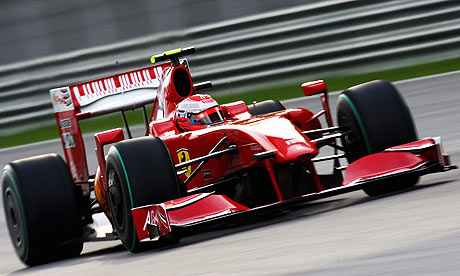
Ferrari's drivers and engineers have struggled in 2009, winning only at Spa. Photograph: Clive Mason/Getty Images

As Fernando Alonso prepares for his transfer, long rumoured and announcedtoday yesterday, from the Renault team to Ferrari in time for next season, the Spanish driver could be forgiven for wondering what he has got himself into. On the face of it, the world champion of 2005 and 2006 is leaving a team that, although almost destroyed by the recent scandal that led to Flavio Briatore's departure, can still produce a car capable of carrying him to a solid third place in last week's Singapore grand prix.

The cars of the outfit he is joining, by contrast, qualified 13th and 15th on the street circuit and went on to finish the race in 10th and 13th places, virtually unnoticed.

The Scuderia Ferrari can be grateful for the spate of headlines currently generated by Formula One. The Renault scandal, the battle between Jenson Button and Rubens Barrichello and the renaissance of Lewis Hamilton have served to obscure the fact that the Italian team are going through another of the bad patches for which they were once renowned. A season that began ingloriously in Melbourne six months ago has disintegrated to the point where it can be said that Singapore represented their lowest point in three and a half decades.

Belatedly, it seems, they are experiencing the slump widely predicted when Michael Schumacher went into retirement at the end of the 2006 season. It was a departure that, unhelpfully coinciding with the exit of Jean Todt, the team principal, and Ross Brawn, the technical director, always seemed likely to put an end to a golden age.

During Schumacher's 11 years in collaboration with Todt and Brawn, the team won 87 of 188 grands prix. Yet the lights stayed on for a while after the German's exit and in the following two seasons there were 17 wins from 35 races, with a world championship in the first year for Kimi Raikkonen and a near-miss for Felipe Massa 12 months later.

With 14 of this season's races already gone, by contrast, their tally amounts to one win, one second place, four thirds, too many retirements and a variety of misfortunes, including the mid-season removal of a couple of senior engineers and the terrible accident to Massa in Budapest. A team that claimed 69 pole positions during the Schumacher era has made the front row of the grid only once this year, with an average qualifying position on the fifth row.

Few men have watched the decades-long Maranello soap opera with as much expertise as John Surtees, who won the title as a Ferrari driver in 1964 and was sacked three years later after falling out with the management. He identifies the decision to replace Schumacher with Raikkonen, who learnt yesterday that he will be leaving at the end of this season to make way for Alonso, as the start of their problems.

"There's a greater strength in depth in the team now," Surtees said yesterday, "but since Schumacher left they've lacked a driver capable of binding the team together. Signing Raikkonen was the first mistake. He's talented, but he's not the sort that provides an uplift. And despite all the technical developments in the modern era, you still need the driver's input to motivate the personnel and provide seat-of-the-pants feedback for the engineers. When you've got a driver who works with the team, it makes a hell of a difference."

Watching the red cars of Raikkonen and Giancarlo Fisichella, the latest replacement for the absent Massa, trundle around among the also-rans under the Singapore floodlights, some observers thought back to the summer of 1973, when the Scuderia turned up at Silverstone for the British grand prix with just one car, a new design entrusted to the hands of Jacky Ickx, among the three or four fastest drivers of the time. This ungainly vehicle, based on a British-built chassis, was so inadequate that the dispirited Belgian could manage only 18th place on the grid and, despite a first-lap accident that eliminated eight of his rivals, could finish no higher than eighth.

So traumatic was the experience that Enzo Ferrari decided to withdraw the team from the two subsequent grands prix in order to avoid further humiliation. Ickx was freed to drive for other teams, while the Scuderia limped back with a single car for their test driver, Arturo Merzario, who finished 15th and 16th in the last two races of the season, the prelude to a wholesale cleansing of the stables.

Before the start of the 1974 Ferrari season hired a new sporting director, the 27-year-old Luca Cordero di Montezemolo, a former rally navigator with no previous Formula One experience. There was also a new No1 driver, the 25-year-old Niki Lauda, along with a brand-new car. Together they won the 1975 world championship, but by the time Lauda secured a second title two years later Montezemolo had set off on a 15-year odyssey that would lead him, via managerial posts with Fiat (Ferrari's parent company), Cinzano, the America's Cup and the 1990 World Cup, back to Maranello, where he took over as president in 1991, three years after the founder's death. By recruiting Todt, Brawn, Schumacher and others, he began the process of rebuilding a distressed, dishevelled and discredited institution.

Montezemolo, now the chairman of the Fiat group, appointed Stefano Domenicali to fill the gap left by the departure of Todt at the end of the 2007 season. A younger and more congenial figure who had served a long apprenticeship with the team, Domenicali revived the Scuderia's national character by promoting a greater proportion of Italian engineers to senior posts. Recent events suggest that he may also have restored some of the legendary inconsistency banished by the fierce discipline of the Todt regime.

A quick response to the poor initial showing of this year's F60 car was to demote Luca Baldisserri, the respected chief track engineer, to factory duties. Baldisserri had replaced Brawn as the team's strategist, having learnt the necessary black arts from a long and close observation of the acknowledged master. And in mid-summer, when the car's basic flaws had become apparent, Domenicali fired John Iley, the British chief aerodynamicist recruited from Renault five years ago.

Even a win for Raikkonen at Spa a couple of months later, achieved through judicious use of the Kers power-boost button, could not dissuade Domenicali from calling a sudden halt to further race-by-race development of the F60. Instead of trying to keep up with their rivals, he threw the team's resources into planning a new car, ready for Alonso's arrival and Massa's return in 2010.

"It's a very different Ferrari team today," Surtees said, looking back at previous crises, "but certain things remain the same. They're hoping that Alonso's the answer. Some things about his character have to be looked at, but he's the nearest thing to the kind of balanced, complete driver they need." And only by following the example set 35 years ago, and providing a new star driver with the equipment to win races and titles virtually from the start, can the present regime dispel doubts and restore the expected lustre to the sport's most famous name.

Ferraris love to race

HERE is a tip for classic Ferrari lovers: avoid buying low-mileage models.

Multiple Ferrari owner Len Watson, 63, says low-mileage classic Ferraris have been left idle too long.

"They are actually very reliable cars and don't give you any problems, so long as they are used on a regular basis," he says.

"The problem is people store them in damp garages and the rubbers perish, the tyres get flat spots and they just become horrible.

"Very low mileage cars are not as good as some that have much higher mileage.

"I did 70,000 miles in my 328 (1991 Ferrari 328 GTS) – very hard miles – and we only spent about £2000 (about $A3875) on repairs in about 12 years."

When he says hard miles, he means hard miles, having competed in track days, hillclimbs and classic races.

He currently competes in various Queensland Racing Drivers Championship events in a 1980 Ferrari 308 GTB. Next year he intends to compete in the full season.

The retired software company owner from the UK started his love affair with old cars with his first, a three-wheeled British Frisky with a bored-out 250cc Villiers two-stroke motorbike engine in the back.

It cost him £18 in 1966 and only about 100 were made.

"It was quite unusual as it had a top speed of 70mph (112km/h) forwards and 70mph backwards as well," he says.

"I got up to about 40mph (64km/h) in reverse.

"The way it went backwards was you stopped it and started the engine in reverse. There were four speeds both ways."

He swapped it for a Nash Metropolitan, "then had boring cars for a long time".

The last new car he bought was a 1979 Triumph TR7, then he switched to a Porsche 924 Turbo and in 1983 he wanted to "upgrade" to a 911. "I hated them. Porsches didn't handle at all in the '80s," he said.

"My wife said 'why don't you buy a Ferrari', so I bought a 2+2 Mondial 8 which was a couple of years old.

"I had it for a year and then bought a 3.2-litre Mondial QV (Quattrovalvole) as a company car.

"They were expensive but in those times you didn't lose any money on Ferraris. However, the classic car bubble started in the late '80s and people were buying cars for silly money, so driving to customers in a classic Ferrari was a bit silly because they thought you were ripping them off. So I went to a Porsche 928 as a company car."

However, the Ferrari bug returned in 1991 when he bought the Ferrari 328 GTS which he used and abused in track days, concours and hillclimbs.

"After all, they are only a car," he says.

"Cars like that which were built conventionally on a chassis, you can replace bits. Today's cars crumple and cost a fortune to fix."

About five years ago Watson migrated to Australia, sold the 328 and brought with him a left-hand-drive F40 which he drove in the Classic Adelaide rally.

When he moved to Queensland he couldn't register the car without converting it to right-hand drive.

"Being a carbon fibre car it is almost impossible to convert, so I got special permits for a couple of times," he says.

"But if you can't drive a car I don't want it, so I sent it back to England."

He was "Ferrari-less" for about two years and then in 2007 returned to the UK to compete in the classic series and get his international race licence, so he bought a 1980 308 GTB "sight unseen".

"That was a mistake. The engine was knackered and needed a total rebuild," Watson says.

"But I still have it. The reason I have an old Ferrari is that it is eligible for historics and there is more opportunity for historic racing here than conventional racing."

So he was careful when he restored the car not to turn it into a full-blown race car.

"We put in sprint cams and pistons to make it sure it was still historic," he said.

"It's not highly modified."

Other changes were a rebuilt suspension, Sparco race seats, roll cage and lightweight carpets.

"Usually the first thing you do to a race car is take out the carpets which are heavy, but because it's a Ferrari people expect it to look nice, so we glued lightweight felt to the floor so it looks like carpet," he said.

The 308 GTB cost about £20,000 in 1980 and features a three-litre V8 with a quoted 255 horsepower (190kW), "but you can take that with a pinch of salt".

"It can rev up to 10,000rpm but not for long periods. It pulls really well from about 3000rpm."

His plan in obtaining an international licence was to race a friend's $15 million Ferrari 250 GTO at Le Mans. However, his friend felt the car was "too expensive to risk in a race". That thought won't even enter Watson will take his 308 out on to Queensland Raceway in the inaugural Festival of Italian Motorsport this weekend (October 2-4).


Share this article What is this?

Ferrari 458 Italia debuts in Frankfurt

The Ferrari 458 Italia debuted recently at the world renowned Frankfurt Motor Show. It represents a genuine evolution of Maranello's mid-rear engined V8 sports cars. As with every new Ferrari the 458 Italia is a concentration of innovation thanks, in no small part, to the company's racing expertise.

The levels of fuel consumption and C02 emissions of the car set the benchmark in this market segment.

The car has innovative solutions such as the 'aeroelastic winglets' at the front that generate downforce and, as speed rises, deform to reduce the section of the radiator inlets and cut drag.

The new 4,499 cc V8 engine is a powerhouse, punching out 570 CV has a weight-power ratio of 2.42 kg and can move from 0 to 100 km/h in under 3.4 seconds and hit a maximum speed of over 325 km/h.

The driver-car interface has been revolutionised grouping all the major commands on the steering wheel, and the secondary functions on two satellite pods that just out from the dash on either side of the wheel.

This solution, together with the immediate visibility of all the car's settings on dedicated screens ahead of the driver, ensures maximum control of the car at all times, an important safety factor.

Another important announcement at Frankfurt is the extension of the Atelier One-to-One personalisation programme to the Ferrari California which thus joins the 612 Scaglietti and the 599 GTB Fiorano.

The Ferrari California is the first car in Ferrari's V8 line-up to be included in this exclusive service, and clients may now personalise their car directly at Maranello, benefiting not just from a vast range of special contents to choose from, but also the support of one of the factory's expert specialists.

As well as the F2008, the Scuderia's F1 World Championship-winning car from last season, the Ferrari stand features the flagship 2+2, the 612 Scaglietti, in Grigio Ferro Met. with Nero interior, and a 599 GTB Fiorano in Nero Setoso and Nero.

The latter is equipped with the optional Handling GTE package launched at Geneva this year which now accounts for 70 per cent of all orders. Joining the 458 Italia, and completing the V8 line-up, are two examples of the Ferrari California, the first in Nero Setoso and Cuoio interior and the second, Grigio Titanio with Bordeaux interior.

Click here to go to the official Ferrari website

Ferrari expects tougher times after disappointing qualifying

Singapore (dpa) - Ferrari team principal Stefano Domenicali on Saturday expected tougher times to come for the Scuderia after a disappointing qualifying for Sunday′s Singapore Formula 1 Grand Prix.

Ferrari expects tougher times after disappointing qualifying

Stefano Domenicali (file picture)

"Our package just wasn't quick enough in this qualifying session," said Domenicali, whose drivers Kimi Raikkonen and Giancarlo Fisichella will start from place 13 and 18, respectively.

"Furthermore, if so many of our competitors continue to develop their cars, while we stopped doing so with ours several weeks ago, then the more time goes by, the more we will find ourselves in an even more difficult situation," he said.

For the Singapore GP, Domenicali said, "it will be difficult to reach our minimum target of finishing in the top eight."

Fisichella said he still had not found "the right level of confidence" in the car.

"It's almost as if it is driving me rather than the other way round," he said.

Getting into the points in Singapore's night race "would be the maximum, but even that will be a very tough target to reach."

His teammate Raikkonen agreed, noting that "we can expect a tough race as it is very difficult to overtake here."

Tuesday, September 29, 2009

Street life in Singapore

SINGAPORE is an immaculate city without a hair out of place.

Its people are polite and softly spoken.

So it was with a mighty roar of the Formula One cars that the Lion City was shaken to its core on Sunday night.

I had never been to a grand prix before and I was expecting to see a long line of cars chasing each other round and around in a circle like a child's mobile.

But if like me you are a F1 virgin, nothing can prepare you for the sheer ear-popping volume of these supercars as they pass, screaming through corners and down the straights.

The city's vast tower blocks, which peered down on the floodlit street circuit, seemed to wobble as the engines cut their way in amongst them through the humid Asian evening air.

I was sat on a packed grandstand on a corner halfway around the lap.

The crowd waited with baited breath as the first sign of one of the 850hp machines rounded the corner in the distance and began accelerating down the straight towards us.

The cars sped up to around 185mph before slamming on the breaks with a deafening squeal and then a groan as the drivers lurched down through the gears.

In seconds, the first car was out of sight again as the others followed in a blur of shapes and noise.

We sat mesmerised as car after car flew past — only through watching the big screen and the commentator's mangled words over the loud speakers did we know who was winning and what was happening.

The impressive backdrop of the Marina Bay area gave the race a quality not seen elsewhere in the world.

Bright lights from the skyscrapers provided an awesome backdrop as sparks flew up into the air as the cars skidded across the bumpy road surfaces, chased by the trail of their own red brake lights.

The circuit ran past the old colonial-built Fullerton hotel, formerly the General Post Office head office, past the newly-built modern theatre and under the Singapore flyer, a giant Ferris wheel.

This was only the second time Singapore had hosted the event and the feverish excitement could be felt among the thousands of spectators and F1 fans lining the track.

As an F1 newcomer, I was amazed by the incredible fanbase the sport attracted.

HISTORIC ... Hamilton won the first night race to be held in the island state and the first on an Asian street circuit

HISTORIC ... Hamilton won the first night race to be held in the island state and the first on an Asian street circuit

People who had travelled from all over the world were decked out in team colours of Ferrari and Braun, others had faces painted or flags and T-shirts with the names of their favourite drivers.

The whole weekend had been geared towards the race.

The hotels and bars swelled with thousands of fans and the city's streets had been brought to a virtual standstill as a swathe of the busy Marina Bay area was closed off and converted into racetrack.

The weather on the small city island, south of Malaysia, is very hot and muggy — with the drivers sweating out up to six pints of water during the race.

During qualifying, I had been taken to a viewpoint on the 70th floor of a nearby hotel where we could watch the cars practising — speeding round the circuit like angry ants.

But it was not until we were up close that you got a feel for the awesome power of these cars.

For two hours we sat glued to our seats with our earplugs firmly in before the chequered flag was announced and the drivers came round for a final time — Lewis Hamilton leading the way on his victory lap.

It had gone by in a blink of the eye — one of the most exhilarating experiences of my life.

The huge crowd then slowly melted away back into the city as the cars were packed up ready to be flown to Japan where it would all start again a week later.

The Lion City could sleep again, until next year.

Formula One 2010 title still undecided

Formula One 2009 drivers title still undecided Racing series   COMMENTARY F1 Date 2009-09-29

By Berthold Bouman - Motorsport.com

After the Singapore Grand Prix, both Formula One championships are still undecided. Jenson Button and Rubens Barrichello are still leading the Drivers Championship with 84 and 69 points, with Red Bull drivers Sebastian Vettel in third place with 59 points and Mark Webber in fourth place with 51,5 points. Brawn GP is still leading the Constructors Championship with 153 points, followed by Red Bull and Ferrari with 110,5 and 62 points respectively.


Lewis Hamilton, the nuber one in Singapore. Photo by xpb.cc.

At the Singapore street circuit Lewis Hamilton delivered another of his start-to-finish victories, obviously an excellent result for the McLaren team, although it must be said that Hamilton's job became a lot easier after many of his competitors were eliminated by drive-through penalties and brake problems. After a disastrous start of the season for McLaren, Hamilton has had no chance to defend his 2008 championship title whatsoever. All he now wants is to win as many races as he can, and score as many points as he can to help McLaren to take the third position in the Constructors Championship from Ferrari.

Button, after his bad qualification result, he only managed to score a twelfth place, was lucky to score any points at all. Button finished in fifth place, and because Vettel finished in fourth place, he only lost one point to Vettel in the championship. His team mate Barrichello had a bad weekend as well, he got a five-place grid penalty for changing his gearbox after qualifying, but nevertheless managed to finish in sixth place and scored four valuable points for the championship. The race for the Drivers Championship will now be decided between Button, Barrichello and Vettel.

Brake problems for Red Bull Racing and Toro Rosso

Drivers Vettel and Webber kicked off their race weekend by qualifying in second and fourth place, but their race results did not reflect the promises of their qualification. Both drivers were on a two-stop strategy, but after his second pit stop, Vettel was caught speeding in the pit lane and was handed a drive-through penalty. This ruined his chances to win the race, and after he served his penalty, Vettel was back in ninth position and had to fight his way up to collect as many points as he possibly could.

Mark Webber had problems with his right front brakes, every time he hit the brakes a black cloud of brake dust surrounded the right front wheel. During his second pit stop, the Red Bull mechanics checked the brake cooling ducts for debris, but couldn't find anything, and Webber was send on his way again. One lap later he hit the brakes again, and this time they completely failed, sending the helpless Webber into the barrier and thus ending his hopes for the world title. A few laps later, Vettel's brakes started to fade too, spewing the same black brake dust, and he was forced to slow down and was told by the team to be easy on the brakes and settle for fourth place.

Red Bull's sister team, Toro Rosso, experienced the same brake problems, and on lap 48 the team called Jaime Alguersuari and Sebastien Buemi into the pits, the cars were pushed into the garage and for both drivers the race was over.


Fernando Alonso on his way to third place. Photo by xpb.cc.

First podium place for Renault

Bob Bell and Jean-Fran�ois Caubet replaced Flavio Briatore and Pat Symonds after they were banned from motorsport by the WMSC on the Monday before the race. Alonso was keen to show the world that he and Renault had put all that behind them, and surprised friend and foe by landing his fist podium position of the season. Although he again had some luck with the safety car, Alonso again showed he is still a very motivated and strong driver. And with all the problems Renault experienced during the last three weeks, that was a truly remarkable achievement.

During the post-race press conference he dedicated his third place to Flavio Britore, which was in fact, as far as I'm concerned, the only mistake Alonso made this weekend. Romain Grosjean, who already had brake problems during qualifying, retired on lap 4, again with brake problems.

D�j� vu feeling for Rosberg

In 2008 Rosberg got a drive-through penalty for speeding in the pit lane which ruined his chances for a possible victory, and this year he was handed a drive-through penalty again. While exiting the pit lane after his first pit stop, Rosberg was a bit too enthusiastic and his Williams jumped over the kerbs that line the pit lane exit. He immediately steered his car back between the white lines, but it was too late, the marshals had no mercy and he got a drive-through penalty.

Unfortunately, as a result of the collision between Adrian Sutil and Nick Heidfeld, the safety car was deployed at the worst possible moment for Rosberg. The rules say that you cannot serve a drive-through penalty while the safety car is deployed and poor Rosberg had to wait until the safety car went into the pit lane again. But by then all the cars were already closely lined up behind race leader Hamilton and when Rosberg went into the pit for the second time for his penalty, he rejoined the race in seventeenth and last position, and ended the race in a disappointing eleventh position.

Disappointment again for Giancarlo Fisichella

Fisichella was again very disappointed by his qualifying result, he didn't make it into Q2 and ended on eighteenth place. He told the media he still hadn't managed to find the right level of confidence in his car, and admitted that scoring points during the race would be a difficult task. The Ferrari has less downforce than his Force India car, which forces him to adapt a different driving style. He was right about scoring points, although he drove a flawless race, he only managed to bring his Ferrari home in thirteenth position.

Kimi Raikkonen also had weekend to forget, he qualified in thirteenth position and couldn't score any points either during the race. Raikkonen told he was struggling for grip during the first two stints of the race, when he changed to the softer tyres for the last stint he found some more grip, but by then it was too late and he had to settle for tenth place. Ferrari didn't score any points this weekend, and their third place in the Constructors Championship is now being attacked by McLaren, who now have narrowed the gap down to only three points.

Best performance of the season for Timo Glock

Before the race on Sunday, Glock was informed by team principle John Howett that the option in his contract for the 2010 season would not be taken up by the team. Glock did the only thing a driver can do in such a situation, during the race he gave it everything he had and drove an impressive race, resulting in a second place, his best performance this year. Jarno Trulli wasn't really competitive the whole weekend, and ended the race in twelfth position.


Adrian Sutil limping back to the pits, with his front wing caught under the front of his car. Photo by xpb.cc.

Force India

No luck for Force India this weekend either. After their sensational performance in Belgium and Italy, the team didn't do well on the high downforce circuit of Singapore. Adrian Sutil and Vitantonio Liuzzi did the best they could, but a sixteenth place for Sutil and a twentieth place for Liuzzi during qualifying was clearly not an ideal result. It was business as usual for Force India, and both drivers struggled to keep up with the rest of the competitors.

To make things worse, Sutil tried to overtake Jaime Alguersuari on lap 21, but missed his breaking point and spun to a halt on the right hand side of the track, narrowly missing Aguersauri. But when he tried to rejoin the race, he slammed his car into the BMW-Sauber of Nick Heidfeld, who was just at the wrong time at the wrong place. Quick Nick had to abandon his race at the spot, while Sutil minus his front wing limped into the pits for repairs. A few laps later he had to give up his race, and to make things worse, Sutil was rewarded with a $20.000 fine for his action. Team mate Liuzzi couldn't impress either and ended on the fourteenth and last position of the race.

Next race: Japan

After 14 races Jenson Button will still be satisfied, he leads the championship 15 points ahead of Rubens Barrichello, and 25 points ahead of Sebastian Vettel, the only two remaining candidates for the this year's championship. Vettel already vowed he would not give up before the end of the season, and Barrichello will certainly not give up either. Ross Brawn promised us that we will see a fair and clean championship right until the end. The next race in Japan could decide the championship, we will take a closer look at the possible scenarios in our preview of the Japanese Grand Prix at the renewed Suzuka circuit, which will be available on Thursday morning at Motorsport.com.


Discuss this article in the Motorsport.com Forums channel: F1

Ferrari says drivers did their best

Ferrari boss Stefano Domenicali said drivers Kimi Raikkonen and Giancarlo Fisichella were not to blame for the team's awful performance in the Singapore Grand Prix.

The duo qualified 13th and 18th, and finished 10th and 13th, having spent the whole race in midfield traffic jams.

Domenicali reckons the results showed that Ferrari has now been leapfrogged by the teams still working hard on their 2009 cars, whereas the Italian squad has now written off this year to focus on a major resurgence in 2010.

"Honestly, I don't think we could have done much better," said Domenicali.

"Kimi and Giancarlo did their best, trying to exploit what their cars had to offer.

"We have to accept the fact that many other teams have made yet another step forward in terms of performance, which makes our technical situation even more difficult, given that development on the F60 stopped a while ago now."

Both drivers said they lacked the pace to make progress even if they hadn't been stuck in traffic.

"I couldn't do any better," said Raikkonen.

"The car was sliding everywhere and I had no grip.

"In the final part, with the softer tyres, the situation improved a bit, but by then it was too late."

Fisichella was similarly frustrated.

"The pace was not up to Ferrari's standard and we have to take that on board," he said.

"I was struggling to keep the car on track because of a lack of grip."

With Lewis Hamilton winning, McLaren is now just three points behind Ferrari in the battle for third in the constructors' championship - and Domenicali insisted the team is still fighting for that spot despite its efforts being poured into the new car.

"When we took that decision, we knew we would pay for it more and more as the end of the season approached, but let's be clear on one thing-  we are not giving up," he said.

"There are still three races to go and we will tackle them with maximum effort because we want to do all we can to finish third in the constructors' classification.

"In a strange season like this one, anything can happen."

The Ferrari of CEOs

Too often the people who run car companies look more like accountants than race car drivers. That might explain why some of these companies have a hard time coming up with cars that consumers want to buy. Ferrari does not have that problem.

That's because its CEO, Luca Cordero di Montezemolo, is a former race car driver. The stylish, 62-year-old Italian, who is also chairman of Fiat (FIA.MI), has panache in spades. He looks like the sort of man who could not only own a Ferrari but also know how to drive one. Neither of which is a small feat.

But beneath the playboy looks beats the heart of a businessman. Descended from Piedmontese aristocracy, di Montezemolo earned a law degree from Sapienza-Università di Roma in 1971 and studied for an MBA at Columbia University in Manhattan. After practicing at a Wall Street law firm, he returned to Italy to work as special assistant to Enzo Ferrari, where he became the race team manager. He then joined Fiat in a variety of positions, including being responsible for international public affairs, then moved to become CEO of aperitif maker Cinzano (also a Fiat company) and was chairman of the organization of soccer's 1990 FIFA World Cup in Italy.

In 1990, di Montezemolo returned to Ferrari as chairman and CEO—and subsequently CEO of Maserati—charged with making the company financially successful and the Ferrari Formula One team a winner. In short order he accomplished both. Even during the recent economic downturn the company posted only a slight decrease in sales and sees continued growth in the U.S. and new opportunities in expanding markets such as China.

During the recently concluded Frankfurt Motor Show, di Montezemolo spoke to BusinessWeek about the future of Ferrari, the strategic importance of Formula One, Fiat's plans for Chrysler, and why Ferrari will never build a hybrid.

Given the state of the automobile business worldwide, how was Ferrari's business in the first six months of the year?

We are slightly down—8%—from last year, but that included the best six months in the history of Ferrari, and last year was a record year for Ferrari. In the first half of 2009 we sold 3,221 Ferraris around the world with a value of €891 million and profits of €124 million. Our merchandising and licensing revenues were up 27% in the first half, and our market share went from 22% to 53%.

What are the key parts of Ferrari's businesses?

The business of the Ferrari brand around the world has three main activities, road cars, racing cars, and Formula One cars for annual sales of $1.5 billion. Our licensing, merchandising, and e-commerce businesses, facilitated by our Formula One team activities—the most winning—amounts to $600 million.

How has Ferrari been able to continue selling its expensive automobiles?

I always tell our people, "We do not sell a car, we sell a dream" and we sell 6,500 Ferraris a year. Buying a Ferrari is different than buying a normal car. And so we are lucky because we are out from the crowd and even with this recent financial storm we are not in the middle of the storm.

Where are your strongest markets?

The U.S. is our largest market, yet this is a country with very strong speed limits and in which Formula One is not as popular as it is elsewhere in the world. So it is the brand, the beauty of the car, the exclusivity, the technology, and the fame of the Ferrari dream. We also sell well in Italy, the Middle East, and we have a growing market in China.

Are there problems selling your cars in China?

In China this year we will sell 201 cars despite a very high tax. Today if you want to buy a Ferrari in China, you will pay double! Exactly double. Yet despite high taxes, there is still a strong demand for our cars.

Why is Formula One so important to you and to Ferrari?

Because Ferrari is extreme technology.

Singapore GP, Scuderia Ferrari: Race

No points for Scuderia Ferrari Marlboro in the Singapore Grand Prix, which turned out to be as cursed as expected for the Maranello team. Kimi Raikkonen and Giancarlo Fisichella were classified tenth and thirteenth respectively. It thus brings to an end a string of races which saw at least one Ferrari finish in the points (10) and on the podium (5.) Today’s result means that the lead over its closest rival in the fight for third place has now been cut to just three points.

Stefano Domenicali: “Honestly, I don’t think we could have done much better. When you start this far back on a track like this, it’s difficult to climb up the order. Kimi and Giancarlo did their best, trying to exploit what their cars had to offer. We have to accept the fact that many other teams have made yet another step forward in terms of performance, which makes our technical situation even more difficult, given that development on the F60 stopped a while ago now. When we took that decision, we knew we would pay for it more and more as the end of the season approached, but let’s be clear on one thing, we are not giving up: there are still three races to go and we will tackle them with maximum effort because we want to do all we can to finish third in the Constructors’ classification. In a strange season like this one, anything can happen. Again today, for example, we saw teams that used to be a long way back, now at the front end, while others did the opposite.”

Kimi Raikkonen: “I couldn’t do any better. The car was sliding everywhere and I had no grip. In the final part, with the softer tyres, the situation improved a bit, but by then it was too late. I closed up to Nakajima and, a few times, I tried to risk a passing move, but here it’s really difficult to overtake unless the guy in front makes a mistake. I don’t expect the situation to be much different next week in Suzuka: it is a very demanding track for the car, from an aerodynamic point of view and we are lacking in this area. Having said that, I will be trying my hardest.”

Giancarlo Fisichella: “It was a very tough race, both physically and mentally. The pace was not up to Ferrari’s standard and we have to take that on board. I was struggling to keep the car on track because of a lack of grip. At the end, on the softer tyre, the car’s handling improved and I managed to do some good lap times. We brought my first pit stop forward to try and get me out of traffic, given that I was stuck behind Sutil, but then with the safety car the move didn’t give the result we’d hoped for. Here, KERS was less of a factor than at Monza: at the start I managed to pass a car and then it was mainly useful to defend my position. Now we go to Suzuka, a real track: given how things have gone this year, with cars being strong in one race and weak the next, it’s difficult to make any predictions.”

Chris Dyer: “It was a very difficult race, for both Kimi and Giancarlo. Contrary to what has happened in recent races, we were unable to make the most of the start, which has been one of our strong points this year. We were already a long way back on the grid and so our situation was immediately more complicated, especially as overtaking is virtually impossible here. Today, several cars failed to finish, or were struggling with brake problems, but we were not able to exploit that to make it at least into the points. As for the tyre performance, the softer compound, in the final part of the race proved to be better than expected in terms of consistency, but it was not clear enough to decide to use it as from the second stint, which was the longest one. It’s easy to say things after the event, but I do really think we made the right choice.”

Kimi Raikkonen's McLaren return could be making of Lewis Hamilton

Then, with the racing over, the even hotter rumour that Ferrari will confirm Fernando Alonso’s long-anticipated move to the Scuderia on Thursday, clearing the way for Kimi Raikkonen’s return to McLaren.

It's an intriguing proposition and begs the question: what makes anyone think it would work this time? McLaren have a dreadful record of equal No 1s, Ayrton Senna and Alain Prost being perhaps the best example. Alonso’s spell alongside Lewis Hamilton two years ago was hardly a match made in heaven.

  Related Articles

I lasted six years at McLaren but it was mainly because I never achieved full No1 status yet was fast enough to be an effective wing man for Mika Hakkinen and Raikkonen. Heikki Kovalainen, unfortunately for him, is not fulfilling that brief, hence the return of the Iceman to Woking.

So why will it work this time? Well, for a number of reasons. Firstly, Kimi is not in the Alonso mould. He will not be politicking with the engineers. In fact, he won’t be doing much communicating at all with anyone, if previous form is anything to go by.

It is no secret that Kimi’s major problem at McLaren during his five seasons there between 2002 and 2006 was Ron Dennis. Ron used to want to package him like he did Mika but it never worked. Kimi is unpackageable; he is an outsider in the F1 paddock. If McLaren allow him, he will turn up, drive the car and then go home, no questions asked. And this time, crucially, I think they will.

That is not to say Kimi won’t be quick. The Finn is one of the quickest guys around. He certainly doesn’t need the money so he is coming to race and to have fun.

Lewis will be behind him on occasions, just as he was with Fernando, and that is what makes the move so intriguing. How will Lewis react this time?

Will his bottom lip come out?

I think he now has the confidence and maturity to cope with another top team-mate and certainly over the course of the season I would expect him to emerge victorious; he is younger and hungrier.

Best of all, Kimi offers Lewis the chance to cement his reputation as a modern great. You can only really be judged against your team-mate and I don’t think Lewis has really been defined in that sense. All the greats have been: Prost v Senna, Nigel Mansell v Nelson Piquet. To be honest, it was the one thing lacking from Michael Schumacher’s CV.

So I think this is great news for Lewis. In his first season he had nothing to lose and was brilliant, no question. But he was raw. Now he will have to prove himself against a top driver and it should make great theatre.

Looking ahead to Japan, as much as Jenson Button must be hoping to wrap up the title on the night, the rest of us would love it to go down to the wire.

I sense a great weight has been lifted from his shoulders since his second place in Monza a fortnight ago. He knew then that he just had to keep plodding away and he would emerge as world champion. That’s exactly what he did in Singapore.

Yes, he has been lucky on occasions but it’s no coincidence that his rivals keep tripping up; they are having to push their cars beyond their natural limits to catch him.

When Jenson’s brake pads started smoking on Sunday he was able to back off. I expect much the same at Suzuka — he just needs to get the car home. He’s nearly there.

First Drive: Spyker C8 Spyder

Spyker C8 Spyder.Photograph by: Bud Moore Photography.com, National Post

Imagine you’re in love with old-time motoring. You know, the kind that balding curmudgeons claim was ruined by power steering, hydraulically assisted brakes and, God forbid, electronic driving safety aids. Real seat-of-the-pants stuff where you can feel every crease in the road. Tail-wagging oversteer that isn’t automatically throttled by some overly ambitious digital safety nanny looking to save the world from itself. And, perhaps most of all, a car that hasn’t become so plebian — like the Lamborghini Gallardo — that you meet its duplicate at almost every downtown stoplight.

Money’s not a problem, so you can afford anything internally combusting that the planet has to offer. You’d shop for some classic sports car, only experience has made you that much wiser and you’re loath to suffer from automotivi interruptus, that horrible ache in the pit of your stomach as you reach for your cellphone because the damned Jaguar D-Type, Aston DB4 or Ferrari 330 GTC blew its magneto, carburetor, bearings or whatever the heck it is that your mechanic is going to bill you $10,000 for fixing this time.

Besides, would it be too much to ask for a few creature comforts, like a seat that coddles or even working air conditioning?

Has Spyker got a car for you. Or two. Maybe even three. Haven’t heard of Spyker? Not many people have, a not unsurprising state of affairs considering the Dutch company has sold only 253 cars since it opened its doors in 2001. That’s not to say Spyker is without lineage. It originally started building horse-drawn carriages in the 1880s. It was the first to build a six-cylinder, four-wheel-drive car and, along the way, joined forces with an aircraft manufacturer. Resurrected by wealthy Dutch entrepreneur Victor Muller in 1999, the company now has three hand-built models — the C8 Spyder convertible, a hard-top version called the Laviolette and the all-new Aileron coupe.

The Spyder was the first of the species. In fact, my tester was a 2006 model with more than 24,000 hard kilometres on it. The first

impression of the Spyder is one of impeccable craftsmanship worthy of an obsessive Germanic machinist. My next thought was that it’s obvious whoever penned the exterior styling suffered an obsession with being noticed.

The exterior has scoops, intakes and aerodynamic lips — all beautifully sculpted in polished aluminum — seemingly everywhere, gorgeous twin pipes that exit through, not under, the rear bodywork and the kind of exhaust note usually reserved for the drag strip. The Spyker is an extrovert’s car in every way.

That’s nothing compared with the interior, which boasts deeply quilted leather (often seen in truly outlandish hues), toggle switches for every possible electronic function and an acreage of milled aluminum not seen since Bentley was an independent automaker. The coup de grâce is a shift linkage that looks like a high-tech version of the articulated linkages found in aircraft of yore. I’m not sure it makes shifting any more precise, but it is part and parcel of an interior package that is completely unlike anything else in the automotive industry.

But there’s far more to the C8 than just outrageous looks. For one thing, it boasts an all-aluminum space frame not unlike that that renders the Audi R8 so robust. So rigid is the Spyker’s basic undercarriage that, in hardtop Laviolette form, it requires an amazing 18,840 pound-feet of torque to deflect the chassis one degree (that, dear friends, is a stoutness equal to anything from the big boys).

Suspension-wise, the Spyder (and Laviolette) owe much to open-wheel racers, all four corners being cushioned by double wishbones controlled by inboard, rocker arm-actuated Koni shocks. It makes for wonderfully communicative handling.

Despite having the Audi-sourced engine situated fairly far rearward in the framework, the C8 steers neutrally thanks to a rear track wider than the front and asymmetrical 19-inch tires (265 millimetres wide in the rear and 235 mm in the front). Without a race track to test its outer limits, there’s no way of knowing whether the C8 outhandles a Porsche, Ferrari or even a Corvette. But this much can be said: The steering is almost perfectly linear despite its lack of power boost, and stability at any speed is truly amazing for a car this short and light (about 1,250 kilograms for the Spyder, a slightly heavier 1,275 kg for the Laviolette). That’s all fortuitous because the Spyker has not a hint of the electronic driving aids that burden most modern supercars; the basic chassis absolutely needs to be controllable. Perhaps even more amazing is that the racing-derived suspension hasn’t resulted in a bone-jarring ride. I can think of all manner of mass-produced sports cars with far worse damping.

I am less enthused with Spyker’s decision to provide no power boost for the Spyder’s brakes. I get that it’s all part of the company’s purist image, but despite the use of humongous, six-piston AP Racing front brakes and 356-mm discs, the brake pedal still requires serious quadriceps work to get maximum power. Considering the Spyder’s price tag limits the clientele to the aged (if not quite yet infirm), requiring this much fitness from its owners might be a sales limitation.

A huge part of the C8’s everyday practicality stems from Spyker’s sourcing of its engines from Audi. Originally seen in the previous-generation S4, the 4.2-litre V8 in both the Spyder and the Laviolette has been boosted to 400 horsepower thanks to Spyker’s own intake and exhaust plumbing as well as judicious remapping of the fuel injection and ignition mapping.

Nonetheless, one doesn’t buy a Spyker for its straight-line speed. Any number of sports cars — many costing much less — can out-accelerate the Dutch demon. But the high-revving Audi mill provides what purists would call adequate power.

Remember my opening gambit about that old-time, non-electronically assisted steering? Virtually anything with more power than this would require any number of digital monitors to make it drivable, ruining that whole visceral, I’m-completely-in-charge-here feeling. Besides, any car that can spring to 100 kilometres an hour in just 4.5 seconds and top out at 300 km/h cannot possibly be found lacking.

Lewis Hamilton tells Jenson Button: 'Enjoy it while you can'

“It is character-building. It will be another step in his life and a very proud moment for him and his family and I can only wish him all the best. I look forward to challenging him next year and taking it back.”

Hamilton knows exactly what Button is going through as he tries to close out the title race, with a 15-point lead over his Brawn GP team-mate, Rubens Barrichello, with only three races left, starting with the Japanese Grand Prix at Suzuka on Sunday.

“It is an overwhelming experience and for many of us drivers it is a dream since we were very young,” Hamilton, 24, said. “It is something that you wake up with and you live and breathe it day by day. You live to get to that dream and he is now in a great position to take it.”

For all his positive comments, Hamilton is also more aware than anyone how close a driver can get to the title only to see it snatched from his grasp. In 2007 he went into the last two races with a 17-point lead, but lost out to Kimi Raikkonen, of Ferrari. So his message to Button is “keep pushing” to the end.

“I can only guess what will happen,” Hamilton said. “But I know Jenson has a huge amount of support back home and it’s the same for me. It is going to be great for Britain, for England. They are very proud of their sportspeople back home so it is going to be great for them.”

Hamilton is rightly proud of his performance on the streets of Singapore, which he feels has helped to reinforce his standing as a worthy world champion at the end of a difficult season for him and McLaren. “I am showing that that No 1 was earned,” he said. “It was on my car for a reason. It is a positive feeling to be able to do that.”

He has also posted another marker for next season, which already has the makings of a classic, with Fernando Alonso, Hamilton’s former team-mate, likely to be a real threat should he complete his expected switch from Renault to Ferrari.

The pair are widely regarded as the best drivers in the sport and both have the same fighting quality and burning desire to win. Their stormy season together at McLaren in 2007 has left plenty of psychological baggage for them to unpack and, provided that both teams come up with competitive cars, the battle should be compelling.

Alonso’s move to Ferrari could be formalised this week. Helping to facilitate it is Raikkonen’s expected switch to take Heikki Kovalainen’s place alongside Hamilton at McLaren. Nico Rosberg looks to be heading from Williams to join Button at Brawn in place of Barrichello.

Raikkonen has appeared to be on the decline since winning the world title two years ago. The Finn is still quick, but his motivation is nothing like that of Hamilton and the move, unambitious but safe, looks like cementing the Briton in the No 1 role at McLaren.

For Raikkonen, who spent five years at McLaren before joining Ferrari, it is a backward step, but he may feel more comfortable in the British team now that Martin Whitmarsh has taken over the team principal’s role from Ron Dennis, whom he did not hold in high regard. It also presents Hamilton with a new challenge in an insular team-mate who is likely to ignore him professionally and socially.

How they stand 1, J Button (GB, Brawn GP) 84pts 2, R Barrichello (Br, Brawn GP) 69 3, S Vettel (Ger, Red Bull) 59 4, M Webber (Aus, Red Bull) 51.5 5, K Raikkonen (Fin, Ferrari) 40 6, L Hamilton (GB, McLaren Mercedes) 37 7, N Rosberg (Ger, Williams) 30.5 8, F Alonso (Sp, Renault) 26 9, T Glock (Ger, Toyota) 24 10, J Trulli (It, Toyota) 22.5 11, F Massa (Br, Ferrari) 22 12, H Kovalainen (Fin, McLaren Mercedes) 22.

Monday, September 28, 2009

'Spyke' of adrenalin

The 2010 C8 Spyker aileron presents a super-sleek profile on highway 22, near Millarville.Photograph by: Courtesy, Bud Moore Photography, Calgary Herald

Strapping in--no, let me rephrase that--climbing in to the Spyker C8 Aileron feels a little like being a test pilot.

Not only does it take a little practise to squeeze under those pivoting gull-wing doors, but once in place, the panel in front of you is lined with toggle switches and aviation-style gauges on a spartan, brushed aluminum dashboard.

The leather-lined cabin is cavern-like and tightly enclosed, visibility is aimed at the road ahead, the engine tucked smack right behind you--all told, a very serious environment.

Ladies and gents, this is not your uncle's Sunday driver.

That feeling--what serious drivers call the pucker factor --increases when you begin the start sequence; flipping up the red guard switch, pushing the ignition button and engaging the automatic Sport mode.

At this point, and much like a test pilot, you had better get your seating position right and the mirrors at the perfect angle. You might also want to tie your shoelaces, too, because what you are about to experience is nothing like any other sports car on the road.

Last week, the Netherlands-based carmaker brought its first pre-production model C8 Aileron --yes, you heard right, the one and only first production model C8 Aileron coupe--to North America and Tony Dilawri's Spyker Calgary dealership for a series of media test drives.

So raw was this first model, that some of the fit and finish on the vehicle had not yet been finalized. By the time this article goes to print, the Aileron will be flying straight back over the pond, where it will be tested further --the results to be implemented in upcoming production models.

While elite carmakers such as Ferrari, Lamborghini and Maserati boast decades of sports car tradition, Spyker Cars is fairly new to the game, but the marque itself, is not.

Founded in 2000 by Victor R. Muller, its chief executive, Spyker Cars draws it name and inspiration from the famed Dutch car and aircraft company founded by Jacobus and Hendrik-Jan Spijker in 1898.

Known for its circular radiators, that firm would go on to build successful touring cars and racers, as well as airplanes and airplane engines for the First World War. After changing ownership it would run out of money in 1926 after producing about 2,000 vehicles in total.

That same aviation heritage is overtly reflected in all Spyker sports cars, and especially the new C8 Aileron.

The first styling cues that catch one's eye are the sweeping ducting tubes on the roof and side panels, which bring cool air to the engine compartment, brakes and cabin.

The 19-in. turbine inspired Rotorblade wheels are also hard to miss. Reminiscent of the blades of a modern jet engine, they carry race-ready Z-rated Michelin tires (235/35 up front, 295/30 in back) for optimum handling.

The Spyker logo itself also sports a propeller, and stamped on the exhaust pipes is the Latin motto of the original car company: "Nulla tenaci invia est via," which translates to: "For the tenacious no road is impassable."

Tenacious or not, the Aileron represents a new direction for the boutique car company.

Spyker has refined and distilled some of the racetrack rawness seen in its other available models, the popular Spyder convertible and the Laviolette coupe, and made the Aileron as much an exhilarating daily driver, as it is a street legal, full-blown sports car.

They also widened and squared off the frame and given the all-aluminum body a stunning new look which, arguably, makes it obscenely noticeable wherever it goes. So much so, in fact, rubberneckers can pose a menace as they pull up alongside to get a look.

But the Aileron is more than good looks. Beneath that ultra-sporty skin lies a formidable drivetrain. A mid-mounted 4.2-litre Audi V-8 provides 400 h.p. and 354 ft.-lbs. of torque at 7,200 r.p.m., providing a top speed of 300 km/h and a neck-snapping 0-to-100 km/h in 4.5 seconds.

Weighing in at about 1,360 kilograms (3,000 lbs.), the Aileron boasts an enviable power-to-weight ratio.

The test car was also equipped with a Tiptronic six-speed automatic ZF gearbox, with manual override. (A manual Getrag six-speed gearbox is also available.)

To say this car likes to rev is an understatement. Merely pulling away from a light brings a menacing roar that telegraphs to every living thing within a block that this is no ordinary set of wheels.

Yet the Aileron is not a wildcat that requires a Formula One driver to tame it. Spyker appears to have found the right balance in its newest model.

The Tiptronic allows the driver to sit back and enjoy the sights, sounds and sensations . . . or to use the steering-column mounted shift paddles.

Another Spyker oddity--one which I've never seen in any other car--is a fully exposed console shifter. Instead of hiding the linkage under the console, as in most other cars, it is exposed and presented in polished silver, adding to the lustre of exclusivity.

Where one can't see brushed aluminum, every inch of the Aileron's cabin is covered in luxurious leather from Hulshof Royal Dutch Tanneries.

Fourteen standard colours are available, but Spyker will also make it any colour "if desired by the customer."

Noticeably absent from the pre-production car's cabin was a dash-mounted stereo. The following production models won't have one either, though it will have an iPod input, 300-watt amp and a six-speaker Kharma sound system. According to the rep, this is not in keeping with the Spyker driving experience.

To be honest, one would have to crank it up pretty loud just to match the roar of the V-8, which is packed right behind the driver's seat. Future models will also feature an in-dash navigation system and Bluetooth interface.

And finally, how does the Aileron perform? Quite simply: superbly.

A quick jaunt down to Millarville and back offered a glimpse of the Aileron's "ready-to-rock" personality.

The four-corner, aluminum wishbone suspension with Eibach springs and Bilstein shocks kept us glued to the asphalt and inspired confidence with its precise response on a variety of undulating, twisty roads.

And when it came to stopping that ride--in a hurry--the rock-hard four-piston ventilated disc brakes could seemingly stop a train. I found them a bit too hard for my suburban tastes, but I was told it would probably softened a bit in the coming models.

If Spyker was trying to build a car that could be equally comfortable driving to your favourite restaurant, or give anyone a run for his money on a race track, then it has achieved that.

It also has a trunk which can actually hold a few things, including groceries or a six-pack of Budweiser tallboys.

And speaking of bringing home the bacon, you may be wondering exactly who is the target market for the Aileron. (The automatic equipped coupe retails for $263,000 Cdn, the manual for $252,000)

According to company reps, the typical Spyder customer is worth about $10 million, owns a share in an executive jet and has already had the red Ferrari, the black Lamborghini and the silver Aston Martin. That same customer, they say, is looking for something rare and different.

No question there: the new Spyker A8 Aileron screams "vive le difference" at every angle. Inside and out.

And going by the looks and questions we received from numerous onlookers, this small Dutch car company could well be onto something.

THE SPECS - Type: Advanced mid-engine, two-seat sports car - Body: Structural aluminum space frame chassis - Brakes: Spyker branded aluminum AP brake calipers (four-piston), AP brake discs, cross-drilled and ventilated; Bosch ABS system with EBD - Engine: Audi 4.2-litre V-8, 40 valve, mid-mounted, multipoint fuel injection system with electronic ignition; 400 h.p. @7,200 r.p.m. - Transmission: Tiptronic six-speed automatic ZF gearbox with manual override (automatic transmission), or Synchromesh six-speed trans-axle getrag gearbox (manual transmission) - Performance: Top speed, 300 km/h; acceleration 0-100 km/h in 4.5 seconds - Price: Manual, $252,000; automatic $263,000. plus freight & PDI, $3,000, and Transport Canada green levy, $5,000

Ferrari could confirm Alonso at Suzuka

Ferrari says it could finally announce its 2010 driver line-up as early as this weekend’s Japanese Grand Prix, with Fernando Alonso’s widely-anticipated move now appearing all set to go ahead.

Speculation has been rife for months that the Renault driver will switch to the Maranello-based outfit for next season, even though both Felipe Massa and Kimi Raikkonen have contracts to continue racing for the team for another year.

However, 2007 world champion Raikkonen has long been seen as the driver most likely to make way for two-time champion Alonso should Ferrari be able to agree a deal to release the Finn from the final year of what is the most lucrative deal in Formula 1.

Ferrari is now believed to be close to concluding Alonso’s switch, with the Daily Telegraph reporting on Monday that the Italian team’s lawyers have been working overtime to complete the final details of Raikkonen’s pay-off – which will open the door for the Finn to make a surprise return to McLaren.

With the team’s driver plans now appearing close to falling into place, Ferrari team principal Stefano Domenicali admitted after Sunday’s Singapore Grand Prix that it was keen to end all the speculation soon.

“I think that as soon as we are ready we will let you know,” he said. “We don’t want to wait too long."

And asked if the announcement could be made at Suzuka, he said: “It is a possibility, but it is not guaranteed.”

Alonso himself admitted in Singapore on Sunday that his decision on where he would be driving in 2010 had already been made, adding that scoring Renault’s first podium finish of the year would not change his choice.

“This podium doesn’t change anything, I took the decision already, so soon we will know,” he said after finishing third.

With Raikkonen’s imminent Ferrari departure after three seasons looking increasing likely to pave the way for a return to McLaren, attention could soon turn to when the Woking squad confirms Lewis Hamilton’s 2010 team-mate.

Team boss Martin Whitmarsh – who said several races ago that current incumbent Heikki Kovalainen had to raise his game to remain at the team for another year – remained coy on the subject of drivers on Sunday evening, although he did acknowledge that there were several alternatives to Kovalainen.

“I think by the end of the season we would have made a call there [on drivers],” he said.

“We really like the two drivers we have got at the moment and we would love to continue, but there are other options and we have just got to look at what is the best thing for this team.”

And asked whether the team had any concerns about pairing two star drivers together again after the problems it experienced when Alonso partnered Hamilton in 2007, he insisted: “I think of all the drivers we are a contemplating, I don’t think any are prone to politics and I think there are some exciting opportunities out there.

“McLaren doesn’t run a number one driver policy, we try to have the best two drivers we can have in our cars. That’s a simple policy – we’ve had it for 25 years and we are not about to change now.

“Generally I think it is the right approach. There are clear examples where it has caused us some disquiet and discomfort but [in] motor racing if you don’t go and challenge yourself and challenge your team then you’re not going to be successful.”

The world's most expensive cars

The auto industry may have fallen considerably this year, but that doesn't mean those who can afford to spend six- or seven-figure sums on a luxury vehicle are lacking options.

Behind the numbersTo compile our list of the most expensive cars this year, we reviewed price lists from all the ultra-luxury automakers that had the potential to produce a contender this year for the top spot, including Bentley, Bugatti, Ferrari, Koenigsegg, Lamborghini, Leblanc, Maserati, Maybach, Mercedes-Benz, Pagani, Porsche, Rolls-Royce, Saleen, Shelby SuperCars and Spyker.

We narrowed our terms for the list by choosing only cars that are currently in production and street legal, which eliminated the discontinued $653,000 Enzo Ferrari, $585,000 Saleen S7 and $500,000 Mercedes-Benz SLR McLaren Roadster, among others. Prices do not include taxes; some prices have been converted from euros to dollars. And not all of the vehicles on our list are sold in the U.S.

It's been a mixed bag this year for purveyors of ultra-luxury cars. Maybach sold 12 cars last month - the same amount it sold in July of this year. Rolls-Royce sold twice that, up 50 percent over July. Ferrari, Maserati and Bentley saw relatively routine year-over-year declines of 10 percent, 31 percent and 43 percent, respectively. But all of them except Rolls are down more than 50% in a year when the total auto industry saw a comparatively small 28 percent decrease year-to-date.

When sales do bounce back, expect luxury cars to recover slower than traditional segments. Lincoln Merrihew, the managing director of automotive, petroleum and travel for Compete, a unit of the market research firm TNS, says the delayed recovery is due in part to the fact that these cars never see Cash for Clunkers-type incentives. They also have a shelf-life that matters: The difference between one model year and another is significant for collectors and connoisseur-investors, who notice even the most minute changes in body styling, horsepower or interior trappings.

But more than anything, even people who can afford to buy a $1.5 million Lamborghini Reventon LINK are going to think about just when and how to make the purchase, if at all, Merrihew says.

Race Results: F1 action lights up at the 2009 Singapore Grand Prix

Sunday night's starting grid once again featured defending champion Hamilton on the pole, but the rest of the lineup was a little different from the qualifying order, with Barrichello and Heidfeld dropping back for various reasons and everybody behind them moving up. Qualifying itself had held a few surprises. Q1 was exciting until the end, with several top drivers almost missing out until the closing moments. As it was, the two Force India cars (Liuzi and Sutil) couldn't match the pace they had found at Monza and didn't advance. Neither did Romain Grosjean (Renault), Jaime Alguersuari (Toro Rosso) nor Giancarlo Fisichella, who later said he is still a bit uncomfortable in the Ferrari F60.

Q2 was even more surprising with both Brawn cars struggling to advance, along with Ferrari's Kimi Raikkonen. In the end only Barrichello made it through of that trio. Joining Button and Kimi on the sidelines for Q3 were Jarno Trulli (Toyota), Sebastien Buemi (Toro Rosso), and Kaz Nakajima (Williams). The real excitement came in Q3 however.


Hamilton claimed the top spot on his first hot lap, but several of the others looked to be catching him at the end of the session. Lewis himself seemed set to better his own time until Rubens stuffed it into the wall, ending the session a bit earlier than planned. The session closed under the red flag with everyone's final lap doing little more than burning up fuel allocation for the race. The Red Bulls of Sebastian Vettel and Mark Webber, in particular, were hurt by the incident, as each was setting a great pace in their final hot lap. They settled for second and fourth on the grid respectively, with Nico Rosberg putting in a tremendous effort to get his BMW Sauber on the second row in third.

Qualifying fifth was Rubens, but a grid penalty pushed him down to tenth. Taking his spot in fifth was Fernando Alonso, who didn't seem to let the controversy surrounding his team deter him. He was followed on the grid by Timo Glock (Toyota), Robert Kubica (BMW Sauber), Hamilton's team-mate, Heikki Kovalainen, then Barrichello, Nakajima, Button, Kimi, Buemi, Trulli, Sutil, Alguersuari, Fisi, Grosjean, Liuzi and Nick Heidfeld. Heidfeld actually started from the pits, penalized when his car was found to be slightly underweight. The team blamed it on a lack of ballast. Whatever the reason it negated his eighth place run, putting him at the back of the grid and pushing everyone else up a spot, including Barrichello.

And so the stage was set. The championship-leading Brawns were a couple of rows behind the Red Bulls on the grid, with enough variables between them to keep things interesting. Vettel and Webber needed to capitalize to close the gap and strengthen their hopes of catching Barrichello and Button in the points race. When the green light flashed, Hamilton made a great start but Vettel once again lagged, this time just enough to let Rosberg slip by at the first complex of turns. Behind them Alonso outdragged Mark Webber and even took a shot at going around Vettel, but it basically just slowed his momentum onto the back straight. Webber and Glock both got past, but Webber cut the apron too much and was told he had to let Alonso and Glock back through.


Despite a fairly heavy fuel load, Hamilton opened a two-second gap over Rosberg, with Vettel another two seconds back. As they diced with each other, Glock and Alonso were slowly falling back from the front three. Besides thinking he might be losing his KERS, Hamilton kept the field marching smoothly until the first round of stops.

Actually it was Rosberg who had a small problem, having to serve a drive-through penalty for momentarily crossing the blend line on pit out. Before he could serve it, however, Adrian Sutil took out Nick Heidfeld, bringing out the safety car and ending Heidfeld's record continuous finishing streak at 34. Sutil was later fined for the incident, wherein he spun trying to pass Alguersuari and crashed into Heidfeld trying to get back into the action. Alguersuari pitted and started to take off before everyone was clear, knocking over some crew members and taking the fuel hose with him. Video replay shows the lollipop was still down so we're not sure why Jaime thought it was safe to leave. Thankfully nobody was hurt.

Hamilton, Alonso and Barrichello were all fortunate enough to get into the pits before everyone lined up behind the safety car, but Button wasn't as lucky. He had planned a long first stint to get past some of the cars ahead of him, but now he was pitting right along with them. When the race restarted on lap 25 it was Hamilton, Rosberg, Vettel, Glock, Alonso, Barrichello, Kovalainen and Button.

Rosberg still had to serve his penalty, however, and when he did so a few laps later, he came out in 14th position. As bad as that was for Nico, it gave Vettel a chance to latch onto Hamilton's McLaren Mercedes. He pushed Lewis until lap 39 when he had to make his second stop. Just like Rosberg, unfortunately, Sebastien pushed a bit too hard leaving the pits and exceeded the pit lane speed limit. He had to serve a drive-through as well, but as if if that wasn't bad enough he also damaged his rear diffuser on some curbing, robbing the car of some of its downforce.

Glock and Alonso moved into second and third respectively as Hamilton just cruised to victory. That didn't mean there wasn't plenty of action back in the pack. When Mark Webber had a brake failure that sent him into the wall with 15 laps remaining, several cars that had been waiting to make their second stops dove into the pits expecting a safety car period. The safety car didn't come out, however, and Button ended up gaining a few spots as a result, coming out ahead of his team-mate and right on Vettel's tail when the second round of stops was over. Button had his own brake problems a short time later. That forced him to back off Vettel at the end, allowing Barrichello to close in before he too had a similar problem. Brake problems had already claimed Webber and Alguersuari, so Brawn GP made the smart call in having their drivers ease off.

Points go to Hamilton, Glock, Alonso, Vettel, Button, Barrichello, Kovalainen, and Kubica, who might have done even better had the safety car period not conflicted with his pit strategy so badly. Hamilton gets his second win of the season on the heels of a last lap crash at Monza, Button moves another point ahead of his Brawn buddy and a step closer to the title, Vettel remains a mathematical possiibilty for the crown, Glock gets another second place for Toyota, and Alonso scores another podium for the team under the magnifying glass. The lights are out in Singapore and the show now packs up for the short hop over to Suzuka for next weekend's Japanese Grand Prix. Just three races left before the 2009 Formula 1 Champion is crowned.


Gallery:

For Ferrari, customers come first

By Chia Han Keong

RARE is a car manufacturer that does not place priority on sales projection when opening a showroom for its latest models in Singapore.

But when it comes to Ferrari, the famous Italian motoring company is hardly bothered about how many of its cars it can sell.

Indeed, upon officially opening its Singapore showroom in Leng Kee last Saturday, the buzzword on everyone's lips is "customer service".

Said its chief executive officer, Mr Amedeo Felisa: "It's always been our company's policy to under-supply for whichever market we enter. We want the car buyers to feel the exclusivity of owning our cars.

"Instead of sales targets, we aim to provide the very best customer service to the owners of probably the best cars in the world."

Previously, Hong Seh Motors had been associated with the Ferrari brand in the Republic, since 1982.

But from today, Ital Auto, a subsidiary of Komoco Motors, will assume the official dealership.

And its principal, Mr Teo Hock Seng, promises total commitment to providing customer satisfaction.

Said Mr Teo, who is also Komoco's managing director and chairman of the Formula One Singapore Grand Prix: "We look forward to offering as complete an ownership experience as possible.

"We will work closely with the Ferrari Club here to bring the best activities and services to our privileged owners."

There is also talk of eventually moving out of the current showroom - which is at the rear of the sprawling Komoco complex - to a more "private" location than the traditional Leng Kee motor belt.

Mr Teo said he has shortlisted one or two locations, and moves are underway to try and acquire the land.

Meanwhile, Ferrari lovers can look forward to the introduction of its new grand touring sports car, the Ferrari California.

Already, the showroom is attracting famous names eager to own one of Ferrari's prestigious models.

The Sultan of Selangor, Sharafuddin Idris Shah, dropped by just after it was officially opened by Ferrari's F1 drivers Kimi Raikkonen and Giancarlo Fisichella, quietly viewing the sleek cars on display.

hankeong@sph.com.sg


For more my paper stories click here.

Sunday, September 27, 2009

F1: Singapore GP: a thrill a minute

The good news was that the humidity level was relatively low at just under 80%. Air pressure, the Met Office reported, was exactly where it should have been: it's sea level so it's one bar.

But a wind of 2 metres per second, which translates to 7.5kph is worrying: the "concrete canyon" effect of the barriers, tunnel and buildings may result in that wind funnelling and causing unwanted and unpredictable handling.

The temperature 30C (air) and 29C (track). This is the usual way around for Europe but it's upside down for races in hot, especially tropical countries.

This means tyre choice will be even more critical. There is no doubt that soft-tyres will give better grip but even Bridgestone appears to be uncomfortable with the likely life of the softer of the two compounds, saying yesterday that they have a tendency to grain on the rear, in particular.

That is probably indicative of the fish-tailing referred to in our qualifying report which creates more lateral wear than is suffered when cars corner more normally.

==

Race Report

There are some who might think that today's race was unexciting: and they have a point. If they don't like wheel to wheel racing, if they don't see technical problems developing and they can't work out how pit stops slot into the overall times that cars run.

The most surprising aspect of the race was that the tight qualifying times did not translate to similar times on the road: at one point, some back markers were running some four seconds slower than the front runners. As various factor shook up the back of the field, some quick cars were bottled up behind slower cars. Eventually, blocked for so many laps that his car was overheating, Sutil hit the back of Alguiersari, spun into the path of Heidfeld. Although he made it back to the pits, Sutil was retired, Heidfeld, three wheels on his car drove away from the crash site but was obviously going no further.

Webber had an interesting day: on the opening lap at Turn 7 he was on the outside of Alonso who drifted wide. Webber kept his foot in and went alongside the Spaniard. Webber had all four wheels off the track: it looked as if Alonso did, too. Webber, however, was instructed to give the place back. Unfortunately, Glock was tucked in behind Alonso - and so dropping back cost Webber two places.

Grosjean, who in qualifying complained that his brakes were not working but had been dismissed by the team, was called in with just four laps gone whilst running last. Bitterly, he complained that the team could not find the fault which was afflicting his car only.

Rosberg's day was ruined by the narrow, tight and slippery exit from the pits: he overcooked it and ran wide over the kerb. Although he pulled it back behind the white line long before the end of the pit lane, the line is sacrosanct for safety reasons and he was awarded a drive-through. That would have been bad enough - except that the incident was right before the Sutil accident and so he had to serve it as the cars were bunched up after the safety car session that resulted.

Sutil's retirement removed what could have been a good day at the office: for much of the race, Liuzzi in the sister Force India sat firmly on the tail of Fisichella, the man who left Force India to take the second seat at Ferrari - and who is now looking increasingly like a temp. as Massa has said he wants to try to make it back into his seat for the last race of the season at Abu Dhabi. But there should not be any criticism of Fisi: his vastly more experienced (in the difficult Ferrari) team mate Raikkonen was only three places ahead of him.

But the real drama of the race was unfolding behind the front wheels. Webber's right front brake developed problems. Despite a quick service in the pits, the brake soon let go, spitting him into one of the few soft padded areas around the track. Despite that, as he walked down the pit lane a few minutes later, he was clearly holding himself awkwardly, although no word has been issued on injuries.

But two laps later, both the Torro Rosso cars were withdrawn over fears for their brakes. Vettel , however, with the prospect of some points, stayed out, but did his best to protect his brakes.

Button, informed of Vettel's brake problems, pushed on as quickly he could. But then his team warned Button that his brakes were also overheating and told him to hold station and nurse the car.

Rubens' team told him to protect his position and look after his brakes, too.

Pit: Look after the car. Jenson has issues with his brakes.

Rubens: Can I catch him?

An almost exasperated pit message was that Jenson was ten seconds ahead and running at the same speed and there were concerns over the brakes on both cars. Rubens did what any good racing driver would do: put the hammer down, to finish 1.8 seconds behind Jenson.

With Vettel finishing fourth, the top three were Alonso, Glock and Hamilton.

And it's because of these latter three that one must have some sympathy with anyone who thought the race was a bit boring. The reason for this is simple: all three were millimetre perfect, on but not over the kerbs, close to but not touching the walls, fast but not so fast that their cars broke or slid around too much.

Alonso is a machine : we have often mentioned his ability to place a car in exactly the same place for lap after lap. And, once more, he did so. Having bashed the kerbs through qualifying, Hamilton stayed on the black stuff for the whole race. And, to be frank, Glock arrived in second, just ten seconds behind Hamilton, by being the invisible man. He did absolutely nothing to draw attention to himself for the whole race. And that's the mark of a real racing driver in the Jackie Stewart mould: drivers should win races at the slowest speed possible, he once, famously, said.

That isn't boring: it's masterful performance. And to be able to wonder at the skill of these these three is a privilege. In fact, trying to think back to someone who had the same kind of car control, who looked boring while making outstanding performances, I've had to think back to Ronnie Peterson. In the dry, Peterson was an oversteer specialist and late braking demon. But when he had a comfortable position, or in the wet, he was simply the smoothest of drivers. Alonso is nowhere near so smooth - but he does have the precision of a metronome. Hamilton has the ability to be smooth, but more often than not chooses not to be. And Glock, he's a mystery. He never seemed to be trying today, demonstrating that, given a car with pace and grip, he can make the Toyota sing and do it with stealth.

Alguersuari, however, was anything but invisible: he faces disciplinary proceedings for a pit lane incident where he shot off when the jacks were let down, without waiting for the lollipop: the fuel hose was still attached and pulled the fuel mechanic down, pinning him under the heavy piping.

And Sutil faces a stewards inquiry into his crash with Heidfeld. At first sight, it did appear as if he was trying to spin the car around regardless of traffic, but on a closer look it appears that he was simply trying to prevent a stall and not making significant - if any - movement into the course of the oncoming cars. The result of both of those will be known later.

Vettel was punished with a drive-through for speeding in the pit lane - which compounded a difficult day: as he came out of the pits on cold tyres, he ran over a kerb, ripping part of the rear-diffuser off his car. But as the only Red Bull / Torro Rosso to finish, and finishing fourth, he hasn't too much to complain about: except that the drive-through cost him approx 20 seconds: an he was less than that behind Hamilton at the end.

One safety car incident lasted for five laps. Had it been longer, the race would have been in grave danger of reaching its limit of two hours, running as it did for a little over 1 hour 52 minutes.

And for those that though it wasn't interesting enough: how many realised that it lasted almost half-an-hour longer than many races on the calendar?

With just three races left this season, Button has slightly extended his lead over his team-mate but Vettel took points out of both of them. Whilst Vettel has some chance of catching Rubens, his prospects of beating Jenson are mathematical rather than realistic.

Singapore GP: Jenson's charmed life continues

Ed Gorman

Another not hugely gripping Singapore Grand Prix underlines how difficult it is to get the setting right in Formula One and the racing at the same time, because this track doesn't produce much in the latter category.

A few bullets to consider

Lewis
The boy absolutely flew off the line as if powered by rocket fuel. When he is in this sort of mood, he looks, as JYS would say, the "complete" driver. Even his most bitter enemies can see that Lewis is a class act, I would imagine, (he writes, looking for his hard hat). I can also imagine that, back at Woking, the McLaren brainstrust will be sweating over next year's car. They know they have the driver, they can't afford not to get it right when it comes to the engineering and the design for a second season in a row. Lewis needs a good car to take on Fernando at Ferrari and Sebastian at Red Bull. Martin Whitmarsh needs a good car from the off to cement his own position as team principal. Enough said.

Nico
A very disappointing drive from the man who has ambitions to join Lewis - there are also rumours he may be heading to Brawn. It is so easy to criticise Formula One drivers but, crossing the pitlane exit limit line, even in slippy conditions and when your blood is up, is a pretty basic error and, as soon as we saw it, we knew what was coming. Nico probably got the red mist because he almost lost the car at Turn 5 just after his second stop as well.

Sebastian
A similar story. He drove well and looked to be giving Lewis a real run for his money in the second stint until he forgot his speed-limiter coming into the pitlane for his second stop. Again a basic error and Sebastian has made one or two of these this year. We can - and he can - put it down to experience. For Red Bull generally this was a poor evening with Mark Webber paying for overtaking Fernando when running wide on the first lap and eventually crashing out when his front right brakes gave way on 46. He is out of the title race and Sebastian is as good as.

Fernando
Gritty drive from the Asturian hero who looked and sounded absolutely done-in afterwards. He more or less indicated that the move to Ferrari is on. He also dedicated his podium to Flav. I noticed that Lewis dedicated his win to God. An interesting choice by both men.

Brawn
It's not spectacular is it? Jenson still looks the most likely but neither man set the pulses racing on the streets of Singapore. Jenson was hampered by the safety car and clearly believed he would have got past Heikki and Rubens through his first stop had it not intervened. Rubens seems to have paid heavily for stalling his car at his second stop. He has made quite a few errors of this type this year.

Weird race
It was strange seeing how the top three stepped away in the first stint, then there was a mid-field group and then there was a completely separate race behind the moving road block that was Jaime Alguersuari in the Toro Rosso who looked like he had strayed from GP 2. The poor chap was miles off the pace and leaked time with every lap. It was almost inevitable that Adrian Sutil was going to have a go at some point. He had to for his own self-respect. When it came, it all went haywire and Nick Heidfeld ended up bringing his "remarkable" 42-race finishing streak to an end.

Ferrari
Not much to say really. Kimi trotted round while Fisi struggled. Even for him it has been very difficult to switch cars mid-season and be competitive.

We are going to Japan - is Suzuka going to be decisive in this shuffling championship finish?


Rolling sculpture beats gold as values of collector cars soar

“When you have something they’re not making any more of, the value goes up,” said comedian Jay Leno, host of the Jay Leno Show, who has a collection of 105 cars, including 8 Duesenbergs, and 90 motorcycles. “If you’re knowledgeable, you’ll probably end up making money.”

Prices on collectible cars have gained about 60 per cent since September 2006 according to an index created by David Kinney, publisher of “Hagerty’s Cars That Matter,” a pricing guide and Website. His Blue Chip index of 25 vehicles tracks actual sales and includes automobiles such as the 1960 to 1963 Ferrari 250 GT California Spyder, which has gained 112 per cent since September 2006, and has a current book value of $4.2 million.

Collectible cars have beaten art, wine, stocks and gold, which is up 30 per cent since September 2006. The Art Market Confidence Index at Artprice.com has fallen 37 per cent from a year ago and is down 69 per cent since September 2006. The WinePrices Fine Wine 100 Index dropped 38 per cent between April 2008 and January 2009, and the Standard & Poor’s 500 Index has declined 24 per cent over the past three years.

“It’s an addiction, a passion,” said Guy Anderson, 56, a Georgia collector. “We all make sacrifices to have these cars. You can’t have just one. Each car does something different.” He rents buildings around his Woodstock, Georgia, home to house his 15-car collection, which includes a 1965 Abarth Simca race car.

A 1953 Aston Martin DB 2/4 Coupe sold at the Gooding & Company auction in Pebble Beach, California, in August for $1.65 million, more than triple some pre-auction appraisals of about $500,000, said Serio, the Massachusetts dealer. The last time the one-of-a-kind vehicle was available, in 2007, it sold for $887,000.

“That car just blew the roof off the market,” Serio said. “Everybody in the car world was looking at each other and saying, ‘Are you kidding me?’”

Television has helped fuel market boom, said Ford Heacock III, president of Heacock Classic, a collector-car insurance company. The Speed Channel, a unit of News Corp, has been expanding coverage of auto auctions since 2002. Bidding under cameras and lights gets people excited, Heacock said. Transactions among private parties are generally priced well below auctions, he said, a flaw most pricing guides don’t account for.

“There’s a lot of glitz and glitter. It’s hard not to get mesmerised. The whole industry is driven by passion,” Heacock said.

Some collectible cars, such as the ‘57 Chevy, have declined, said Richard Lentinello, editor-in-chief of Hemmings Motor News, a collector-car publisher in Bennington, Vermont.

The most-desired cars such as Italian-made Ferraris and Bugattis and have held up very well, Lentinello said. A 1938 Bugatti Type 57C sold at Gooding & Company’s August auction for $1.38 million.

“If you’re reasonably knowledgeable and you know what you like, there’s a good chance other people will like it too,” Leno said.

Cars that were popular 30 or 40 years ago will generally remain popular today, Lentinello said. Collectors are attracted to features such as hand-made bodies, small production runs, certain types of engines, and a racing pedigree.

“All Ferraris aren’t worth $1 million to $2 million,” Lentinello said. “Some are worth only $200,000. You have to do your homework. You can get burned fast.”

Among the traps for buyers: cars that aren’t the advertised model, switched vehicle identification numbers, restamped engines, cars restored with shoddy workmanship, and cars whose most valuable production parts have been removed.

The biggest declines among collectible cars are high- octane muscle cars from Detroit’s so-called golden age: the 1967 Corvette 427 Convertible and the 1970 Plymouth Hemi ‘Cuda Convertible, down 25 per cent last year and 47 per cent over three years, according to Hagerty’s guide.

Bonhams auction house has sold 5 or 6 cars for more than $1 million in the US over the past year, and between 10 and 15 worldwide, said Rupert Banner, director of business development for the firm’s motorcar department in New York.

Cars that were expensive when built tend to be expensive now, he said. A 1933 Duesenberg Model J Torpedo Convertible once owned by William Boyd, the actor who played Hopalong Cassidy in US movie Westerns, was sold at a Bonham’s auction in Carmel, California, for $1.44 million in August.

It’s one of a very small number of cars manufactured by the Auburn, Indiana-based company in the 1920s and 1930s. Duesenbergs gained cachet from a 265-horsepower engine with a top speed of 119 miles per hour.

storypagge