Oct. 22 – Two of the issues surrounding the generation of this particular “naughty” cultural series expose two of the great divides between China and India. While last week’s accompanying piece about the Indian naughty things was published complete with You Tube clips to visually demonstrate errant Indian behavior (from Formula One cars racing along Mumbai’s bridges to rampaging elephants), our China-based readership at 2point6billion.com cannot access these. YouTube is blocked from view in China by the Chinese censors. Now we’ve heard the phrase that India can be an assault on the senses, but we didn’t expect the Chinese government to take it so much to heart and ban online visual social commentary in their own country to make the point. So this entry is more literal than visual to cater for our Chinese readers. Secondly is the issue over sex. With a title for an article with the word “naughty” in it, the subject is bound to crop up, but let’s not be too bashful about it. Both China and India have populations well in excess of 1 billion people, and both nations are therefore apparently rather good at deploying its eventual biologically stimulating results. However, there the similarities end. India remains a rather conservative society, whereas China has, as always, a rather more pragmatic, and some would say, tolerant view – as long as it doesn’t necessarily directly impact upon them. So that said, let us begin.
Smashing up a Ferrari at 210 kph in Hainan
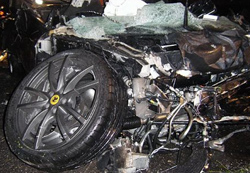 The Ferrari owners club of Hong Kong organized a private road race in China’s Hainan Island and arranged to have the police cordon off a large stretch of the local six lane highway to race. One of the owners had his car serviced by Italian Motors of Hong Kong for HK$56,841 just the week before in preparation for the event. When touching about 210 kph between the Zhuhai and Yangjiang toll highway however, he noticed a severe vibration on the left rear of his car. The tire blew; the car spun around, and smashed itself to bits along the central reservation. Miraculously, the driver was unhurt apart from a few cuts and bruises. The Hong Kong servicer, who it transpired was not officially part of Ferrari – was sued for more than U$630,000 in damages for the loss of the car. The cause of the accident, forensic investigators found, was the fact the tire was over eleven years old and the service had failed to spot it as a risk. The matter was eventually settled out of court; however we believe that thus far, it is the only instance of a Ferrari being totaled in China. It couldn’t happen in India however. The roads are too crap to attempt driving at that speed.
Football punch ups with professional English club sides
China’s Olympic soccer team toured England just before the Olympics to get some much needed experience. Playing a “friendly” against London hosts Queens Park Rangers, a second tier professional team; it all went horribly wrong when Chinese player Gao Lin hit a player from the Championship club. “I’ve never seen anything like it in my life,” a witness told the Ealing Gazette. “There were punches, kung-fu kicks and all sorts. It was absolute mayhem.” Chinese Under-21 international Zheng Tao had to be taken to hospital with a suspected broken jaw, while Xi’an Chanba defender Zheng was unconscious for five minutes after the fighting. The referee, Dermot Gallagher was forced to abandon the game, and the police had to be called in to stop the fighting. Seven members of China’s Olympic team were sent home after the incident. The Chinese TV report is here. According to the current FIFA rankings, China is the 102nd best team in the world, just below international soccer giants the Cape Verde Islands, while India rank 138th just two places below Equatorial Guinea.
Ladyboys
India does have a specific class of transgender in its population. Known as Hijra’s, they number almost a million, and have their own specific caste, a throwback to the days where like the eunuch’s in China’s Forbidden City, Hijra’s played a large role in the affairs of the Indian Mughal court. However, China has all but lost, banned or medically “cured” the issue over eunuchs, homosexuality, transvestitism and hermaphrodites. The British, when occupying India, just looked on with stupefaction and immediately branded them all as immoral outcasts. However, where India and even ultra conservative Pakistan are now taking steps to rehabilitate and recognize them, Hijras are now largely reduced to making a living through invading weddings and threatening to expose themselves at traffic lights to taxi drivers. China, by comparison, now has a thriving, and not so underground bar scene in many of its cities where ladyboys – often sexual professionals from Thailand and the Philippines – openly tout for customers, especially in Western-patronized low end bars. The chance of bumping into a ladyboy in Wanchai, Hong Kong, or on Tong Ren Lu in Shanghai is far higher than it is in more conservative India, even though they have caste recognition in the latter. Whether many of China’s expats can tell the difference after a night on the town is a matter of some debate.
Sex toys
As I mentioned earlier, when it comes to sex, there’s a Chinese pragmatism set against Indian conservatism that begins to become apparent. When it comes to sex toys, these sorts of devices are (very) discreetly available in India, but in China, the business of legitimate sexual openness has gone mainstream. Shops are now to be found on many main Chinese streets advertising themselves as “Sex Shop,” staffed by white coated, professional looking assistants with shelves stocked full of a huge variety of latex, rubber and other pertinent objects to enhance or act as a substitute in the game of love. In India, such a shop would incite a riot and be burnt down within a week. In China, I wonder if this is not a little to do with China’s sad sexual background; a lack of communication between the Communist educated parents and younger Chinese over matters of sex can be strained in ways which they appear not to be in India. Additionally, China now maintains a massive imbalance in terms of male to female ratios. Female infanticide, while now well on the wane, exacted a huge toll on Chinese birth statistics in the 1970s and 1980s, and there is now an imbalance of about 10 percent between sexually fertile available men and women. Purchasing such products from a Chinese store may be a way out of sexual frustration, if not physical love, for many. Not surprisingly, China has also cornered the global sex toy market. A click on Google will reveal that many of the manufacturers are Chinese. In India such objects are very much taboo.
Extinct species
A lesson India very much needs to learn from China is what happens when a country massively develops in the space of a couple of decades. China has achieved impressive goals, mostly measured in terms of finance, but the ecological damage wrought as a result has been dramatic with consequences that are still to be fully understood and in some cases even noticed. It is in India’s interest to follow China’s path with caution as regards the future. China possesses some 393 living mammal species against India’s 316, and although no-one intends species to become extinct, it is a huge worry when active, coordinated efforts appear to be utterly lacking when faced with questions concerning economic development measured against ecological damage. Consider then, the fate of the Yangtze River Dolphin. In a little trumpeted milestone, China produced as a direct result of a considerable lack of environmental awareness, the first mammal to become extinct in 50 years, worldwide. That’s not just naughty, that’s outrageous. With China’s Giant Paddle Fish, about to leave us, and according to the World Wildlife Fund some 20 percent of China’s total species population being marked as endangered, China needs to get its skates on fast to prevent it losing Tigers, Pandas and two in every ten of every living variety of creature forever. India needn’t be smug, despite it having a far larger area of total land set aside as totally protected reserves – 1.4 percent as opposed to China’s miserly 0.01 per cent – its ratio of endangered species is far higher – an estimated 28 percent of all of India’s creatures are headed for destruction. Irresponsible would be a descriptive word.
Predatory expatriates
Maybe it’s due to the lack of sophistication of most Chinese, newly eyes widened to the global world, but the quality and behavior of many expatriates they have permitted to enter China are one of the global expatriate communities’ dirty little secrets. The open mat thrown down, and the bars offering cheap drinks, coupled with impressionable young Chinese eager to make new foreign friends have ushered in a sordid era of poor expatriate male behavior across China. While a minority, it is however true to say that their vocal, demanding, and aggressive nature more than makes up for their lack of numbers. If you want to see expatriate white trash in action, head for an expatriate bar in Shanghai on a Friday night. A excess of cheap beer, a lack of social confrontation by the Chinese and a desire to keep foreigners happy at all costs while they keep spending money has resulted in a shameful descent of expatriate life into a cesspool of aggressive, surly, and pre-determined views of white supremacy that would put any reasonable person to shame. Conquests of local girls are not to do with superiority of physical endowments or possession of a green card; it’s to do with exploitation. While China needs to sort out its immigration policies and dump the expatriate passengers that are turning areas of Shanghai and similar cities social scenes into whites-only clubbing ghettos, such behavior in India would not be tolerated. Indeed, India has tightened its visa issuing policies to all foreigners in the last few weeks to prevent it. China would do well to follow that example.
Decadent in-flight treats
A good reason to fly Dragonair internally in China is the free Häagen-Dazs ice-cream they serve an hour before landing. That in itself, let alone the superior service, leg room and attractive, bilingual trolley dollies, is a justification for spending a few hundred RMB more. Air China has a lot of work to catch up on. And although Air India remain in similar straits (governments around the world are incompetent airline operators), India’s private airlines are catching up – Jet Airways especially. But for in-flight luxury in China, Dragonair takes the naughty prize for seducing us to fly with offerings of ice-cream.
Cuisine sensibilities
OK, so China may have been cut off from the rest of the world due to rampant communism, civil wars and World War II, but India hasn’t exactly changed its geographical or historical position while this was going on. China and India have been cross culturally fertilizing neighbors for thousands of years. So while airlines like Dragonair can do a good job at customer service, naughty cuisine sensibility in behavior means not having any vegetarian meals aboard an Air China direct flight between Delhi and Beijing. With an overnight, seven hour flight, at least 70 percent of the passengers went without food, possibly in breach of international air travel regulations. The vegetarian passengers were essentially offered culturally inedible food on an international long haul flight. That’s a classic example of state ownership and poor management of a national airline, and of crass cultural insensitivity, not to mention a complete lack of understanding of the cultural market being served. Naughty? Add incompetent, stupid, and when describing the Indian passengers, apoplectic.
Collapsing buildings
 Maybe it’s an inevitable byproduct of the massive construction and development that China has been going through the past two decades that has seen them have a fair share of projects go disastrously wrong. Possibly India’s turn awaits as infrastructure projects kick in and developers build ever higher buildings at less cost and in less than sensible time frames to meet demands. However, China now seems to be adding collapsing buildings to its long list of exports. From one of many disasters on the Chinese mainland, Chinese engineers recently managed to build a massive tower in India that disintegrated, killing 40 workers. Naughty? I have a feeling that Indian construction crews will be doing their best to win this title back in due course. However, the Chinese don’t just make them collapse; this apartment block in Shanghai just totally fell over, still intact. Now that takes skill.
Chili battles: Vindaloo vs. Sichuan hotpot
India’s taste for fiery cuisine is legendary, and the hotter the better, especially in the northern regions of Rajasthan and Jaipur. Vindaloo is not actually an especially endemic Indian dish, containing some elements unique to the Portuguese cuisine, but globally it is recognized as being one of the hotter Indian dishes. In contrasting then a Mutton Vindaloo with a Sichuan Hotpot, which one is the hottest? Curiously, the main ingredient in both – the chili pepper – is not a native to either country. The essential chili ingredient is actually a vegetable from the plant of the genus Capsicum, which are members of the nightshade family, Solanaceae. Botanically speaking, the peppers we use are actually a type of berry. Chili’s originate from South America and spread to Asia, probably through Portuguese merchants in the late 15th century. Until that time, neither India or China had chili peppers, and their inclusion into their cuisine or as part of their diet was unknown. What a difference an imported plant can make to a nations entire culture. However, to cut a long story short, who takes the “naughty” prize of the hottest cuisine, India’s hottest dish, a good Vindaloo curry, or the legendary Sichuan hot pot? In the esteemed interests of both culinary science, and of satisfying 2point6billion.com reader’s insatiable curiosity, I ordered and sampled both. There is indeed a clear winner, and the Chinese take it with the Sichuan hotpot. I very nearly exploded.
Chris Devonshire-Ellis is the founding partner of Dezan Shira & Associates and lived in China for 21 years. He is now based in Mumbai.
Related Reading
The Ten Naughty Things You Can Get in India You Can’t Get in China
Ten Things in China You Can’t Get in India
Ten Things in India You Can’t Get In China
One Response to “The Ten Naughty Things You Can Get in China You Can’t Get in India”
Leave a Reply

No comments:
Post a Comment