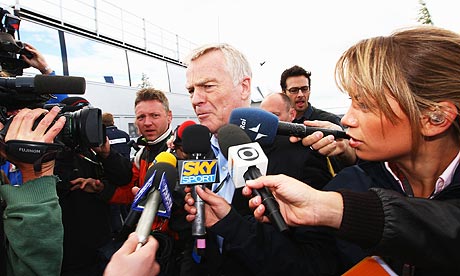
The FIA president Max Mosley at Silverstone following the announcement of a breakaway series from Formula One. Photograph: Clive Mason/Getty Images
It would be easy to imagine that Formula One today linked arms and jumped over the cliff into a gaping abyss, leaving the FIA-backed establishment facing the prospect of staging an official world championship contested by a group of makeshift newcomers.
However, although it may seem a daunting task for the teams association, Fota, to get a new series off the ground, it is by no means impossible and what it has in its favour is the cachet that currently the most glamorous names in the sport – Ferrari, McLaren, Brawn and Renault – will bring.
Even the FIA president, Max Mosley, has admitted that the governing body will be prepared to license a breakaway series if the manufacturers choose, although whether he will be so sanguine when it comes to the crunch remains to be seen, particularly as most Fota members make little secret of the fact that Mosley is the main cause of the problem.
In practical terms the eight dissident teams, who include BMW Sauber, Toyota, Red Bull and Toro Rosso – have now got to get down to the practicalities of going it alone. They may pray that Mosley might defuse the situation by announcing at the next FIA World Motor Sport Council meeting that he will not re-stand for election as the governing body's president in October, but they would be unwise to pin their hopes on such a selfless act.
The first challenge facing Fota is to work out a calendar for a breakaway championship in 2010. For that they will need to find organisers and promoters whose circuits are up to FIA safety standards while not being contracted to Ecclestone from a commercial standpoint. That might be easier said than done. Ironically Silverstone, the venue for British grand prix, might be up for a deal, having failed to renew its contract with Ecclestone for 2010. Magny-Cours in France is a possibility, as are Hockenheim and Imola, home of the San Marino grand prix until 2006 and evocatively named after Enzo Ferrari and his son Dino.
The supporting infrastructure might also be a problem. Equipping the circuits with the necessary timing equipment, officials, FIA stewards, scrutineers and general administrative staff, elements which are taken totally for granted, not to mention the necessary technical support to ensure conformity with whatever rules they might be running under, can be measured in millions of pounds.
Then there is the challenge of overlapping commercial contracts for television coverage, whether or not they can be re-negotiated in Fota's favour, and the logistical challenge of moving cars, personnel, fuel, tyres and all the other sporting paraphernalia by air freight to four different continents during the course of a season. Despite all this, it says much for the level of Fota's dissatisfaction with the status quo that the teams are prepared to take such challenges in their stride as well as indicating how let down they feel by Mosley's autocratic governance.
The prospect of a breakaway series is nothing new. Back in 1980 the Formula One Constructors' Association, headed by Bernie Ecclestone backed up by his legal adviser Mosley, picked a fight with the FIA which basically stemmed from the teams' desire to have a bigger share of the sport's commercial rights income, one essential component of the Fota argument in the current dispute.
At the start of the season the predominantly British-based teams who were members of the constructors' association signed up to compete in a pirate series under the auspices of the grandly titled world federation of motor sport, an organisation which in reality had only a couple of press releases and a set of regulations to its name. The 1980 Spanish grand prix at Jarama was run as a pirate event in which the FIA-loyalist teams Ferrari, Alfa Romeo and Renault refused to compete.
Ecclestone and Mosley even ushered the FIA officials off the premises and the governing body responded by disallowing the race. Nine months later the rebels staged another pirate race in South Africa, points for which were again disallowed by the FIA, while at the start of 1982 the boot was firmly on the other foot when Foca boycotted the San Marino grand prix at Imola which took place with only nine cars on the grid. But proving that you only need two Ferraris to make a race, Didier Pironi and Gilles Villeneuve ran wheel-to-wheel for the entire distance. Shortly after this event the first Concorde agreement was signed, with Ecclestone taking over the lucrative role as commercial rights holder, a stranglehold he has maintained ever since with the acquiescence of the teams – until now.
Click

No comments:
Post a Comment