Wednesday, March 31, 2010

Al-Zayani unveils new Ferrari

‘Designed to fulfill all expectations’

KUWAIT CITY, March 30: In a festive press conference on Monday, Al-Zayani, the official importer of Ferrari in Kuwait, unveiled to clients and the press Ferrari’s new 458 Italia. The event, held at the Ferrari dealership, was attended by Mohammed Dawleh, Brand Manager - Al-Zayani, Pietro Innocenti, General Manager - Ferrari Middle East & Africa as well as Derek Davies, Automotive Director - Ferrari, among other officials from Ferrari Middle East and Africa and Al Zayani. Speaking to the audience, Pietro Innocenti said that Ferrari’s new 458 Italia represents a very important step in the completion of Ferrari’s product range which comprises of grand tourism products and sports products. He said that in the 8th cylinder range, the cars are for everyday family use, however, they maintain the extreme performance Ferrari is known for.

Innocenti added the new V8-engined berlinetta is a synthesis of style, creative flair, passion and cutting-edge technology, characteristics for which Italy as a nation is well-known. For this reason Ferrari chose to add the name of its homeland to the traditional figure representing the displacement and number of cylinders.
In a release given to the press, Al-Zayani and Ferrari officials state that the 458 Italia is designed to fulfill the expectations and ambitions of the most passionate clients and it continues the Ferrari tradition of putting the thrill into driving as a result of track-derived technological innovations.
The Ferrari 458 Italia is a completely new car from every point of view: engine, design, aerodynamics, handling, instrumentation and ergonomics, just to name a few.
With the Ferrari 458 Italia, Maranello has brought a highly distinctive new car to its 8-cylinder range.
The company now offers two models that share a common, race-derived DNA, both exceptionally sporty and fun to drive in true Ferrari tradition, but aimed at two very different kinds of client.

While the Ferrari California was created for owners requiring a more versatile sports car with a practical edge, the 458 Italia is designed for owners for whom the priority is uncompromising on-road performance with occasional track day capability, but who still demand a car that is useable in day-to-day driving like all Ferrari’s recent models.
Ferrari produces a range of sports and GT cars powered by V8 and V12 engines.
As well as the V8-engined cars described above, clients can also choose from two V12 models.
The first, the 599 GTB Fiorano, is a mid-front engined V12 sports car — the most powerful 12-cylinder berlinetta ever produced by the company.
With 620hp and an enviable power-to-weight ratio the 599 GTB Fiorano represents the maximum expression of performance and driving involvement.
Complementing this extreme sports car is Ferrari’s flagship GT model is the 612 Scaglietti, which epitomizes Ferrari’s ability to create a car that boasts the comfort and practicality of a true 2+2 tourer, yet also offers levels of performance and handling normally only associated with the finest sports cars.


By: Nihal Sharaf

Fernando Alonso backs flexible Ferrari to cope with rain in Malaysia

Fernando Alonso during the 2010 Bahrain grand prix

Fernando Alonso believes his Ferrari will cope if there is rain in Malaysia. Photograph: William West/AFP/Getty Images

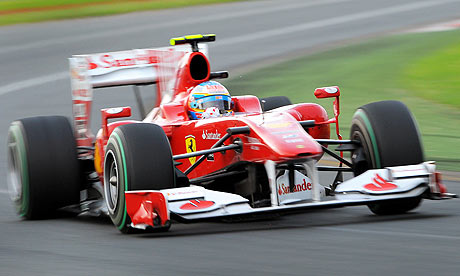
Fernando Alonso believes the quality of the Ferrari car is responsible for the early lead he has opened in the Formula One world championship. The driver, in his first season for the team, followed up his season-opening win in Bahrain with a fourth-place finish in the Australian Grand Prix three days ago.

Ahead of the next round in Malaysia on Sunday, Alonso holds a four-point lead over his team-mate Felipe Massa, with the McLaren duo of Jenson Button and Lewis Hamilton six and 14 points adrift respectively.

"It's been an incredible start to the season," said Alonso. "I definitely didn't think I'd be leading the championship after two races. This situation is way more than I had expected."

As far as Alonso is concerned, it is all thanks to a near-perfect car. "In Bahrain and Australia we showed we are competitive at the highest level," he added. "We can only be pleased and proud of what we have done so far, not just at the track, but also back at the factory over the winter.

"The F10 has proven to be very good, even on a semi-street circuit like Albert Park. It's an easy car to drive. It is reasonably easy to find a good set-up for any type of track. On top of that, it is very consistent, in that its handling doesn't change much between qualifying and the race.

"That should be a very important factor over the course of the year as there is a world of difference between trying to do a quick time with a minimum fuel load on Saturday afternoon and starting the race with a full tank on Sunday.

"Add in the factor that the car is not too hard on its tyres and that completes the package. I'm not too sure exactly where we are compared to the others, but one thing is for sure, we've definitely got off on the right foot."

Crucially for Alonso, Red Bull Racing's reliability issues have aided his cause as Sebastian Vettel should have scored back-to-back wins, only to suffer problems. The Spaniard is now simply looking to build on solid foundations.

"There's no time to relax," he said. "But our target is simple: to carry on doing what we have done in the first two races. It won't be easy, but we must trust in our ability to get the job done."

The likelihood is Alonso and the rest of the field will have to cope with another wet grand prix at Sepang, as occurred a year ago. On that occasion the race was stopped after 31 laps – which led to half points being awarded – due to persistent heavy storms. Although the race starts an hour earlier this year, at 4pm local time in an effort to try and avoid the rain, a Malaysian Meteorological Department spokesman is predicting the worst.

"The rain is expected to start around 4pm and normally lasts two hours," he said.

Button won the rain-affected race at Sepang last year but the British driver is cautious about his chances of repeating his success.

"I think we travel to Sepang mindful that the characteristics of the circuit probably won't suit our car as well as it will suit some of the others, but I'm confident that, once again, we'll be fighting at or near the front," Button said.

His team-mate, Hamilton, added: "Last year we saw what could happen once the weather took over. While I'm hopeful that this year's race will be run in the dry, you can never discount the threat of rain. Either way, I think we'll be competitive."

Michael Schumacher has conceded his Mercedes car is less competitive than others on the grid and believes a podium place "probably is the maximum we can look for at the moment."

He says the Mercedes is having difficulty following other cars closely and overtaking is "almost impossible unless someone makes a mistake." However he insisted that he was "quite happy I've made the maximum out of my possibilities ... We still can fight for the championship."

He says the car will be upgraded by the Barcelona race in early May. Schumacher currently has nine points from two races.

Is The Manual Transmission Dead?

ronniestransmissions

There was a story a while back in one of the automotive trade journals, that hand cranked windows would soon be going the way of the crank starter. Everyone opts for powered windows, so most manufacturers were simply moving to make power windows standard, even on the cheapest of econo-boxes.

And now, there are disturbing reports to traditionalists from two high profile auto manufacturers that might be pointing to the death of the manual transmission.

It started a few weeks ago when our friends over at AutoBlog flatly stated: “The California is slated to be the last Ferrari available with a traditional manual transmission.” Not only do very few people order their Ferraris with old-style, traditional manual gearboxes any more, there is also a performance penalty to be paid. The Ferrari California equipped with the company’s semi-automatic gear change can do zero to 60 in the sub-four second range, and returns with a 17.8-mpg fuel economy rating. Opting for the traditional way to change cogs will net you a 4.2 second sprint to 60 MPH and your fuel economy will drop to 15.8 miles per gallon.

And then came word from Maurizio Reggiani, the director of research and development for a small Italian car maker based out of Sant’Agata Bolognese, Lamborghini. Reggiani told Car and Driver Magazine that manual transmissions are fitted to less than five percent of Lamborghini’s cars. He also added, somewhat defensively, that dual-clutch automated manuals with seven speeds or more, like Porsche’s PDK unit, are not automatically better than Lambo’s six-speed single-clutch unit. Reggiani says Lamborghini is opposed to unequal gear steps, and also makes note that the Porsche gearbox is roughly 50 pounds heavier than the Lambo six-speed.

Now, we could say that this is just a case of Lambo, yet again, copying their rivals up the road (which the Bolognese have been want to do). But there is also no denying the fact that semi-automatic gearboxes offer both performance and fuel economy benefits, not to mention they also greatly enhance overall reliability.

Also, look no further than marques like Porsche, Audi, Volkswagen, Bugatti, Maserati, Mercedes, BMW and a host of others that all go with semi-auto boxes of one stripe or another.

So now the question becomes: Is the manual transmission dead?

Photo from Flickr user by Daquella manera

Hamilton's spat with McLaren caps childish weekend for former F1 World Champion

Hamilton's spat with McLaren caps childish weekend for former F1 World Champion  


Hamilton's spat with McLaren caps childish weekend for former F1 World Champion The youngest ever F1 champion acted his age at the Melbourne Grand Prix.  

by Greg Varkonyi on 30 March 2010

Email this Article (2) Comments

Malaysian Pre-Grand Prix Round Up

Fernando Alonso is leading the race for the championship. In an interview today he said that he had not expected to find himself in this position so early in the season. He attributed his early success to the performance and reliability of the new Ferrari, a car that from the offset he is clearly comfortable with. He sais that it was easy to drive and was kind on its tyres, a vital factor in the new style of racing which has no refuelling.

Lewis Hamilton is concerned that his McLaren does not have the ability to qualify well. This is even more vital in the new format, and he has called on the team to do something about it. It was no use having a car that was fast in the race, he added, if it did not have single lap qualifying pace.
The Red Bull is an incredibly fast car and Sebastian Vettell has clearly shown that he is capable of getting the best out of it, but twice it has broken down when he was in the lead in the opening races. Christian Horner the team principal said that he was convinced that things can be turned around.

Jenson Button, the current champion and winner of the race in Melbourne said that he was hopeful of retaining the world title. He said that there were a few things that McLaren would be adding to their cars and he anticipated that their performance would be better.
Currently the season is wide open though Alonso is the favourite at 7/4 with BetFred. Jenson Button has moved up into fourth favourite at odds of 9/1.

Bet Now
Betfred
  Place your bet now with Betfred

Behind the scenes at the Australian Grand Prix

Hamilton and Button showed their differing styles in Melbourne

Button, now in his 10th year of Formula 1, led the decisions on his car, making the call to come off the wet tyres and go on to slicks. From that point on, he had the remainder of the race mapped out in his brain. 'Look after the rear tyres on the abrasive track, and we'll be alright'. No further discussions needed.

The evidence from Australia suggests that Hamilton was follower, rather than leader. Of course, he trusts his team, so when engineers Andy Latham and Phil Prew told him to pit for new tyres on lap 34, he obeyed.

Hamilton's engineers were concentrating on their own battle for third place. Reasoning the Ferrari duo would have to pit to change tyres, they saw Nico Rosberg as the danger. Rosberg had pitted the lap before and was immediately quick.

Hamilton's tyres, already 25 laps old by this point, were starting to grain and lose performance.

By pitting a lap later, they were guaranteed to rejoin ahead of the Mercedes, but by concentrating on covering Rosberg, they lost sight of the fact Robert Kubica's relatively slow pace in the Renault was allowing him and the Ferraris to nurse their tyres to the finish.

Hamilton did what he was told. Time will tell if he will take more control of his own race destiny in future.

It is easy to forget that, compared to Button, Hamilton is inexperienced in F1. Now just two races into his fourth season, Hamilton was still in GP2 when Button won his first race in the wet/dry conditions of the 2006 Hungarian Grand Prix.

But because Hamilton's life in F1 has been lived in fast-forward, it feels like he has experienced just as much as Button, including a world championship. As he often admits, though, he is still learning.

FERRARI

Ferrari's quandary during the race was fascinating.

Should they instruct Felipe Massa, who had been slower than Fernando Alonso all weekend and was struggling on the low-grip track, to let Alonso through to have a go at overtaking Kubica's Renault?

GRAND-AM: Bennett To Debut Ferrari F430…

Bennett Racing will join the GRAND-AM Rolex Sports Car Series presented by Crown Royal Cask No. 16, entering the No. 56 South River Marina & Mercruiser Ferrari 430 Challenge in the April 24 Bosch Engineering 250 at Virginia International Raceway.

This will be the third new team to debut in the Rolex Series GT class in as many races. Lou Gigliotti LG Motorsports first raced in the Grand Prix of Miami at Homestead-Miami Speedway, while Marsh Racing joins the tour with a Corvette in the April 10 Porsche 250 at Barber Motorsports Park.

Skip Bennett is the car owner, and will co-drive for the Annapolis, Md.-based team with Mike Skeen at VIR as the first step in a planned assault on the 2011 Rolex 24 At Daytona. They expect to run with fellow NASA Spec E30 drivers Chris Cobetto, Mike Davidson and Jon Allen at Daytona. That series features close competition among 160 HP 1987-1991 BMW 325is.

Bennett began his racing career in 2005 at a Summit Point Raceway driving experience. His first race was a NASA event at VIR in 2006, driving a Porsche 966, and also ran in the Continental Tire Sports Car Challenge at VIR, going from last to 28th in a field of 55 cars. He finished fourth overall in the USA Ferrari F430 Challenge series in 2007, and has raced in the NASA Spec E30 Series the past three seasons.

“We’re looking forward to joining the Rolex Series and racing at VIR,” Bennett said. “I’ve spent a lot of time at that track and am very familiar with it. Depending on how we do, we also hope to run at Watkins Glen and the Daytona race in July, and are also considering New Jersey Motorsports Park.”

Skeen, who starred in the 2008 edition of Setup on SPEED, won the 2008 NASA SpecE30 national championship as well as two regional series championships. He raced in the SCCA Muscle Mile Trans-Am last season, going from last to second in his debut race at Road Atlanta – earning him the Hard Charger and Star of the Race awards. He has two starts in the Continental Tire Sports Car Challenge, debuting in 2008 at VIR with Freedom Autosport.

"This grassroots effort has developed very quickly, and our crew has put in a lot of hard work to make this possible," Skeen said. "I'm sure we will learn a lot at VIR to help us prepare for future events."

Practice for the Bosch Engineering 250 begins at 9:30 a.m. ET on Friday, April 23, with qualifying at 3:45 p.m. (SPEEDtv.com, live). The two-hour, 45-minute race takes the green flag at noon ET on Saturday (SPEED, live) and will be followed at 3:30 p.m. by a Continental Tire Sports Car Challenge race.


Schumacher hopes to bring cheers to local fans at Sepang

Rain not a bother: Michael Schumacher of Germany powering his Mercedes car through a corner during a street demonstration in front of the Petronas Twin Towers in Kuala Lumpur Wednesday. � AFP

And the German, heartened by the reception even though he is no longer in the familiar red Ferrari shirt, hopes to bring cheers to the locals in the Malaysian Grand Prix in Sepang.

Schumacher is making a comeback at the age of 41 to drive for Mercedes, a company with whom he had close ties with earlier in his career.

The German carmaker purchased the 2009 title-winning Brawn GP team, retaining team principal Ross Brawn, who previously helped lead Schumacher to title glory with Benetton and Ferrari.

It will be hard for Schumacher to add to his tally of 91 wins in Sepang on Sunday, given the Mercedes cars are lagging behind Ferrari and Red Bull in terms of race pace.

�We are a step behind the others at the moment. If we are following the other cars closely, overtaking is almost impossible unless someone makes a mistake,� said Schumacher in facing the media scrum for the first time in Malaysia yesterday.

�A podium finish here is the maximum we can look for at the moment. We can still fight for the championship but we can only look forward to this after we get our big aerodynamic package improvement in Barcelona (next month).�

Petronas Mercedes GP are still searching for their first podium finish and it will be a cherished moment for the fans and the team if the seven-time world champion delivers it.

�I have always loved racing here when I was with Ferrari.

�It�s still the same feeling I get or I will not have come back in the first place,� said Schumacher, who has chalked up nine points from two races.

�I saw the chance to get the podium in Australia but was bumped out.

�I think it�s a special race for everyone here due to the Malaysian connection and I hope to finish with better results.�

For the record, Schumacher is the most successful driver when it comes to the Malaysian GP. He took the chequred flag on three occasions � in 2000, 2001 and 2004.

Yesterday, Schumacher and Rosberg also took the F1 car out for a spin on the streets around the KLCC.

Tuesday, March 30, 2010

Alonso: 'Winning is more special with Ferrari'

Is Fernando Alonso the man to return Ferrari to the glory of the Schumacher years? The early signs are good. His victory on debut – one which saw him match the likes of Mario Andretti, Nigel Mansell and Kimi Raikkonen, who all won on their first start in the famous red car – at the Bahrain Grand Prix suggests he has what it takes, as does his evident excitement to be driving for Formula One's most famous team.

"You know, you hear all about these stories of what it feels like to race for Ferrari," he says with evident relish, "but until you really do it is very hard to imagine the emotion behind it."

Driving for Ferrari is one thing, winning for them another. The ease with which Alonso has moved into his role bodes well for this season, continuing with this weekend's Australian Grand Prix. "Every time you change teams you need to adapt yourself a little bit to the new people, the new philosophy of working, of preparing for the season," he says. "But it's been great here so far and I have felt very comfortable with the team from day one. So we were able to arrive at the first race with a good preparation, ready for the fight."

Related articles

No one has ever looked readier "for the fight" in a Ferrari than Michael Schumacher, whose remarkable success with the team is both inspiring and intimidating. Ferrari are clearly delighted with the quick start their new recruit has made, but they're desperate not to heap too much pressure on his shoulders.

When asked if Alonso – who, lest we forget, has two world championships with Renault in 2005 and 2006 under his belt – can bring back some of the success Schumacher had, team principal Stefano Domenicali is cagey. "I think it is too early to say that," he says. "Michael and Ross [Brawn] was a fantastic period for Ferrari, but it is better to do the result and then celebrate, keep our feet on the ground. Fernando is a fantastic driver with all the potential to do a fantastic job, but we need to go ahead step by step."

Wise words. Schumacher won five of his world titles and 72 of his 92 grand prix victories with the Prancing Horse, and those who have stepped into the cockpit since have struggled to live up to that challenge. Felipe Massa, a charismatic and talented little racer, came so close to winning the crown in 2008 but ultimately failed.

Raikkonen, whom Alonso has replaced, did go one better in snatching the World Championship from Lewis Hamilton in 2007 but, given the expectations Ferrari had for him, even that was something of a disappointment. In the early years of the 21st century the Finn was widely regarded as the man most likely to unseat Schumacher as Formula One's yardstick, but when he actually replaced him at Ferrari the results were less than satisfactory. Kimi liked life too much to adopt the German master's philosophies for consistent success.

The victory in Bahrain suggests Alonso has a far stronger desire for success. "Winning the race was just a very, very special moment for me," he says. "Coming back to the top of the podium is always special but I think it is even more special with Ferrari, with all the history behind the team and all the expectations a driver has when he drives for Ferrari. There is no better way to start the relationship. I am in the best team in the world."

Bahrain was the culmination of one of the most intense periods in Alonso's Formula One career, he says. "We had been preparing ourselves physically and mentally for a lot of months, testing a lot in the winter. You arrive first at the grand prix on a Thursday, there's a lot of stress, media attention, etc, and then come to Sunday and it is time to deliver.

"So winning means a lot, but especially it means a lot with Ferrari, the first victory. It was very special, and it will be difficult to forget that day."

Like many before him, Alonso truly began to appreciate what it is to be a Ferrari driver only when he undertook his first official engagements with the team, when he had become an insider. In Maranello he was feted wherever he went in his smart new red clothes. When he started to test for Ferrari in Valencia, a record 36,400 spectators turned out to watch his every move in the sleek new racer that he described as "the best car I have ever driven".

He was savvy enough to give the Ferrari fans what they wanted, a big smile and nice words about their beloved cars. But you sense that he has been slightly taken aback by the sheer level of passion that Ferrari inspire in their supporters.

Back in his championship years with Renault it was hard to detect flaws in Alonso. The Spaniard seemed like the most flawless of the pretenders to Schumacher's crown. Where Raikkonen and Colombia's Juan Pablo Montoya were mercurial, prone to moody hotheadedness or off days, Alonso was calm and focused.

Yes, there were the occasional "Greta Garbo" outbursts, as they came to be known, when he would voice the opinion that he felt "like an island within Renault", but that was just taken to be the odd bit of emotion surfacing in times of stress when he didn't feel fully supported. But the arrival of Hamilton in Formula One when Alonso went to McLaren put him under massive pressure and suddenly the flaws were all too apparent. He couldn't handle being upstaged by a rookie who was as fast as he was and, on the occasion when Hamilton scored his maiden win in Canada, less prone to the mistake that Alonso repeated time and again, underbraking for the first corner.

The psychological havoc that Hamilton wrought led ultimately to their argument after qualifying in Hungary and Alonso's ill-advised attempt to blackmail Ron Dennis into influencing the outcome of that season's title fight in his favour rather than Hamilton's. He left the team for a wilderness period back with Renault, relieved only by the "Crashgate" win in Singapore and another, next time out in Japan, which came courtesy of his own talent.

"It helped me become a better driver," he says now of his time at McLaren, which left various management members unable even to mention his name without curling their lips. "I've arrived with more maturity because of those experiences. I'm more relaxed, more at peace. I'm ready for any challenge."

Even the one to bring Ferrari back to consistent greatness? "Yes, if by that you mean bringing everything that I have learnt to bear on making the car better and pushing myself and my team to be the best we can be."

How did he feel when he knew he was going to win on debut with Ferrari? "I thought of many things," he says. "It was very long, not only for the two-minute lap but also because you try to bring the car home safely and you want to avoid all the kerbs, all the strange noises, everything, so it was a very long lap.

"But I was thinking about the great job that the team have done so far. I was thinking about the mechanics, everybody running in the garage to change the engine at the last moment that morning. So all that stress and all those difficulties that the team had are paid off now, and I was thinking just to celebrate with them."

He says that winning in Bahrain has in no way lessened the weight of responsibility on his shoulders. "There is always pressure at every race we go to. Even every test we go to in Spain, there are 20,000 people who expect us to be P1 at the end of the day, so we live with pressure on our shoulders. After that first win it was good to enjoy the time with the mechanics, with the guys who had helped to make it happen, but when I came here to Australia it was in my mind that we had to start again from zero.

"There are things to improve in the car, for sure. There's not a perfect car in the world."

How they love to hear that at Ferrari! It could have been Schumacher speaking, the German champion's quintessential restlessness and refusal to let complacency cloud his search for perfection. No hint of criticism, just confirmation of the need always to look ahead to a yet faster lap, a yet faster race time.

The signs are all there, of Alonso's determination and dedication, of his intense desire to lead and shape this legendary team. They love Massa at Ferrari, but they also know that the man with one of the best combinations of talent and backbone to lead them back down the old familiar paths to glory is the one sitting in car No 8. The marriage of Alonso and Ferrari is every bit as pregnant with potential greatness as those of Niki Lauda and Ferrari in 1974, Alain Prost in 1990 and, of course, Michael Schumacher in 1996.

Top of the world: Alonso's rise

World Championship standings

1 F Alonso (Sp) Ferrari 25pts

2 F Massa (Br) Ferrari 18

3 L Hamilton (GB) McLaren 15

4 S Vettel (Ger) Red Bull 12

5 N Rosberg (Ger) Mercedes 10

6 M Schumacher (Ger) Mercedes 8

7 J Button (GB) McLaren 6

8 M Webber (Aus) Red Bull 4

9 V Liuzzi (It) Force India 2

10 R Barrichello (Br) Williams 1

*Alonso's victory in Sakhir this month was his 22nd in 141 races. The 28-year-old began his F1 career with Minardi in 2001, although he failed to score a point all season. His first win came the following year in Hungary in a Renault, with whom he went on to win consecutive titles in 2005 and 2006. He joined McLaren in 2007 before moving to Ferrari this season.

Ducks honor Selanne's 600th goal, stellar career

MORE NHL INSIDER STORIES › Selanne kept his remarks brief, describing the "unbelievable" feeling of having scored the big goal in front of a home crowd on March 21 against a former club, the Colorado Avalanche. 

As he finished his remarks and posed for photos, he was serenaded by chants of "One more year!" Selanne turns 40 on July 3 and has stated recently that he'll take time after the season to contemplate whether he'll return or retire.

Kurri and Selanne met when a young Teemu attended Kurri's off-season hockey camp.

"He came to my hockey school," Kurri said. "We had a (mutual friend) who put us together. I had heard of him before, but I had never met him. We started to spend some time together, do some training together, during the offseason. We became good friends."

Selanne, 17 at the time he first met his childhood idol, was impressed with Kurri's wheels, and introduced himself through their mutual love of sports cars.

"Good car," Selanne claims were his first words to Kurri. 

Selanne laughs when he remembers that Kurri found out too late that he wasn't supposed to be driving.

"I didn't even have a driver's license," he said, "but I asked him if I could borrow the car and take a spin and he realized ‘he's 17.'" 

"I told him, ‘Take it easy, don't spoil my tires,'" Kurri remembered. "Later on I heard that it was a hard time for my car." 

Kurri joked that 600 goals and a Stanley Cup later, things are different.

"Now, I need to borrow his car," Kurri said. "Times (have) changed."

While in town for the ceremony, Kurri is staying at Selanne's family home. Selanne jokes that his legendary friend gets the "master suite" when he's in town.

A big fan of auto racing and car collecting, Selanne counts a Ferrari Enzo as his favorite.  Make no mistake, though, he won't be bumming a ride from Kurri during his visit.

"I'm not going to go with him," Selanne said. "I have to take control. Here we have six lanes and (in Finland) we have one or two. Got to be safe."

Selanne's ability to quietly find open ice year in and year out is no joke, however, and the Finnish Flash said his elite ability to do so can be taught by observing greats like Kurri.

"It's one thing you learn at an early age," Selanne said of his stealth quality. "Following guys like Jari and other great players, how are they going to handle different situations and how are they going to find the open (areas) and be the right guy in the right place. Those are the things you can learn from the great players, and I learned that at an early age. Follow that and good things usually happen."

Old champs the only spark in boring Bahrain

And the fact is, life is boring. Despite what they told us in the 80s and 90s, we are not living on the moon, teleporting to the local pub, flying to work in cars like the Jetsons and some of us are still going bald. And guess what, greenies? We are still using a 130-year-old fuel called petrol. No, our cars are not powered by hydrogen, linseed oil, electricity or chicken manure.

Anyway, if you have booked tickets for the only event in Melbourne that is bigger than Moomba, the Melbourne Grand Prix, or better still you have the big screen at home, then don't despair. You will get excited.

First of all, Melbourne is a street track; and, second, there will be more than three people there.

Bahrain was run on a purpose-built track that is absolutely sterile. Sterile. Sterile (adj.) barren, dull and uncreative, hygienic, germ-free, bare; anyway, you get the point. This is what happens when governments think they have to build giant edifices to make people want to come to their unattractive cities.

Shanghai is one the most exciting cities, yet the mayor was talked into building the best new racetrack of all time instead of running races through the city. At least if there is a big race on the Chinese authorities can tell the local factories to close down and send their workers out to cheer for cars and people they have never heard of before. How much did the average Chinese factory worker know about the Holden-Ford battle and Paul Morris and Sirromet Wines? Well, about as much as they do about Tony Abbott and Brendan Fevola, but that didn't stop them filling up the stands for a day out, some free won ton soup and a couple of bottles of Tsingtao, and cheering Paul's Commodore in the first Chinese V8 Supercar series.

Bahrain didn't have Morris and Sirromet Wines. It had about three people in the stands watching a parade of cars race through a desert. It really tried. Timbaland, Hussain Al Jasmi, Sean Kingston and Flo Rida were four of the artists to take to the stage during the weekend. Yes, I wish I could have seen them, too. Where organisers got it right was celebrating the 60th anniversary of the world championship with every world champion still alive (and some who looked as if they weren't) out on the circuit. Keke Rosberg, Jody Scheckter, Michael Schumacher, Damon Hill, Jack Brabham, Jackie Stewart, Mario Andretti, Emerson Fittipaldi, Nigel Mansell and John Surtees were there, as were some of their original cars. If not completely original, then somewhat like the original.

Surtees drove a 12-cylinder Ferrari 158, Fittipaldi his original Lotus 72, Scheckter his Ferrari 312-T4, Rosberg his Williams and so on. The great pity was that Brabham reckons he is too old for hot laps any more.

Now seeing these guys race was very nearly worth the price of the ticket but, sorry, with a few exceptions . . . and they are the old race courses . . . it has to be street circuits or they don't cut it. For me the highlight of Bahrain was Jackie Stewart, 70, in his own beautiful blue Tyrrell. Despite what he says, Jackie is still fast on and off the track and gives hope to all who still dream of managing to knock a few seconds off our lap times as we get older.

The reality was Ferrari and Red Bull were fast and no one else was in the race. Sebastian Vettel should have won but had a dud spark plug. Webber should have done a lot better but no one could pass anyone and Schumacher drove beautifully in a not-too-fast Merc. And don't forget Aussies are still doing well in other cars. On the same day, Will Power drove a blinder to win an IndyCar season opener on the streets (naturally) of Sao Paulo.

jc@jcp.com.au

Alonso: 'Perfect' Ferrari was so much quicker than all the others

Double F1 World Champion Fernando Alonso was left waxing lyrical about the pace of his Ferrari F60 after storming back through the field from last to fourth in the 2010 Australian Grand Prix around Melbourne's Albert Park street circuit Double F1 World Champion Fernando Alonso was so enthusiastic about the pace and potential of his Ferrari after coming through from virtually last to finish less than two seconds from the podium in this weekend's 2010 Australian Grand Prix, that he opined that with a 'perfect' car, 'now there is the possibility that you can win the race even starting last'. Alonso's hopes of victory might have been undone within seconds of the lights going out in Melbourne when he found himself caught in a pincer-movement between the McLaren-Mercedes of Jenson Button on the inside and the Mercedes Grand Prix of Michael Schumacher on the outside, with the resulting contact pitching him into a spin and leaving him facing the wrong way down the track as the oncoming field darted around him in avoidance. Thankfully, nobody hit the stationary scarlet machine, allowing the Spaniard to resume his race – albeit right at the rear of the order. From there, undefeated, the 22-time grand prix-winner went on to fairly scythe his way back through the pack, soon rejoining battle with former team-mate Lewis Hamilton and Red Bull Racing ace Mark Webber. Though his progress was ultimately stalled when he came up behind Felipe Massa in the sister car, still P4 for the world championship leader given the way the race had begun was a fine achievement and a real get-out-of-jail drive – and that, Alonso insisted, was thanks to the equipment he had underneath him. “I was super-happy with fourth,” the Oviedo native enthused. “I do not think I could have done any more than that. I got an awful start, because I had wheelspin on a white line and was last after the first corner following a collision with two other cars. I was not thinking about my team-mate at that moment – I was just thinking about scoring some points. Thanks to the strategy, though, we managed to get this result. “We were able to run a very long stint with the soft tyres. When I found myself behind Felipe, maybe I could have gone a bit quicker, but we know it's very hard to pass in Formula 1, and between team-mates one should not take any unnecessary risks. If we had managed to get past [Robert] Kubica, then it might have been a different story, but it wasn't possible, apart from the fact I also had to defend my position against Hamilton and Webber, who were on fresher tyres than us. “To finish fourth was a fantastic result for the team and for myself, and it was very significant, especially given what happened to some other drivers, meaning we have increased our lead over some of our closest rivals in the title fight. The car was perfect, and now there is the possibility that you can win the race even starting last, because the car was so much quicker today than all the others. “I prefer to start first and be bored until the end of the race, but it was an interesting race in terms of overtaking and battles. For sure, after an exciting and action-packed race like this, I don't think we'll hear much more talk about boring races!” Whilst the lap times do not necessarily bear out Alonso's conviction that the Ferrari is now the class of the field heading next to Malaysia in less than a week's time – the 28-year-old set only the tenth-fastest lap of the grand prix, more than 1.3 seconds shy of Webber's benchmark for RBR – the Prancing Horse's team principal Stefano Domenicali was certainly full of praise for the performance he had witnessed.

New Ferrari ID comes to UK

new-ferrari-id-comes-to-ukFERRARI has just opened its first UK dealership to carry the cutting edge new worldwide corporate ID.

What’s more, Car Dealer Magazine helped the supercar firm move in, for an upcoming feature!

Graypaul’s brand new £5m dealership in Solihull, Birmingham, is the 4th Sytner Group franchise. It has been built fast, taking just 12 months to replace the firm’s temporary premises in Bromsgrove.

This came after the franchise was acquired from Nick Whale Sportscars.

The slick new car dealer has a flash new showroom with space for up to 10 cars – ordinarily, 4 Ferrari and 4 Maserati models will be shown. There is also indoors space for a further 12 Ferrari Approved used cars.

Graypaul has installed a dedicated ‘Atelier’ specification room, too. And, naturally, plenty of goodies from the Ferrari Dealer Selection goodies range.

Matteo Torre of Ferrari North Europe was on hand to help open the new dealership. He said ‘we are delighted to see the new showroom opening here in Solihull as I know we have many enthusiastic clients in the area.’

Sytner Group sells more than a third of all Ferrari UK new cars, and 4 in 10 of its used car stock. Franchise director Mario Vignali said Solihull was chosen ‘because it is the 6th richest borough in the UK.

‘We are proud to be representing Ferrari in Solihull and this new dealership demonstrates the confidence we have in the brand.

The new site joins existing Sytner Group Solihull outlets for BMW and MINI. Later, confirmed Vignali, Porsche is also to be relocated across the road from the new Ferrari and Maserati site.

Read about how Car Dealer Magazine helped Graypaul move £1.5m of Ferrari Approved Used stock soon!

By Richard Aucock

Tags: corproate, ferrari, graypaul, sytner

More than a rain shower needed for Formula One

By John Leicester, AP Sports Columnist PARIS — In the space of just two races, Formula One has veered from one extreme to another -- from total boredom in Bahrain to a near-overdose of thrills and spills in Australia.

The ideal ground for this sport lies somewhere in the middle. And the racing spectacle shouldn't be so reliant on the weather.

Rain, as F1 fans have long known, can improve the show. On Sunday, drops conveniently doused Melbourne's Albert Park circuit shortly before the race start. Viewers in front of their televisions around the world must have been celebrating.

The ensuing crashes, absorbing racing and dashing overtaking moves were just the tonic needed to revive interest in F1 after the dust-dry season-opening downer in the desert of Bahrain.

In this second Grand Prix of the season, Jenson Button showed that he can win even when he doesn't have the luxury he had last year of driving the fastest car. On Sunday, the Briton was the first driver to pit for dry-weather tires when the rain had eased but when parts of the track were still damp. It was risky and brave and paid off handsomely with a second consecutive Melbourne victory for the defending world champion.

His McLaren teammate Lewis Hamilton could do with a dose of Button's cool. As quick as he again proved, clambering to 6th from his disappointing 11th place in qualifying, Hamilton again proved in Melbourne that he is still far from being a well-rounded professional.

Last year, he lied to race officials. This year, police confiscated Hamilton's road car after they caught him showing off and burning rubber on a street near the circuit. A racing car driver should know better.

During Sunday's race, Hamilton also churlishly admonished his pit crew -- "fricking terrible idea," he said over his radio for all to hear -- for bringing him in for a tire change.

Hamilton was right to be angry, because the unnecessary stop possibly cost him a better finish. But the 25-year-old clearly has some growing up to do.

Button didn't need his team to tell him what to do. It's been clear since his first Grand Prix win in Hungary in 2006, which also started in rain and finished in near-sunshine, that he can cope with mixed conditions. His smooth driving style also meant in Melbourne that he was able to make his tires last through to the checkered flag.

Based on the torrential downpour that curtailed the race last year, adverse weather could make things interesting at the Malaysian Grand Prix next weekend, too.

But F1 can't conjure up rain at every race -- not unless it takes a leaf out of the Chinese government's book and sets up its own Weather Modification Office to try to produce precipitation on demand or, just as outlandishly, installs water sprinklers at race tracks to make the tarmac excitingly slick.

Melbourne was a mirage, because races as watchable as that are still too few and far between. The spectacle at Albert Park is helped by the fact that the first turns often produce crashes, that there are places to overtake and that the track is lined in sections by walls that punish drivers who aren't careful.

Fans must brace themselves for other races, perhaps many other races, later in the season that will be as deathly dull as Bahrain's, especially if there are no deluges to spice things up.

The underlying problem with F1 remains that it is still too difficult under normal circumstances for drivers to pass each other. That is mostly because of the way F1 cars are designed with such a heavy emphasis on aerodynamics -- and that is the problem F1 teams and administrators must sit down together to solve.

F1 cars are "so efficient that it's difficult for even a fantastic driver to overtake another slow car," Ferrari team boss Stefano Domenicali says. "That's the point that we need to attack, all together, to make sure that we are able to solve it."

Once solved, F1 won't need to pray so hard for rain.

Even in Melbourne, where there were passing moves galore, the overtaking difficulties were clear. After his second pit stop, with newer tires, Hamilton was more than a second faster than the Ferrari pair of Felipe Massa and Fernando Alonso, who had older tires with less grip because they pitted just once.

But even with that big speed advantage, Hamilton was unable to pass them. That problem, in other races, is a surefire recipe for more Bahrain-like processions.

___--

John Leicester is an international sports columnist for The Associated Press. Write to him at jleicester(at)ap.org.

Copyright 2010 The Associated Press. All rights reserved. This material may not be published, broadcast, rewritten or redistributed.

Sunday, March 28, 2010

Traffic frustrates seventh-placed Schumacher

Michael Schumacher blamed traffic on his fastest lap for leaving him only seventh in qualifying for today�s Australian Grand Prix.The seven-time world champion had hoped for a good showing in his Mercedes GP car following an unconvincing return to the sport at the Bahrain Grand Prix where he finished sixth.He had to be content with a spot at the front of the fourth row, but was annoyed at being held up by Fernando Alonso�s Ferrari on his final fast lap of the session.

�I am OK with the outcome even if I was a bit handicapped by traffic, especially on my final quick lap,� he said.The German confronted Alonso after the session and he confirmed he had talked to Charlie Whiting, the FIA�s (Federation Internationale de l�Automobile) race director, about the rules and regulations for drivers being held up by slower cars.�I had a conversation with Charlie about it because I wanted to know what are the guidelines here and whether the rules have changed a little bit to what they used to be,� he said.

Despite his frustration at being blocked, Schumacher acknowledged that the Mercedes car was still a little off the pace of the Red Bulls and the Ferraris at the front of the field.�We made some changes with the car after practice this morning which did not work out perfectly,� he said. �But in general I would guess the ranking that we see now reflects the situation well and our performance is probably the maximum for our car at the moment.�

For the second successive race, Schumacher was out-paced by Nico Rosberg, his teammate, who lines up one spot ahead of him on the grid in sixth place despite being less than happy with his performance.He said: �I made a couple of mistakes on my best lap on the option tyres which cost me three or four tenths [of a second].�There was more in the car today so it�s always frustrating when you don�t get the most out of it. It�s not typical for me to make such mistakes in qualifying.

�But that�s the way it goes sometimes and sixth position is still a good place to start.�gcaygill@thenational.ae

F1 rule changes force rethink on fuel technology

FERNANDO Alonso came on board with Ferrari at the same time new formula one regulations scrapped refuelling stops.

The distinctly longer wheelbases of this year's machines were designed to carry bigger petrol tanks, but as team boss Stefano Domenicali noted this week, the more fuel you put on the car, the slower you run.

''There is always a balance you have to consider in order not to have any problem … no problem with reliability,'' the Italian said.

Lisa Lilley is a chemical engineer with the task of eliminating problems and improving reliability with every drop of fuel that goes into Ferrari's cars.

Originally from Chester in England, Lilley has worked for Shell for 15 years and spent the past six as the company's technology manager working directly with Ferrari's F1 team.

She was in ''the right place at the right time with the right experience'' when the offer to join Ferrari came along.

''At the time I wasn't too sure, but then I thought, 'hang on, somebody's offering me the chance to travel the world with Ferrari', and that's a once in a lifetime opportunity,'' she told The Sunday Age.

After joining Shell she immediately went to work on ''what goes on inside the engine'' and likened this year's new F1 rules governing fuel to the proverbial kid in the candy store.

''We saw it [no refuelling stops] as a really exciting opportunity.

''If everything stayed the same for us it would be very boring - we want these changes and see them as a really good opportunity to make sure we can learn more about fuel and fuel chemistry.''

It is not the first time refuelling has been removed from the sport. In the late 1980s and early '90s refuelling was banned and the FIA's decision to again dump refuelling strategies gave those in Lilley's position much to do.

''We got advance notice of the fuel changes and started work about the middle of last year,'' she said.

''In the past our focus has been more on the oil, but we've had to completely redesign our fuel. The fuel we're using at this race, the fuel we used in Bahrain, is different to what we used last year and different in a number of ways.''

Fuel, as with every other part of a formula one car, is regulated by the FIA. And this year fuel efficiency is more important than ever because teams only get to fill up their cars once - at the start.

''We don't want the car to stop on the track in the last lap or two,'' Lilley said.

The larger fuel tank (at least twice the size of last year's tanks) carry about 170 kilograms of fuel, which heats up over the course of a 300-kilometre race.

''The fuel will get a lot hotter this year because you haven't got the cooling effect [of refuelling] once or twice during the race,'' Lilley said.

''We developed fuel solutions while Ferrari were developing hardware solutions - insulating the fuel tank, redesigning the aerodynamics so there's more cooling going towards the fuel tank. It was a joint effort, an integrated approach.''

What team boss Domenicali nonchalantly labelled ''just another challenge'' will ultimately play a significant role in shaping this year's championships.

Lilley and her team play a pivotal role in Ferrari, Alonso and fellow driver Felipe Massa's chances and create fuel accordingly.

''When we design the fuel we send it off for approval before the race and we actually want the FIA to come back with a couple of warnings.

''If we're not working on the edge we're not giving the maximum performance.''

Button calls the shots in Australia

Australian GP - Sunday - Race Report Button calls the shots in Australia Robert Kubica, Jenson Button, Felipe Massa, Australian GP 2010

Robert Kubica, Jenson Button, Felipe Massa, Australian GP 2010 

 © The Cahier Archive

Jenson Button put in the drive of a champion as he took his first victory for McLaren at a stunning Australian Grand Prix ahead of Robert Kubica's Renault and the Ferrari of Felipe Massa.

All thoughts of a repeat of the boring Bahrain Grand Prix disappeared 15 minutes before the race when the heavens opened, creating ideal conditions for a mix-up. The race didn't disappoint - relegating the memories of boring F1 back to oblivion again.

In a race full of overtaking moves, action and incident, it was a piece of inspirational thinking from Button that proved crucial. The whole field started on intermediate tyres but the rain stopped soon after the start. Less than a lap after he was passed by Lewis Hamilton and dropped to 7th - apparently losing yet another internal McLaren battle - Button dived into the pits for slick tyres on lap 7.

It looked like a desperate move as he went off the track early on the following lap - indeed even Button admitted that he thought it had been 'catastrophic' as he saw how much water there was in the pit lane. But his next two sectors were the quickest of the race by far.

Most of the field duly followed Button's move a lap later but the Englishman had made the jump. He passed Robert Kubica's Renault and only pole man Sebastian Vettel was ahead of him by the time the pit stops had shaken out a couple of laps later. When Vettel's Red Bull suffered a brake failure midway through the race Button inherited the lead and he was never headed.

McLaren team boss Martin Whitmarsh confirmed Button had made the crucial call, adding: 'Great call, great drive - he preserved his tyres - but it was his bravery that gave him the win. I thought it was a bit risky and early but he made the call, he got it spot on and that won him the race.'

Button admitted that his move was inspired by his struggles on the intermediate tyres, adding: 'It's a lot easier for the drivers to feel the conditions. The team can see on the TV, the cars on the circuit but we can feel what's happening. I didn't have the balance at all on the intermediates, I was really struggling and I lost a couple of places. There was a dry line but in a few places it was a bit wet. When I came into the pit lane I thought I'd made a catastrophic decision because it was soaking wet. But once I'd got it going up to speed - after the little off at turn 3 - the pace was pretty good. I was able to put in some good laps and overtake cars whose tyres were still cold. So it was the right call and I'm very happy that I made it.'

It all so nearly went wrong at the first corner for Button, who had a coming together with Fernando Alonso after the Spaniard left him no room on the inside. Alonso spun, damaging Michael Schumacher's front wing in the process and sending both to the back. It was that kind of race, with battles and moves right the way down the field.

The safety car was brought out later in the first lap after a pile-up caused when Kamui Kobayashi's Sauber lost its front wing for the second time in the weekend - apparently due to contact with another car at turn 3. Kobayashi was left as a passenger as his car piled into Nico Hulkenberg's Williams and the Toro Rosso of Sebastien Buemi. Mercifully they all escaped unharmed.

Pole man Sebastian Vettel avoided all the carnage and led the field behind the safety car ahead of Felipe Massa, Mark Webber, Robert Kubica, Nico Rosberg, Jenson Button and Lewis Hamilton. Webber soon made it past Massa into second place and at that stage it was looking good for Red Bull.

In fact, the Red Bulls were the slowest to move for the pits after Button as neither Vettel or Webber felt there was a problem with the intermediate tyres. Most of the field came in a lap after Button but Vettel waited one more lap, forcing Webber to wait even later. Vettel survived in front but Webber dropped to 5th, losing a further place when he went off on his way out of the pits.

It was the start of a desperately frustrating race for the team. Vettel pulled away and looked comfortable in front until he went off into the gravel on lap 25. For the second race in succession, the German succumbed to a reliability problem in the Red Bull, this time an apparent brake failure at the front left wheel.

'A couple of corners earlier I could feel something was wrong,' said Vettel. 'There were sparks from the front left wheel and there was a big vibration. I wanted to pit but then coming into turn 13 it felt like the brake disc exploded.'

Starting on the front row in front of his home crowd, Webber ultimately had an afternoon to forget too. 'I had wheelspin at the start and I was glad to drop only one place to Felipe,' said Webber. 'After the restart I passed Felipe again then I had to wait for Sebastian to pit so that hurt me. From then on I wanted to go down fighting.'

Fight he did, but Webber's afternoon all but ended with him running into the back of Lewis Hamilton with a couple of laps remaining as they battled to pass Fernando Alonso. He apologised, but it summed up the Englishman's weekend.

Hamilton's visit to Australia had already been more than eventful and his race lived up to the hype. He made a good start from 11th on the grid and he was up to 8th by the first corner. A few laps later he seemed to have made a point by passing McLaren team-mate Button - only for Button to pull off the inspirational change to dry tyres a lap later.

By the time Hamilton came out he was down in 8th place, six places behind his team-mate. From then he nonetheless proceeded to battle through the field, making a number of stunning passing moves. He took Rubens Barrichello and Felipe Massa before an amazing pass round the outside of Nico Rosberg at turns 11 and 12. He was up to 3rd by half-distance and reeling in 2nd-placed Kubica when he was called into the pits for a new set of tyres. The two Mercedes had just done the same and the improvement in their pace convinced McLaren to make an ultimately poor call.

Hamilton exited 5th and immediately found himself in a battle with Mark Webber. Unfortunately for them the Ferraris in front didn't pit again and the pair spent the rest of the race catching up, leading to the eventual clash between them as Hamilton tried to force his way past Alonso late on. Both drivers rejoined the race but Hamilton's sixth place was scant reward for an impressive drive.

Afterwards a disconsolate Hamilton said: 'I had one of the drives of my life. Unfortunately due to the strategy I was stuck further back - everyone else did one stop, I did two - then I was taken out. I drove my heart out and deserved better.' Any doubts about Hamilton's mood had been dispelled when he came on the radio during his futile chase with the words: 'Whose call was it to bring me in? It was a terrible idea.'

If McLaren celebrated the call with Button, this one indeed proved a mistake. Hamilton had been well placed to pass Kubica before his second stop and the team admitted they should have had a one-two.

As it was, Kubica held on for an impressive second place in the Renault - a result set up by a stunning start that saw him move up from 9th on the grid to 4th at the first corner after he survived the coming together between Button, Alonso and Schumacher: 'I just broke very early, went over the kerb and managed to pass them,' he said.

It could have been even better for Kubica, who was the only car other than Vettel to be ahead of Button during the pit stop phase. But the Pole was still warming up his tyres as the Englishman forced his way past. From then on there was no matching the McLaren but he looked after his tyres well and kept the field at bay, resisting the attentions of Lewis Hamilton's McLaren before holding off the two Ferraris, who spent the second half of the race directly behind him.

Third and fourth for Massa and Alonso was ultimately better than Ferrari could have expected due to Hamilton and Rosberg's extra pit stops. Massa admitted he'd been having trouble with the tyres and he held up his team-mate for much of the race as a result. Still he held on for his second podium of 2010.

Alonso's first corner accident sent him to the back of the field but he made up a lot of places in the course of an exciting afternoon. If he was aggrieved that Ferrari didn't ask Massa to move over for him late on he didn't show it.

The other multiple world champion in the field, Michael Schumacher, had a much more trying day. He'd also gone to the back after his tangle with Alonso and Button at the first corner. But while the other front-runners found ways to force themselves past the backmarkers, Schumacher was re-passed by Lucas di Grassi's Virgin early on before spending most of his afternoon looking forlornly at the Toro Rosso gearbox of Jaime Alguersuari, a man half his age.

He finally forced his way through with a few laps left to take a solitary point for 10th place - but he will be wondering what he did to deserve this. Not only was he again beaten by Mercedes team-mate Nico Rosberg (5th), but he finished behind Vitantonio Liuzzi's Force India, a fine 7th and Barrichello's Williams in 8th. It's still early in the German's comeback but this certainly isn't what he came back for.

Even further back, it was another difficult afternoon for the new teams. For Lotus, Jarno Trulli failed to even leave his pit due to a hydraulic failure. Heikki Kovalainen did make it to the finish, though - again the leader of the new teams. Both Virgins retired, as did Bruno Senna in the Hispania. Karun Chandhok put together easily his longest string of laps of the year to make the flag, albeit 5 laps down.

Formula 1 boring? Jenson Button an unworthy champion? We could hardly have been more wrong. As Button said: 'It's taken a while to get to grips inside the car but the team have really welcomed me and today is very special. We'll take a lot from this and I'm building in confidence. Hopefully at the next race we can do something similar.'

Ferrari back on top a year after dismal start

By Chris Lines, AP Auto Racing Writer MELBOURNE, Australia — Ferrari maintained its lead atop the Formula One constructors' championship, marking a drastic turnaround from its dire start to the 2009 season when it went through the opening three races without a point.

Strangely enough for a team that long had an image of occasionally temperamental brilliance, Ferrari's revival has come through reliability and consistency rather than having the fastest car.

Felipe Massa finished third and Fernando Alonso fourth in the Australian Grand Prix in Melbourne on Sunday, following their one-two finish at the season-opener in Bahrain.

Massa had a brilliant start, vaulting from fifth to second by the first corner. At that first bend, Alonso was involved in a collision that relegated him to 18th and last after the first lap.

"Fernando staged a fantastic climb through the field and might have got an even better result," Ferrari team principal Stefano Domenicali said. "In terms of the championship, today's result is very positive: those who are our strongest competitors at the moment picked up just a few points and even when compared to other drivers, we have extended our lead."

___

SCHUMACHER UPBEAT: Michael Schumacher's comeback to Formula One remains underwhelming, with the seven-time world champion struggling into 10th place Sunday.

The Mercedes driver had his race all but ruined at the start, as he collided with Ferrari's Fernando Alonso at the notorious Melbourne first corner.

Schumacher had to immediately pit for a new front wing, and then again shortly afterward when many cars changed from intermediate to slick tires as the track dried.

"I could have had a good race today so it was a pity that I was hit right after the start," Schumacher said. "That incident decided my race obviously. But things like that happen and you have to just say 'that's racing'."

Even when he emerged back on track, it took Schumacher a surprisingly long time to pass Toro Rosso's Jaime Alguersuari, who is 21 years younger than the German and who was a 1-year-old when Schumacher made his F1 debut.

Still, Schumacher remained upbeat.

"I was still having fun as our pace today was promising and for part of the race, we were going quicker than the top group," Schumacher said. "It was nice to pick up a point and we can take that good feeling into the next race where we will look forward to another challenge."

___

LOOK BACK IN ANGER: F1 drivers are asking for a change in the side mirror positioning on their cars to put the emphasis on safety rather than aerodynamics.

Several drivers have complained that the 2010 cars have the side mirrors placed too far out to the sides, where they are subject to significant vibration and make it difficult to see what's happening behind on the track.

There have been several incidents of cars being blocked in qualifying due to the leading driver not seeing cars coming up behind him.

"I hope we put a proposal, as the GPDA (Grand Prix Drivers' Association) to see if we can have the mirrors back to where they belong," Williams' Rubens Barrichello said.

Sauber's Pedro de la Rosa inadvertently blocked some drivers in practice and qualifying in Melbourne, and has discussed the matter with FIA safety delegate Charlie Whiting.

"They have to come back to the monocoque, with the old style, as that is the best position to work," de la Rosa said. "The reason they are out is that they are an aerodynamic device so they give downforce. That is the reality. We have to compromise -- this is a safety issue."

___

LOW RIDERS: The latest engineering arms race in F1 involves adjustable ride heights on the cars.

Red Bull have raised eyebrows with what appears to be a device which enables it to lower the car by a tiny fraction during qualifying, giving the team a marginal aerodynamic advantage.

Sebastian Vettel has taken pole in both races this season, with his teammate Mark Webber making it an all-Red Bull front row in Australia -- demonstrating a qualifying edge.

Under new rules banning refueling, all cars this year are built with a slightly higher ride height to enable them to clear the ground during the race. That means that when using light fuel loads in qualifying, the cars should be slightly higher than the ideal. Therefore any device which could lower the car during qualifying would be an advantage.

McLaren boss Martin Whitmarsh questioned the legitimacy of the adjustment, but also said all teams will try to make their own version if it is deemed acceptable by officials.

However Red Bull denies it has any such device.

Copyright 2010 The Associated Press. All rights reserved. This material may not be published, broadcast, rewritten or redistributed.

Friday, March 26, 2010

10 Cars to Drive Before You Die

Arguments are frequent in our office, and sometimes they even have to do with cars. On topics such as comparison-test winners, 10Best, and the proper way to brew a pot of French roast, our wide range of opinions and preferences quickly outstrips our civility, and whittling down the list for this story came close to inciting a riot. In this year alone, there are more than 400 vehicles available in the U.S., so to sift all of global automotive history down to just 10 great cars to drive before you die was a momentous task. No doubt some of your favorites didn’t make the list. We sympathize. Some staff members still aren’t speaking to each other.

Ultimately, we settled on the cars below because they are the representations of their respective eras in automotive development, the purest distillation of what we consider to be necessary automotive traits, and because these 10 would provide a person a broad and comprehensive overview of automotive history. And our readers decided on the 11th car because the S2000 forum at www.s2ki.com pulled together for an unmatched campaign effort in our blog voting. (For the record, the second-highest vote-getter was the Bugatti Veyron, followed by the McLaren F1.)

Ford Model T


Compared to many of the cars in this collection, the prospect of getting behind the wheel of a Model T Ford may seem a trifle tame, not to mention primitive. Just 20 horsepower, two forward speeds, three foot pedals (one for reverse), advance the spark, retard the spark, a top speed of about 40 mph—novel, but hardly a thrill ride.

However, the unique part of this experience is cultural. Driving a Model T gives the operator a portal into the dawn of the automobile age, the era when cars made the transition from toys for the few to an everyday necessity for the many. It can be argued that more people learned to drive in a Model T than any other car ever, and that no motor vehicle has had a bigger influence on history. At one time, shortly after World War I, half the cars on the planet were Model T Fords, a fact that makes the prospect of actually driving one a bit more plausible than some of the other cars arrayed here. When Model T production ended in May of 1927, after a 19-year run, the tally stood at just over 15 million. A good many of those cars have survived—experts estimate at least 25,000—in good running condition. There may even be one in your neighborhood.

Duesenberg SJ

Australian Grand Prix: David Coulthard on Albert Park's twilight zone

  Related Articles

In general cars with understeer will struggle. The long straight into the tight right-hander at turn one springs to mind. McLaren struggled with downforce in Bahrain but claim to have a better balance here. We'll see.

On the battle between Schumacher and Rosberg...

I thought Michael Schumacher handled the pressure well in Bahrain, dampening expectations after losing out to team-mate Nico Rosberg.

So far Rosberg has delivered in a make-or-break season. He will be desperate to keep the wind in his sails while Michael will be desperate to turn the tide. If Schumi can recapture his old form, I expect him to come out on top. But Melbourne may still be too soon for him.

On the atmosphere in Melbourne...

Since I first raced karts here in 1986 I have loved the atmosphere. The track is in the city, just a stone's throw from the Yarra river and St Kilda beach. There is a great vibe.

Not everyone loves it; this year was probably the first I haven't been met at the airport by banners saying 'Save our Albert Park'.

On the Albert Park circuit characteristics and the twilight racing...

There may not be many overtaking opportunities but this track is semi-permanent, which means it is bumpy and less grippy. This can result in accidents. And with the tight barriers, the safety car is often out.

Taking place at twilight for a second year running, Jenson Button feels glare from the sun can be dangerous.

It certainly poses more of a challenge; the change in light reduces visibility under the trees in the second sector and as it cools the cars will also get quicker as air density and downforce increases. This can catch people out.

On whether we can expect better racing than we saw in Bahrain...

Well, the rules haven't changed so in that respect I'm afraid the cars will still struggle to overtake each other.

But there is cause for hope; Albert Park is only a temporary track, like Monaco. The tarmac is not grippy.

Accidents can happen, as we saw last year with Sebastian Vettel and Robert Kubica. It ain't over til it's over in Australia.

On how the drivers cope with jet-lag on these long-haul races...

A lot has been made of the fact that Lewis Hamilton arrived here via Los Angeles where he was visiting his girlfriend. Is he burning the candle at both ends? I don't think so.

We get pretty used to the constant changes in time zones. I can assure you Lewis does not fly economy.

2011 McLaren MP4-12C: An audacious performer

DAMASCUS, Md. (MarketWatch) -- With the world for the most part still trying to dig its way out of a recession, imagine an upstart sports-car company planning a two-seater in the very upscale Ferrari-Lamborghini class?

Then you find out this will be their first road car since 1993-98 when the firm turned the sports-car world on its nose with the McLaren M1.

Audacious?

"I am confident that now is the right time for McLaren Automotive to become a full-line high-performance sports-car manufacturer," said Ron Dennis, chairman of the little firm with a space age-looking headquarters in little Woking, England.

And that is where McLaren showed off the car, some of its specs and announced its ambitious plans for the future.

Dennis is convinced that there is a growing market for a very-high-end performance car from a well-known company in the world of Formula 1 racing.

"By the time the 12C is launched in 2011 we expect the economic conditions to be much improved," said Antony Sheriff, managing director. The sales staff won't exactly be stretched to the limit, since McLaren only plans to produce 1,000 cars in the first year. It is now in the process of lining up dealers worldwide.

So what about the car itself? While breathtakingly fast and very lightweight, you should also know that McLaren made virtually every part in the car. Mounted low and just behind the cockpit will be a twin-turbo 3.8-liter V-8. Think about 600 horsepower with a 7-speed dual-clutch transmission. Do not go looking for a clutch pedal; there is none, with paddle shifts mounted on the steering wheel.

Sixty miles per hour should come up in under 3 seconds, a quarter mile in 11 seconds, and a top speed of about 200 miles per hour, which should make for a very nice track day.

Car and Driver says the go-fast numbers will top those of a Corvette ZR1, the Ferrari 430 Scuderia 3.5 and the new Porsche 911 Turbo, just to put all that in perspective.

With the emphasis on weight reduction, the McLaren should tip the scales at about 2,900 pounds.

McLaren MP4-12C

Using its race-car technology, McLaren created a carbon-fiber chassis structure and in fact has not produced a car with a metal chassis in the past 30 years. The maker says the car has passed all safety tests with flying colors. It says the same chassis was subjected to three high-energy crashes and the center "tub," which is where you would sit, came through unscathed and uncracked, as did the windshield.

Size wise, the 12C will be 177.4 inches long, 74.6 wide, and 47 inches tall. That is an inch longer than a Porsche 911, slightly wider than a Corvette, and less than an inch shorter than a Dodge Viper.

Fueling F1 winners

Ferrari drew first blood in this year’s Formula One Grand Prix championships with Fernando Alonso leading teammate Felipe Massa to a one-two finish for the Prancing Horses at the Bahrain Grand Prix.

An interesting sidelight to all the drama and intrigue in the 2010 F1 season brought about by new rules, new team lineups and the return of seven-time F1 champion Michael Schumacher from retirement is the ban on refueling during the race.

The reviews are mixed over the ban on refueling and its effect on racing and race strategy.

Some fear the Bahrain Grand Prix could be a preview of most F1 races this year, a procession-like race after the usual first corner and first lap histrionics, owing to drivers being overly cautious in managing tires and most teams banking more on pit stop strategy and performance of the tire-changing crew.

Others expect teams and drivers to learn better tire management and when to gamble on overtaking maneuvers that affect tire performance over the course of the race, leading to more exciting races.

They cite the new rules concerning points-scoring which favor and reward those who go for wins and podium finishes which will force drivers with an eye out for the title to take chances on the racetrack.

Another intriguing result of the ban on refueling lend to more emphasis on the kind of fuels used by teams.

In this regard, Ferrari lubricant and fuel provider Shell has also drawn first blood in a way because of the victory at Bahrain.

Immediately after the race Shell issued press releases proclaiming the superiority of Shell V-power racing fuel used to power the Ferrari F10 engine and, yes, the Shell Helix Ultra lubricants.

Shell said the Ferrari engines used advanced biofuel components derived from cellulosic ethanol, an advanced biofuel made from straw.

Even before the racing started, Shell already was crowing about developing fuels for the 2010 F1 season.

Mike Evans, Shell Formula One Fuels Development Project Leader said, “For 2010, we've got the new fuel regulations; the formulation space for the fuel has been enlarged and we've got the change in refueling rules. We really need to get the performance out of the car to make sure Scuderia Ferrari make the end of the race, and to make sure there's no problem with the fuel temperature since we can no longer have the benefit of adding slightly cooler fuel during a pit-stop. We've got some exciting challenges ahead for the sport, and we've been working hard for that.

“Engines, performance-wise, are tuned to run a rich, heavy type of fuel but you can then run them on a slightly leaner formulation, which will give you a small drop in performance but it will also give you better fuel efficiency. It's getting that balance right. We can alter the mix of components in the fuel to enable the engines to run leaner but still give optimum performance, and that's an area we've been working hard on for the last nine months leading up to the 2010 season, given the latest FIA rule changes.”

We believe we will be getting more press releases crowing fuels used by other winning teams as the season progresses.

For those who’d like to know, Red Bull Racing cars use Renault RS27-2010 engines powered by fuel and lubricated by oils developed by the Total. Red Bull driver Sebastian Vettel had been in control at the Sakhir circuit after starting from poll until his race car began losing power allowing the Ferraris and the McLaren of Lewis Hamilton through. Vettel finished fourth.

McLaren’s MP4-25 is powered by Mercedes-Benz FO 108X engine using Exxon Mobile High Performance Unleaded fuel with 5.75 percent biofuel blend and Mobil 1 lubricants.

By the way, Schumacher finished sixth in his first F1 race after a three-year retirement behind Mercedes Benz GP teammate Nico Rosberg. Mercedes Benz GP has taken on Malaysian oil group Petronas as a sponsor and partner for the 2010.

Ferrari Finds Smoke Without Fire

View Full Image

ferrari0326 Getty Images

Ferrari drivers Fernando Alonso and Felipe Massa embrace after finishing first and second in the Bahrain Formula One Grand Prix earlier this month.

ferrari0326

"I'm endlessly impressed by Marlboro's ability to take the core values of Formula One—sex, speed, innovation, coolness—and apply them to a cigarette brand," says Mr. Lindstrom, a vehement anti-smoker himself. "That is an amazing achievement. Just by showing me a red Ferrari car, much more so than if you show them an advert for cigarette smoking.

"On a personal level I hate it, because the evidence is clear that tobacco sponsorship does make people smoke more, and is not just about switching brands, but professionally there is much to recommend.

"Even though that sponsorship is no longer legal we carried out experiments just showing a Formula One car, and people immediately craved cigarettes. What Marlboro has done is create a huge number of what I call 'smashable components' to their brand. They are sending indirect, subconscious signals that are talking to the brain without explicitly telling it we are being sold to."

Mr. Lindstrom believes his findings have fundamental implications for the sport-sponsorship industry. "Sponsorship works when we are not really aware of the signals that are being sent: The messages get through because our guard is down, not up. A Formula One car passing below me with no logo is an example of this, and as a smoker it creates a craving, Pavlovian effect. When there are no logos around my rational mind tells me I shouldn't crave those things. Without the logo my intuition kicks in and I want to smoke."

The tobacco-advertising ban has had a series of unintended consequences, Mr. Lindstrom says. Because firms are unable to use brand logos and conventional channels, the sector was inadvertently liberated from traditional marketing dogma. As a result, cigarette companies are now among the most innovative and sophisticated marketers in the world.

Neuro-marketing remains controversial, but the audience for its findings is growing rapidly among the marketing community, says Paul Brennan of design agency Fitch. He says Marlboro's relationship with McLaren and now Ferrari is aimed at "owning the color red," which remains "the holy grail" for many companies seeking to differentiate themselves from competitor brands.

Mr. Brennan says we shouldn't regard subliminal advertising as a way of "tricking the consumer into buying something they don't want to," but rather as a more innovative way of promoting a brand.

Sponsor logos have become a familiar backdrop to top-class sport around the world, but most are failing to make an impression, according to Mr. Lindstrom's research.

"We are bombarded with thousands of direct-marketing messages a day, very few of which we are able to take in, let alone process in to changing buying behavior," he says. "Having a logo on the perimeter board is not worth the money, there has to be a synergy, where the brand becomes synonymous with the sport, and better still, becomes a ritual.

"Likewise, rights holders must prove that they are about more than just awareness, which is not as valuable a commodity as it was 20 years ago, when the sponsorship model was built that still applies today."

— Richard Gillis is editor of Platform magazine

Lewis Hamilton determined to turn the tables on Ferrari

Lewis Hamilton is vowing to carry the fight to Ferrari after setting the fastest time in practice today for the Australian Grand Prix.

At the season-opening race in Bahrain a fortnight ago, Hamilton and McLaren team-mate Jenson Button were out-qualified and out-raced by Fernando Alonso and Felipe Massa, who claimed a one-two for the Italian team.

But the British pair hit back to set the pace in the second practice session at Melbourne's Albert Park circuit, as Hamilton was fastest with a lap of 1min 25.801secs, just over a quarter of a second better than world champion Button, while Alonso could finish no better than 15th, two places ahead of Massa.

Hamilton said: �I love this place. I just wanted to get out there and have some fun. I definitely think we've made some improvements to our pace compared with Bahrain. The feeling over one lap is better for us.

"That's what we've been trying to work on since the first race and I feel more confident that, going into qualifying tomorrow, we'll be able to attack the guys who were at the front two weeks ago.�

Alonso put a brave face on Ferrari's disappointing performance. He said: �We are not worried. We more or less did 80 per cent of the things we wanted to test, so it is okay.�

Seven-time champion Michael Schumacher failed to match the pace of young Mercedes team-mate Nico Rosberg on his Formula One comeback in Bahrain but got the upper hand today.

Schumacher, fourth fastest, nearly half a second quicker than Rosberg, said: �We learned a lot and we could improve the set up of our car quite reasonably.

�In the end our times were competitive so we can look forward to the rest of the weekend.�

Hamilton, Button, Schumacher and the rest of the front runners will be well aware of the old motor racing adage that states to finish first, first you must finish'.

Unfortunately, the new Sir Richard Branson-backed Virgin Racing know they will neither finish first � because they are yet sufficiently competitive � nor will they reach the finish after it was discovered their cars cannot hold enough fuel to complete the 58-lap race distance of 191.110 miles.

With mid-race refuelling banned this year, it is a huge embarrassment for Branson and the British-based Virgin outfit, who have been granted special permission from the FIA to make major modifications to their car's chassis in order to squeeze in a bigger tank. But the complicated operation cannot take place until after the fifth race of the season in Spain.

That means Virgin drivers Timo Glock and Lucas di Grassi face the threat of running dry before the chequered flag, particularly in Melbourne where the nature of the track with its combination of ultra-fast straights and tight corners makes it one of the most demanding in terms of fuel economy.

Nick Wirth, Virgin's technical director, said: �It has become clear during pre-season testing and our debut race in Bahrain that our fuel tank capacity is marginal.

�If not addressed, the fuel pick-up could become an issue. At the time that the design of the tank was locked down in June 2009, its capacity was determined by a number of factors, some of which have since changed and the tank capacity needs to be increased accordingly.�

At least Paul di Resta, Britain's latest F1 challenger, was smiling today after making an impressive debut as reserve driver for the Force India team.

The 23-year-old set the 11th fastest time in opening practice and said: �Hopefully I can show the team that I am capable of being in a race car at some point in the near future.�

Wednesday, March 24, 2010

Scots supercar owner makes record £300k insurance claim after driver wrecks ...

Scots supercar owner makes record £300k insurance claim after driver wrecks £528k Pagani Zonda S Damaged Pagani Zonda Image 2

A WHOPPING insurance claim for a wrecked Pagani Zonda S supercar is set to break the £300,000 mark.

The £528,000 car was badly damaged after a professional driver took it on a test drive with its owner but lost control.

The driver collided with a telegraph pole before careering through a fence.

Despite extensive damage, the insurers decided it was fit for repair.

The supercar has now been shipped to Italy - where the cars are painstakingly manufactured.

The smash happened on a country road on the outskirts of Aberdeen last September.

Only 10 Zondas, one of the most expensive cars in the world, are made every year.

They have a top speed of 220mph and are tailor-made from carbon fibre, titanium and aircraft aluminium.

A spokesman for Aviva, who insured the test driver, said: "This is the biggest payout for repair costs to a private car we have ever seen.

"It is a massive repair cost claim and is definitely out of the ordinary."

After talks between engineers and the car's designer, Horacio Pagani, it was agreed the vehicle could be repaired. It is expected to be ready by May.

Pagani said: "A Zonda is like a fine Italian suit - it is made to measure."

Pagani owners are known for their strange requests.

The makers once spent three months finding the right shade of denim after one of their customers wanted a car's cockpit lined in the same material as his jeans.

Do you know the driver of the car? If so, please get in touch on 0141 309 3383 or email reporters@dailyrecord.co.uk


10 MOST EXPENSIVE CRASHES IN HISTORY

1 Ferrari 250 GTO - £19million The owner rammed it into the back of another car at a race.
2 Ferrari 250 GTSpyder - £7.5million This 1961 classic was wrecked in a hurricane.
3 1959 Ferrari 250GT TDF - £1.1million This crashed into a wall at the Shell Ferrari-Maserati Historic Challenge in 2003.
4 Bugatti Veyron - £1.1million Only 300 are expected to be produced of these and already two have crashed.
5 Ferrari Enzo - £900,000 "Fat Steven" Eriksson crashed the car at 196mph.
6 McLaren F1- £800,000 One of these was crashed by Mr Bean star Rowan Atkinson.
7 XJ220 - £900,000 One owner crashed his at a golf course.
8 Mercedes Benz SL 300 - £500,000 One owner was rammed by a landscape truck owned by the city of Seattle.
9 Pagani Zonda - £400,000 One owner crashed this beauty in Hong Kong.
10 Bugatti EB110 - £350,000 A mechanic crashed one of these gems into a pole.

Force India eye 5th place finish in 2010 Championship

NEW DELHI: Force India has set itself the target of finishing fifth -- just behind the Big Four -- in the 2010 Championship and the Bahrain Grand Prix was the right start for the Silverstone-based outfit, its chairman Vijay Mallya said. Vitantonio Liuzzi's ninth place finish in Bahrain put Force India just behind the Big Four of McLaren, Ferrari, Red Bull Racing and Mercedes GP and Mallya said this should be the trend. "It's what our objective was over the winter," Mallya said, ahead of Sunday's Australian Grand Prix. "We set ourselves an internal objective of finishing fifth in the World Championship. I know there's a long way to go, but it's a right start," Mallya said. Liuzzi's ninth place finish in Bahrain earned the team two precious points and Adrian Sutil underlined the car's potential when he clocked the second fastest lap in the Sakhir circuit. Mallya said the team has got a really fast car and they should now strive for consistency. "We've got a solid car to start with and we've got a good base. Now it's about the development rate for the rest of the year," explained Mallya, also the team principal. "It was fantastic for Tonio to have scored points for the first time since 2007. Adrian's second fastest lap means there's also some good for him to take out of the race too. "I think we all acknowledge that last year our progress was sporadic - on some tracks we were very quick, on others not so good - so to come out this strongly is a really good step forward," he added. Talking about Sunday's race, Mallya said, "With the new upgrades we have in the pipeline for Australia I can say with every faith that we can carry the momentum forward." Talking about Formula One's popularity in the country, the liquor and aviation tycoon felt Karun Chandhok's entry would boost F1 viewership in India. "Firstly they have an Indian team and now, in the form of Karun Chandhok, they have an Indian driver. The fans now have genuine interest to hold on to. "People were aware of the big legends of the sport - Ferrari, Michael Schumacher, Lewis Hamilton - but for them to have tangible, identifiable properties is the difference between a minority sport and national interest. "With the Indian Grand Prix now looking very promising it's really building - you've got these heroes and now you can go and watch them too. You can see the interest growing day by day, on our social networking site we've got more than one million followers," Mallya added. He said test driver Paul di Resta will be driving one of the cars on Friday in Melbourne. "Paul is a very good driver and has a lot of potential. But as a third driver the question is how he can use this potential if there's no testing in-season. This is a good solution all round, he can learn the car and the tracks in real time and therefore spend his simulator time helping to develop the car, which will be of real benefit to us," Mallya explained.

Door Still Open for Rossi and Ferrari

The FIA have said that they will not introduce a third car policy after teams like Ferrari and McLaren declared they would be able to run a third car. The Formula 1 governing body ruled that this would be damaging to smaller teams, taking points away which they would otherwise win if the third car was introduced.

Rossi has said that he has been interested in a move into Formula 1, but also has said that he would like to stay in MotoGP if the sport goes back to its 1000cc engines. The Ferrari boss was speaking at the launch of Ferrari’s new road car.

-"He's a friend and an undisputed champion, from Emilia-Romagna, a great fan of Formula 1 and engines, and also a potential Formula 1 champion," said di Montezemolo. "If there was the possibility in 2011 and he wanted to do it and had the possibility for testing and adapting to F1, then why not?"

The Ferrari head insisted he is in favour of allowing teams to run three cars in the future, a move that would help drivers like Rossi or young stars race in Formula 1."I want to be a little more general: I spoke about the possibility of a third car, but I didn't say that Ferrari needs to have three cars," he said. "I'm well aware of the objections coming from the small teams. I was talking from the point of view of the interest of Formula 1 and of potential new entries in Formula 1. "The third car could also be helpful for young drivers, to let them grow. It's not right that a boy, who has never driven in Formula 1 starts into a race without training and tests. Here's the idea: I would happily give a Ferrari to an American, German or Australian team and let the car be managed by them. "They would definitely spend less than if they had to build a car on their own from scratch. They could hand it over to a talented and strong driver or try it with a young driver with a certain potential. "I told Domenicali to work on the possibility that some teams, like ours, could hand over cars to other teams."

Ferrari currently lead the way in F1, but Rossi is also tipped to take another MotoGP title, proving that he is still passionate about the sport he is in. Currently Rossi is 6/4 to take the title with his Fiat Yamaha team favourite to take the constructors title. Fiat incidentally own Ferrari.

Odds from Stan James, correct at time of writing and are subject to change

Bet Now
Stan James
  Place your bet now with Stan James